

I was in Dallas last weekend to attend the wedding of a friend’s son. After the reception and the other festivities concluded, the family graciously invited us over to their house the following morning. Since we were staying at a nearby hotel, we gladly accepted.
The next day, while we sat chatting by the poolside in their tastefully designed backyard, we were joined by two brothers of the groom’s father.
My friend, the groom’s father, is a doctor. His brothers, both physicians themselves, are also highly successful in their respective fields, having built medical and business empires of their own back in Pakistan. One of the doctors has recently retired from a senior government position.
As Mirza Ghalib immortalised it: “Har chand ho mushaahidaa-e-haq ki guftgu / Banti nahiin hai baadaa-o-saaghar kahe baghair.” (Even if the discussion concerns the observance of truth and faith, one cannot resist talking about wine and the cup.) We Pakistanis, too, follow a glorious tradition whereby, no matter what the topic under discussion may be, the conversation eventually drifts towards politics.
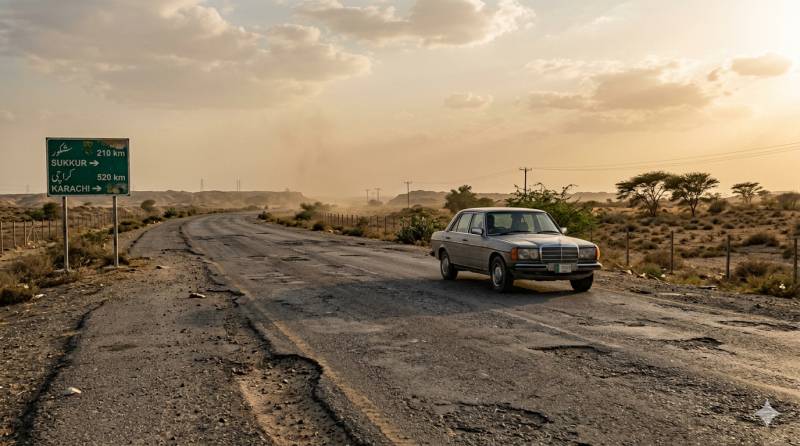
So, after telling them about my recent trip to Pakistan and the bone-rattling, seemingly endless journey from Karachi to Sukkur on the dilapidated National Highway, I asked why the roads were never repaired in Sindh.
The former civil servant smiled bitterly. “Because National Highways is a federal subject.”
“So? Then why does the federal government not repair them?” I asked.
He laughed. “Because the roads you are talking about are in Sindh.” Then he continued, “Do you know how many motorways there are in Pakistan, and how many of them are in Sindh?”
I replied that I knew there were nineteen motorways in the country and that, except for the so-called Super Highway from Karachi to Hyderabad — which lacks virtually every facility associated with a motorway and appears to have been designated one merely to extract motorway tax from Sindhis — there were effectively no motorways in Sindh.
“And,” I added, “I also know that, defying both logic and the traditional practice of building roads from the coast inland, the very first motorway in Pakistan, M2, was built in 1997 between Lahore and Rawalpindi for Nawaz Sharif by Nawaz Sharif.”
On my drive back from Dallas to Austin, I kept wondering whether a country that has failed to evolve a fair and equitable system for sharing resources and opportunities among all its provinces and citizens will ever truly manage to do so
“So when we see a network of motorways expanding every day, even into Gilgit and Khyber Pakhtunkhwa, why are Sindh and Balochistan sidelined? Punjab is obvious. How does KPK succeed in getting motorways?” I asked.
“Because they are Masera. Do you know the Punjabi term Masera?” he asked.
“Yes,” I replied. “The children of your mother’s sister.”
“Exactly,” he laughed. “Masera in Punjabi is what we call Maasaat in Sindh.” Then he added, “Even in Sindh, Maasaat occupy a special place. We say:
‘Maasaat, mithi zaat,
Kukurr kunh ta khaaoon raat.’
(Oh Maasaat, sweetest of relations, let us slaughter a chicken and dine together tonight.)”
“Then,” I asked, “are we their Shareeka — the children of a paternal uncle, seen as rivals in Punjabi parlance?”
“No, my friend,” he replied. “You have it all wrong. We are not even Shareeka. Do you know who their Shareeka are?”
I admitted I did not.
“Seraikis are their Shareeka. Think of it in terms of a family. Whenever something good is prepared at home, the best portion remains within the immediate family. Then a generous plate of the second-best portion is sent to the Masera. Finally, whatever is left over is grudgingly dispatched to the Shareeka. You see motorways in the Seraiki Wasaib too, don’t you? The Multan-Sukkur Motorway. Do you think it was built for Sindh? Most of it lies in Punjab. Have you seen the Dera Ghazi Khan–Fort Munro Highway?”
The other brother interjected emotionally, “Sindhis pay as much tax as anyone else — perhaps more — and yet we do not even deserve a decent highway!”
I nodded. “Then what are we?” I asked quietly.
“Nobody,” he said with another bitter smile. “Perhaps beggars, standing at the door asking for leftover morsels. Or maybe a necessary evil. They need our land and our resources, but they cannot truly accept us. They cannot physically eliminate us, so they merely tolerate us.”
He paused for a moment before continuing.
“They travel on their world-class motorways all the way to Sindh, and the first thing they notice upon entering the province is broken infrastructure and roads devoid of the facilities they have grown accustomed to in Punjab and KPK. Then they begin cursing the Sindh government and Sindhis for incompetence, forgetting that highways are not the responsibility of the Sindh government.”
I looked into his eyes and asked, “Or is it possible that there is no discrimination at all, and that we have created this perception merely to cover our own failures?”
“No,” he replied firmly. “It is not a cover-up. Off the top of your head, can you name a single Sindhi minister in the Shehbaz Sharif government? A powerful bureaucrat who is Sindhi?”
No name came to my mind.
“Fine,” he continued. “Forget this government. What about the previous government under Imran Khan? If there is truly no discrimination, then why is it that whenever there is a selection board dominated by themselves, their Masera, or even their Shareeka, they somehow fail to find a single Sindhi capable of the job, let alone a Baloch? Name any prominent Sindhi in the top ranks of sports, the civil bureaucracy, the armed forces, the foreign service, or even the higher judiciary. Do you know that for a long time no Sindhi-speaking judge or lawyer was allowed to rise to the Supreme Court?”
The name of Amna Baloch, the current foreign secretary, briefly crossed my mind. But I immediately realised that, with the insurgency in Balochistan ongoing, it is politically imperative to demonstrate in international forums that Baloch, too, are loyal to the federation.
“No discrimination?” he continued. “Ask those Sindhis who have had the misfortune of being posted in Islamabad.”
On my drive back from Dallas to Austin, I kept wondering whether a country that has failed to evolve a fair and equitable system for sharing resources and opportunities among all its provinces and citizens will ever truly manage to do so.