

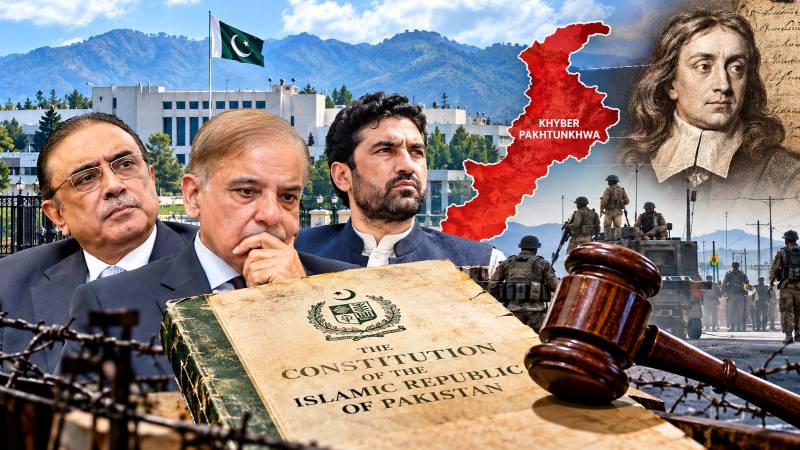
On October 11, 2026, President Asif Ali Zardari, acting on the advice of Prime Minister Shehbaz Sharif’s federal cabinet, signed a decree imposing a State of Emergency under Article 232 and Governor’s Rule under Article 234 of the Constitution in Khyber Pakhtunkhwa. In a single stroke, the provincial assembly was sidelined, Chief Minister Sohail Afridi’s cabinet was dissolved, and executive authority was handed over to a federally appointed governor, accompanied by the deployment of the military in aid of civil power under Article 245. The official justification cited an escalating terrorism crisis and provincial disengagement. Yet what critiques familiar with Pakistan’s political history perceive, neutralizing the opposition Pakistan Tehreek-e-Insaf’s last provincial stronghold was less a pure security measure than a recurring political ritual. This systemic contradiction is illuminated by Jacob Mchangama’s concept of "Milton’s Curse” in his 2022 book Free Speech: From Socrates to Social Media.
In the seventeenth century, John Milton famously defended freedom of publication and conscience, yet later served as Latin Secretary to Oliver Cromwell’s Commonwealth, defending a revolutionary regime that suppressed royalist and religious dissent. Milton’s Curse captures the enduring paradox of political movements that passionately champion fundamental liberties when battling state oppression, only to weaponize the state’s coercive apparatus the moment they enter power. Across centuries, this dynamic finds a modern reflection in Pakistan’s hybrid governance model. In a system where the military establishment retains disproportionate influence over national security and political competition, civilian parties frequently face incentives to accommodate coercive state power. When relegated to opposition, they act as staunch defenders of constitutional rights, judicial independence, and provincial autonomy. Once they partner in government, they frequently adopt, expand, and utilize the state’s coercive machinery against their rivals. Civilian leaders have often treated civil liberties and provincial autonomy not as universal constraints on state power, but as tactical privileges to be granted or revoked depending on who holds executive office.
This pattern echoes deep historical precedents that stretch back to the very foundation of the republic. At the birth of the nation in August 1947, the dismissal of the elected, Congress-backed provincial ministry of Dr. Khan Sahib in the North-West Frontier Province established an early precedent for federal intervention in regional politics, illustrating how claims of security and loyalty could be invoked against an elected provincial administration. While not a direct, unbroken cause of every subsequent crisis, it set a powerful institutional template for executive overreach. Decades later, despite leading the drafting of the democratic 1973 Constitution, Prime Minister Zulfikar Ali Bhutto’s government dismissed the elected National Awami Party administration in Balochistan in February 1973 following the discovery of an arms cache at the Iraqi embassy, launching a military operation and invoking the Defense of Pakistan Rules against political opponents.
Lacking genuine control over the national security apparatus, ruling civilian parties repeatedly rely on the establishment’s coercive machinery to manage political competition. In doing so, they validate and re-entrench the military establishment as the ultimate arbiter of Pakistani politics.
Following the return to civilian rule after military regimes, successive governments implemented significant democratic reforms—most notably the landmark 18th Constitutional Amendment of 2010, which devolved substantial powers to the provinces, dismantled concurrent legislative lists, and strengthened parliamentary governance. Yet, these structural reforms repeatedly fell short of ending the selective use of state power against political adversaries. Under Asif Ali Zardari’s presidency, the Pakistan Peoples Party administration imposed Governor’s Rule in Punjab in 2009 amid intense political friction with the Pakistan Muslim League-Nawaz. Similarly, Nawaz Sharif’s government enacted the Prevention of Electronic Crimes Act in 2016, and under Shehbaz Sharif, that regulatory framework saw significant expansion alongside increased scrutiny, legislative amendments, and restrictions on digital spaces and media broadcasts.
The Pakistan Tehreek-e-Insaf traversed a similar path during its tenure from 2018 to 2022, utilizing accountability mechanisms against opposition figures and attempting to introduce strict amendments to electronic crime laws to criminalize criticism of public authorities. After Khan’s removal through a vote of no-confidence in April 2022, his party increasingly framed its struggle in the language of constitutional resistance, even as critics pointed to its own record in government regarding press freedom, due process, and executive restraint.
The toppling of the Khyber Pakhtunkhwa provincial government reflects this enduring, self-defeating cycle. By endorsing Governor’s Rule and federal intervention in Peshawar, the ruling coalition has once again traded away provincial autonomy for immediate political advantage. Lacking genuine control over the national security apparatus, ruling civilian parties repeatedly rely on the establishment’s coercive machinery to manage political competition. In doing so, they validate and re-entrench the military establishment as the ultimate arbiter of Pakistani politics. Milton’s Curse offers a useful lens for examining these recurring political contradictions: fundamental rights are frequently defended as universal principles in opposition, yet treated as negotiable when their protection constrains those in power. Until Pakistan’s political class resolves to universally defend civil liberties and constitutional limits even when those principles protect their fiercest political opponents—they will remain perpetual junior partners in a hybrid state, condemned to enable the very machinery that will inevitably be turned against them tomorrow.