

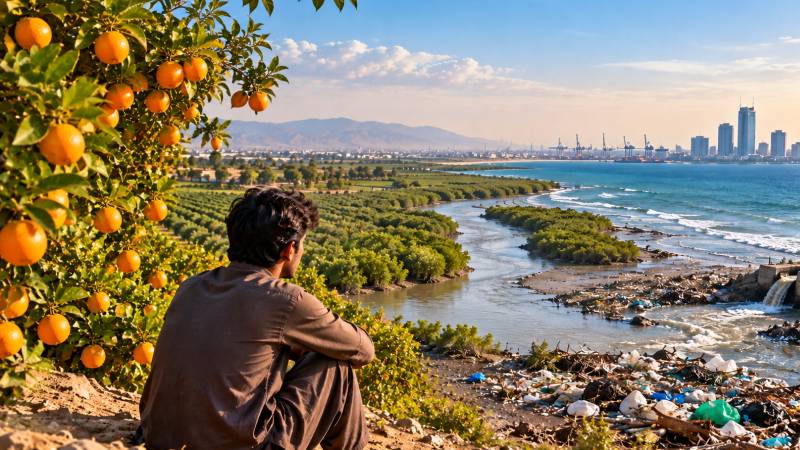
I was born in Sargodha, Pakistan’s citrus capital, more than 1,000 kilometres from the coastal cities of Karachi and Gwadar, where the Arabian Sea meets Pakistan’s shores. Growing up among Sargodha’s kinnow orchards, I knew the land, its seasons, and the livelihoods it sustained. The ocean, however, remained a distant world, one I had never experienced firsthand. Today, living in California alongside the Pacific Ocean, I have come to see the environment through a different lens, one that connects the landscapes of my childhood with the health of our oceans.
Sargodha is at the heart of Pakistan’s kinnow industry, reportedly producing around 80 percent of the country’s kinnows. Yet its agricultural heritage faces growing challenges, with the area under cultivation shrinking by 100,000 acres, from 450,000 to 350,000 acres. Aging orchards, disease, climate change, and changing market demands have all been identified as contributing pressures. These challenges have shown me how environmental pressures can threaten livelihoods even far from the ocean, prompting me to ask whether distance should determine our responsibility for its protection. Although I grew up far from the sea, does that distance make the ocean’s future any less my concern? What about students living in inland cities who have never seen marine life in its natural habitat, witnessed plastic pollution along a shoreline, or met families whose livelihoods depend on the sea?
The answer lies in recognizing that the ocean’s influence does not end at the coastline. Globally, more than 3 billion people depend on the ocean for their livelihoods, while in Pakistan, the Indus Delta’s mangroves alone support approximately 200,000 people, according to the Sindh Forest Department. These figures demonstrate how deeply human well-being and economic security are connected to healthy marine and coastal ecosystems. Yet, these vital resources face growing threats. Pakistan has 814-kilometer coastline along the Arabian Sea, but the Indus Delta is increasingly vulnerable to reduced freshwater flows caused by upstream dams and water diversions. This has allowed seawater to intrude further inland, damaging mangroves, fisheries, and agricultural land.
Meanwhile, Karachi, Pakistan’s largest city, discharges substantial amounts of untreated industrial and municipal wastewater into coastal waters. One study estimates that Karachi generates approximately 472 million gallons of wastewater daily, of which only 55 million gallons are treated, leaving the remainder untreated. Therefore, Ameer Hamza, a sociology student at the University of Sargodha, brings a sociological perspective to Pakistan’s coastal crisis, arguing that “environmental protection depends not only on scientific knowledge, technology, and government policies but also on social norms, community trust, and people’s willingness to cooperate.” His perspective highlights how interfaith harmony can build the trust needed for collective environmental action. Yet turning that cooperation into effective ocean protection also requires scientific understanding and practical solutions.
While community cooperation is essential, effective ocean protection also requires scientific understanding and practical solutions that communities can realistically adopt. For Wise Goodluck Datsomor, an environmental scientist and coastal ecology researcher at Portland State University, ocean protection is inseparable from human well-being. As he explains, “We depend on the ocean to survive in many spheres of life, and that really calls for the need to ensure that we sustainably manage these resources.” His argument highlights why ocean conservation requires collective responsibility and sustained action to protect marine ecosystems and the communities that depend on them. Datsomor illustrates this challenge through the example of plastic pollution. Drawing on his research into microplastics and their effects on fish, he argues that scientific knowledge must translate into meaningful action.
Environmental protection depends not only on scientific knowledge, technology, and government policies but also on social norms, community trust, and people’s willingness to cooperate.
Beyond the damage to marine life, microplastics can enter the food chain, raising concerns about potential implications for human health, although the full health effects remain under investigation. However, he cautions that economic barriers can prevent people from changing their behaviours. Disposable plastics are often cheap and convenient, while reusable alternatives may be unaffordable for low-income households. This illustrates why awareness alone cannot solve the problem. Governments need to strengthen waste management systems, businesses should make sustainable alternatives more accessible and affordable, and communities can encourage responsible consumption. These challenges reflect the broader ambitions of Sustainable Development Goal 14 (SDG 14), Life Below Water, which calls for the conservation and sustainable use of oceans, seas, and marine resources. Achieving this goal requires more than protecting coastlines; it demands coordinated action from governments, businesses, and communities, including those living far inland.
Growing up in Sargodha, far from the sea, I understood environmental challenges primarily through the land, agriculture, and the livelihoods they sustain. Living in California has broadened that perspective. I have observed people working to keep beaches clean and school students volunteering to collect plastic and other waste that threatens marine life. These experiences have shown me how local action can help protect coastal ecosystems. Yet, ocean pollution does not respect geographical boundaries. Waste generated inland can travel through rivers and drainage systems to the sea, while the consequences of marine degradation extend across borders. Local initiatives are essential, but they must be part of a wider global effort. This broader perspective is central to the work of Dr. Dayne Buddo, a Jamaican marine scientist and ocean policy expert.
With more than 25 years of experience in marine conservation, science and policy across more than 40 countries, Buddo, President of the Discover70 Foundation, brings a global perspective to the challenges facing our oceans. His career spans academia, government, the private sector, and international organizations, including leadership in global ocean policy at Georgia Aquarium. Drawing on this experience, Buddo challenges the assumption that ocean conservation is solely the responsibility of coastal communities or marine scientists. He argues that human survival is inseparable from ocean health, making conservation a shared responsibility that extends far beyond the shoreline. As he puts it, “We're not saving the ocean; we're saving ourselves because we depend on the ocean.” Buddo highlights the vulnerability of countries with extensive marine territories but limited capacity to respond to climate change, marine pollution, and other environmental threats. He emphasizes the need for international cooperation to support vulnerable states, particularly when environmental damage originates beyond their borders. Buddo identifies the High Seas Treaty as an important development in international ocean conservation, emphasising the need for countries and communities to cooperate in protecting marine areas beyond national jurisdiction. He also argues that young people and early-career ocean professionals should participate in decision-making, from grassroots initiatives to the United Nations. Environmental solutions developed today will often benefit future generations, who must also carry the work forward.
Buddo's insight that “The solution is not necessarily in the marine environment, even though the problem is there” shifts attention from where ocean pollution appears to where its causes must be addressed. His argument underscores a crucial point: protecting the ocean requires action not only along the coastline but also in the inland communities whose activities influence the waters that eventually reach it. My experiences across cultures have reinforced my belief that young people can become powerful agents of environmental change when they understand how their everyday choices affect the planet. Whether reducing plastic waste, protecting local waterways, or challenging irresponsible practices, their actions can contribute to healthier marine ecosystems. This responsibility transcends the distinction between “developed” and “developing” countries; economic wealth alone does not determine environmental awareness or responsibility. From inland Sargodha to coastal Karachi and communities around the world, young people can help protect the interconnected ecosystems on which we all depend. Ultimately, progress should be measured not only by economic growth but also by the health of the planet we leave to future generations.