

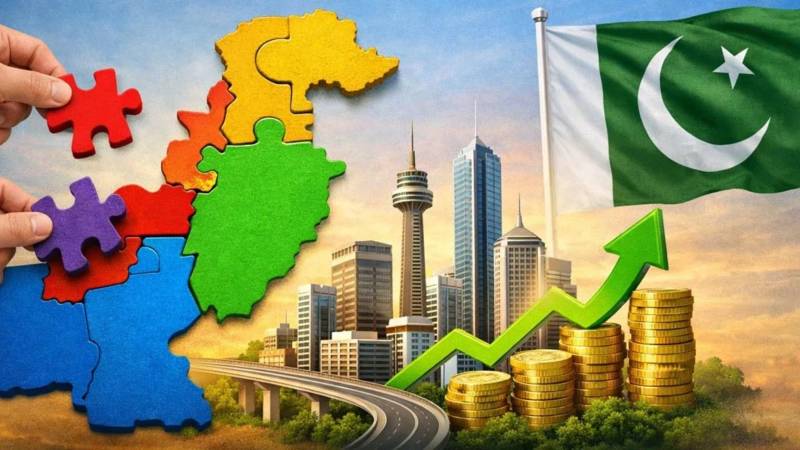
Every government in Pakistan seems to have some sort of reform agenda aimed at improving governance. Regarding this, the latest proposal dominating the political debate is redrawing the map and the creation of new provinces. It is assumed by the administration that governance will automatically improve when administrative units become smaller, as then they would be more manageable. Whether there is any actual need to redraw the maps or whether governance can simply be improved through mere strengthening of local government is a hot question these days.
The initial trigger is believed to be Ahsan Iqbal’s article, which was published in June 2025 in The News. But the recent spark has been the interior minister’s call on July 30 for new provinces, structural reforms, and dialogue among all political parties at the Pakistan Economic Summit in late July. The interior minister, Mohsin Naqvi, went on saying that the present system had "collapsed" and that new reforms were urgently needed both at the administrative and provincial levels. Just one day after, DG ISPR’s reverberation that Pakistan's population has quadrupled since the country’s adoption of its four-province structure. This population boom has exposed the need for the existing structural arrangement to be re-examined.
Pakistan's governance challenges, adding to the current population situation, pose a serious threat to the country’s internal stability. The reason for these governance issues, going beyond nearly 8 decades, is the continuous to-and-fro movement between martial law, aiming to centralize the government, and democratic governments that were not so democratic after all. Since then, the structural changes in governmental architecture were believed to resolve governance failures. Now, the interior minister’s suggestion for creating new administrative units to address governance problems may generate new centers for politicians to exercise power. Unless the local governments are embedded in this reformative decision. The reforms will only be effective when underprivileged citizens are able to receive basic privileges. When any of the reforms are able to bring such improvements, Pakistan will know that the purpose has been achieved. A basic privilege is also having responsive governmental institutions. The purpose of administrative reform should not simply be to redraw the map but to improve the lives of common citizens.
Ahsan Iqbal, while speaking at a consultative session with media representatives in Islamabad, said that there are only 1,170 public offices to cater to the needs of a 260 million population, adding that people's problems could not be resolved unless 150,000 to 200,000 public offices were created through local governments. He further added that currently bureaucrats are the masters of the capital city. A government located closer to the underserved regions could understand the local constraints in a much better way and similarly can respond faster as well. Greater administrative proximity improves supervision of schools, hospitals, roads, and development projects while strengthening transparency and public accountability.
Since the 18th Constitutional Amendment, the provincial governments also seem unwilling to devolve meaningful political, administrative, and financial authority to local governments. Rather than bringing decision-making as close to citizens as possible, the provinces have largely become vessels of power, never passing it on to the local authorities. That reluctance is hardly accidental. Similar remarks were made by Ahsan Iqbal: the federal government devolved 17 subjects to the provinces in 2010, but the provinces did not devolve even one subject to local governments. He further said, "If we are not ready to make new provinces, then there is no option except having 160 district governments, as all social indicators have deteriorated despite the transfer of additional resources under the National Finance Commission."
Pakistan’s governance problem is institutional rather than territorial. Any new province would simply inherit the existing habits if political, administrative, and financial authority remains concentrated at the provincial level.
There always remains a possibility that creating new provinces could further strain public finances while deepening existing disparities. Nevertheless, careful planning can manage any such humongous consequences. So, before the country faces any other major crisis, supporters of map reforms should explain how they intend to meet the bar set by the Constitution and share the cost and where the money will come from when citizens are already economically exhausted. There is no question that Pakistan needs better administrative management, but the stated end of restructuring could be achieved far more cheaply by reviving the local governments.
A relevant case study of the reorganization of Indian subnational administrative units from larger mismanaged units to smaller manageable ones assesses whether the reorganization accelerated the growth trajectories of the newly formed units alongside the state as a whole. The evidence is mixed. Following this upgradation, Jharkhand, Madhya Pradesh, and Uttar Pradesh showed no significant positive transformation, while Uttarakhand experienced rapid economic expansion with significant income growth leading to poverty reduction. The reason assumed by many was the tax incentives and special status given to Uttarakhand.
Pakistan's constitution also makes redrawing provincial boundaries difficult. Under Article 239, any bill altering the limits of a province needs a ⅔ majority in both the National Assembly and the Senate, as well as in the provincial assemblies of the concerned province. The affected province therefore holds an effective veto, and the federal government cannot create new provinces alone. Local government reform, in contrast, has no such requirements for amendment, since Article 140A already mandates it (Constitution of Pakistan, 1973). Pakistan’s governance problem is institutional rather than territorial. As all four provinces run local government systems that remain subordinate to the provincial government, and funds are also not devolved by the province to local governments, any new province would simply inherit these habits.
Sindh Assembly has resisted strongly and objected to any claim regarding the division of its province. The organization of new provinces requires a lot of funds. The economic conditions of the state and its citizens also do not allow any kind of new reforms that would put further burden on them. These points suggest that strengthening local government comes first because it needs no boundary change. New provinces can follow only if they have local government built in, a funding plan available, and the consent of the province concerned.
Pakistan seriously needs to consider the creation of smaller provinces along with strengthening the local governments. The objective should be to create such administrative units that can better represent the citizens, resolve their issues, and provide better governance. Pakistan should therefore move beyond the debate over whether it needs to redraw the map or reform governance. It needs both. Effective local governments can bring public services closer to citizens, while reorganizing the administrative units can bring development planning and decision-making closer to the regions.
New provinces and empowered local governments are not competing alternatives; they are therefore complementary. The call for new provinces is not going away. The debate, therefore, should be viewed not merely as a question of reorganizing the administrative units but as part of a larger national effort to reform governance and reduce regional disparities. Local governments bring services to citizens, but only provinces bargain for resources in national forums. So the suggestion would be to reform the local governments first; new provinces can follow, but only with local government built in. The map is not the first step of reform; it is the last.