

The observance of Independence Day on 14 August provides the perfect backdrop against which to assess the nation’s economic performance.
Eight episodes can be identified during this 78-year period, four of which were episodes when the nation was governed by martial law. Civilian rule prevailed in the other four but civilians governed under the gaze of the military during three of the four.
Economic growth fluctuated across the eight episodes, with the highest growth rates being recorded during the Ayub and Zia episodes. Both rulers were in power for a decade. The lowest growth rates were recorded in the pre-Ayub and post-Musharraf episodes.
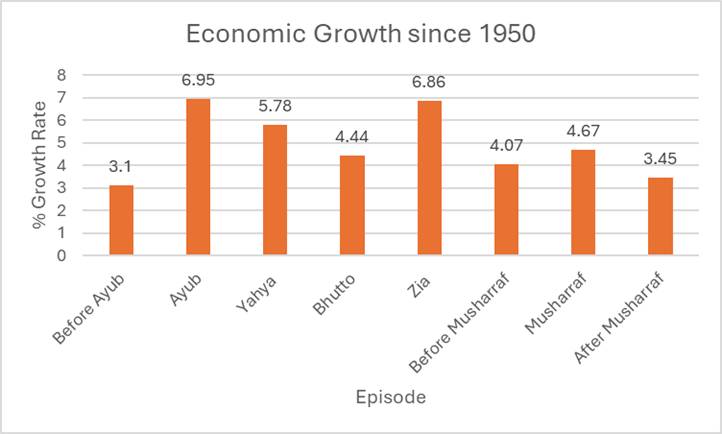
Of course, averages hide some important details. It is useful to look at the growth rates by year within the episodes.
Episode 1: Various civilian rulers, 1947-58
Civilian rule was marked by political instability and anaemic growth. According to Parvez Hasan, a prominent Pakistani economist who served as former chief economist at the World Bank, GDP growth averaged 3.1% a year. Annual data is not readily available for that episode.
The secession of East Pakistan created a data problem which makes it difficult to find annual data prior to 1961.
Episode 2: General (later Field Marshal) Ayub Khan, 27 October 1958 - 25 March 1969
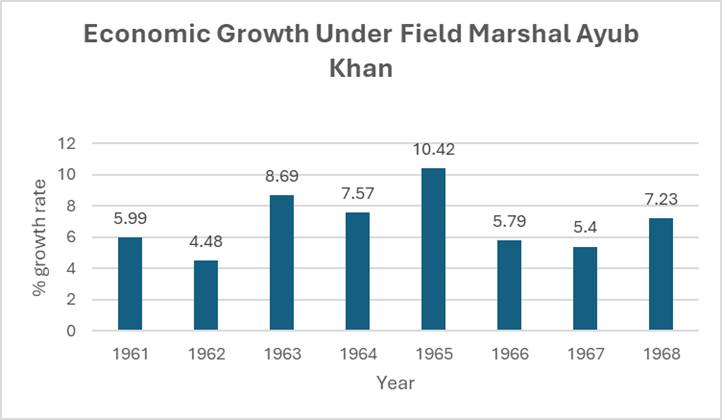
There was much variation on a year-to-year basis during Ayub’s tenure. The highest growth rates were recorded in 1963 and 1965. In the first half of the sixties, Pakistan became the envy of the developing world and became the role model for several countries such as South Korea, which later became an Asian Tiger. US aid made a difference. Growth rates declined after the 1965 war, which was Ayub’s ultimate blunder. Unfazed, he decided to celebrate a “Decade of Development.” This was ill-timed, leading to riots, and to the creation of the People's Party by Bhutto, his former foreign minister. He asked the army chief, Yahya, to declare martial law and Yahya did that provided Ayub handed over the presidency to him.
Episode 3: General Yahya Khan: 25 March 25,1969 - 19 December 1971
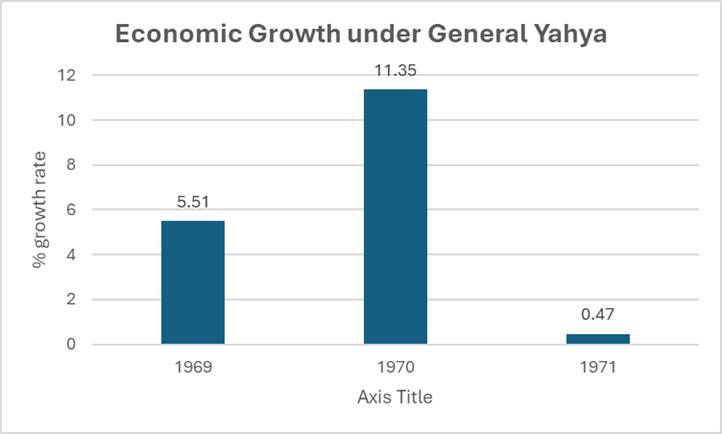
Yahya held the general elections which were called the fairest in the nation’s history. However, in response to pressure from Bhutto, he annulled them and launched a military operation in East Pakistan, whose political party had secured a majority in the national assembly. That ultimately resulted in the break-up of the country.
There was much variation on a year-to-year basis during Ayub’s tenure. The highest growth rates were recorded in 1963 and 1965
Episode 4: Zulfikar Ali Bhutto, 19 December 1971 - 5 July 1977
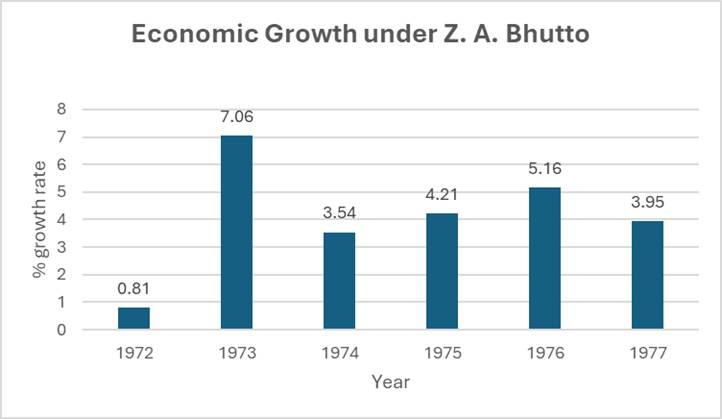
Bhutto took the reins of power on a platform to introduce Islamic Socialism in the country and to ensure that each person got food, clothing and shelter. He destroyed the Civil Service by firing hundreds of officials and replacing them with hand-picked personnel in a clear instance of nepotism. Large scale nationalisation and political victimisation of opponents was unleashed. He appointed a supposedly reticent junior general to be the army chief. However, the riots that occurred after the general elections resulted in his being removed from office by his hand-picked general.
Episode 5: General Zia ul Haq, 5 July 1977 - 17 August 1988
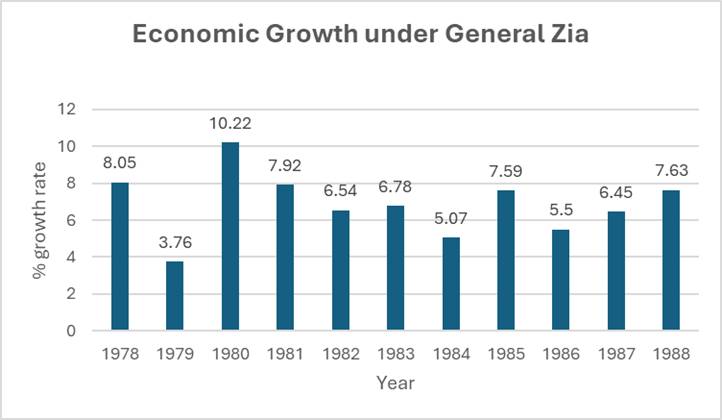
Zia benefited enormously from American aid after the Soviet invasion of Afghanistan. Economic growth was uneven, consistent with previous cycles, but still resulted in one of the top two average growth rates in Pakistani history.
Episode 6: Benazir Bhutto and Nawaz Sharif, 17 August 1988 - 12 October 1999
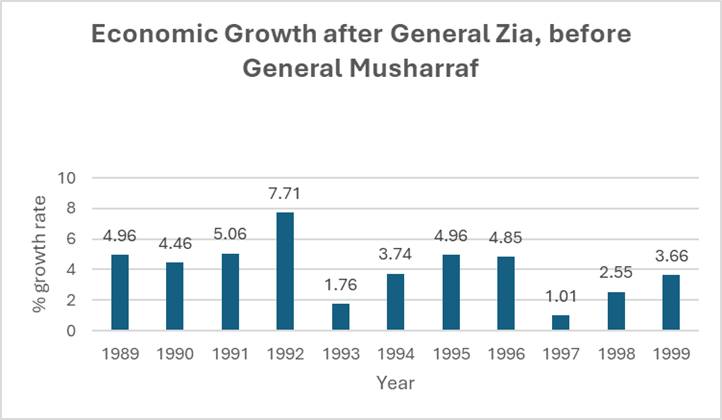
Episode 7: General Pervez Musharraf, 12 October 1999 - 18 August 2008
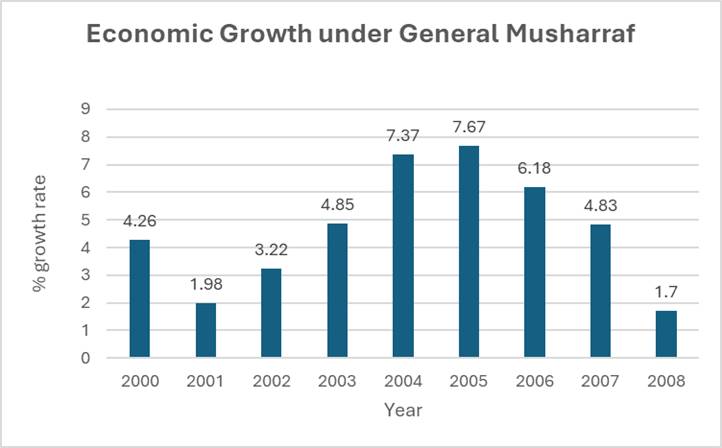
The Musharraf episode was marked by an initial fall in growth rates, as he sought to stabilise the country and consolidate his rule. Once that happened, growth resumed and reached values in the 7% range. But then dictatorial rule’s major weaknesses began to surface, and growth began declining. A record law of 1.7% was reached in his last year in office.
Episode 8: Several civilian rulers, 18 August 2008 +.
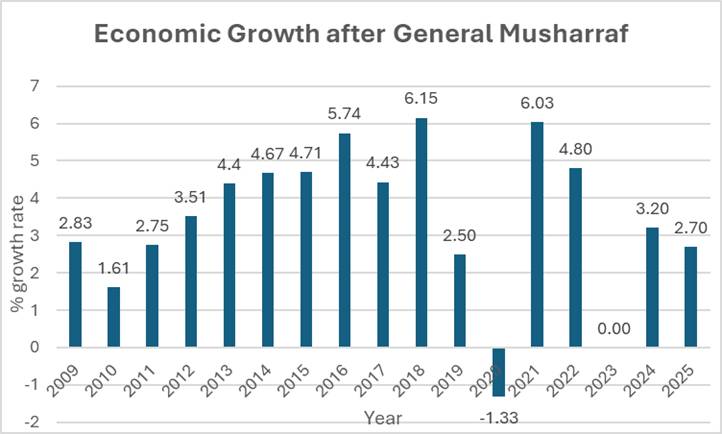
Several rulers governed during this episode, including Imran Khan, who initially had a good relationship with the army. When that relationship soured, chaos ensued, and growth plummeted. This episode has averaged the lowest growth rate and the highest variance.
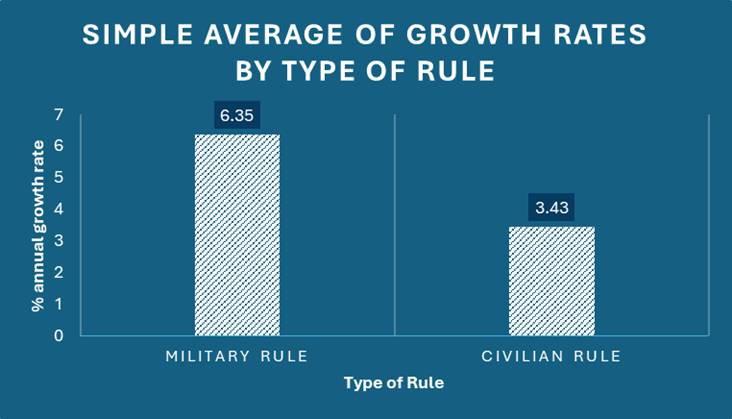
How do economic growth rates compare across the four periods of explicit military rule versus the three periods of civilian rule? The average annual growth rate under military rule is almost twice as high as under civilian rule during the 1961-2025 period.
This provides impetus to those who call for yet another round of martial law in the country but that glosses over the fact that during periods of military rule Pakistan has been the beneficiary of substantial US aid for entirely transactive, geopolitical reasons.
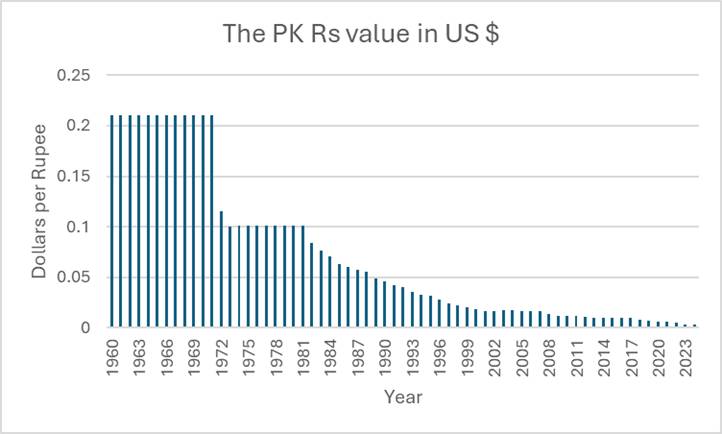
As shown in a previous column, the GDP growth rate has declined over time, but it has seen periods of growth and decline. However, the value of the Rupee, as expressed in US currency units, has consistently declined over time. In this instance, data goes back to 1947. The exchange rate in the fifties was around 30 cents. In the sixties, it dropped down to around 20 cents. In the seventies, it dropped down to around 10 cents. In the eighties, it dropped further to around 5 cents. In the nineties, it fell to around 2 cents. Today, it falls in the 0.3 cents range, which is just one percent of the value that the Rupee had at the nation’s independence.
Generally, a falling currency helps to boost exports and reduce imports. I.e., to eliminate a deficit in the trade balance. But in Pakistan’s case that salubrious outcome has not come to pass. The only silver lining on this dark cloud is the remittances from abroad.
Pakistan’s economic development is a sobering study of how the world’s fifth most populous country is mired in domestic and international debt, 78 years after gaining independence from Great Britain. It survives largely based on remittances from expatriates and loans from the World Bank, the IMF, China and the Gulf states.