

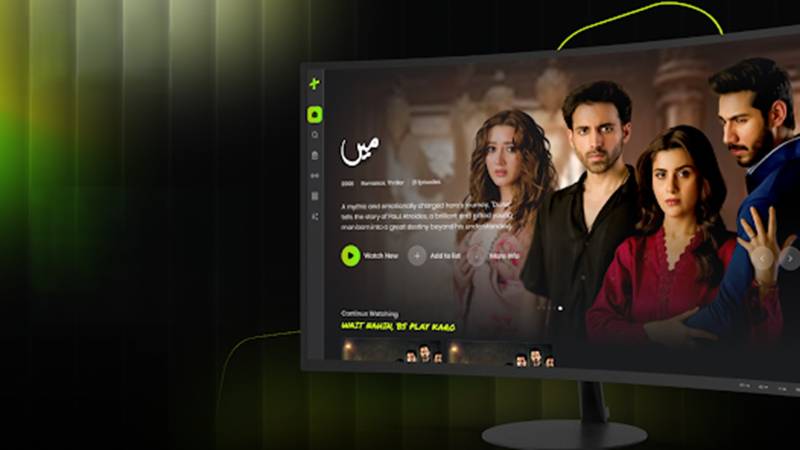
Five months ago, I traced how Pakistani television built a global audience without Netflix's help: hundreds of millions of YouTube views, sustained almost entirely outside any platform the industry actually controlled. Salman Iqbal, CEO of ARY Digital Network, has now offered the industry's most concrete answer yet to that gap. In a recent interview on Kamran Khan's On My Radar, Iqbal unveiled ARY Plus, describing it as three to four years in the making and built in response to sustained demand from the Pakistani diaspora for a home-grown streaming service.
The entire interview can be boiled down to two most significant matters for the audiences: ARY Plus is free, and ARY's dramas are being pulled off YouTube to make sure people use it instead.
That detail reframes the whole story. This was never going to be about whether Pakistani audiences would pay for something they currently get for free; Iqbal isn't charging for it. The real bet is narrower and blunter: if the content that built ARY's YouTube following simply disappears from YouTube, the audience has nowhere else to go for it. That's not persuasion. It's migration by removing the alternative.
It's worth taking the upside seriously anyway because the underlying economics are sound. YouTube gave Pakistani dramas reach, but ARY never owned the relationship with its viewers, the ad revenue split, or the data generated by hundreds of millions of views—YouTube did. Moving content onto an owned platform, even a free one, converts borrowed reach into infrastructure ARY actually controls. Iqbal also described a royalty system tied to a new user-generated content feature, letting independent creators upload work and continue earning as long as it stays live—a real answer to a long-standing industry grievance, if it holds up in practice.
The real bet is narrower and blunter: if the content that built ARY's YouTube following simply disappears from YouTube, the audience has nowhere else to go for it
But forced migration carries its own risk, and it's the one worth watching most closely. A YouTube following built over years, across a diaspora scattered from London to Toronto to Riyadh, isn't guaranteed to follow a brand off a platform it already trusts and knows how to use. Iqbal's insistence that the app is simple enough for elderly users to navigate is a tell here: he knows friction, not price, is the real barrier. Some viewers will download the app. Others will simply drift away, or find pirated re-uploads elsewhere on YouTube—a workaround ARY can't fully police even as its own official channel goes dark.
There's a second claim worth scrutiny: Iqbal's observation that cultural traffic between India and Pakistan has reversed, with Pakistani dramas now finding real audiences across the border. That's happening almost entirely through informal YouTube re-uploads and clips, outside any structure either country's regulators oversee. Pulling ARY's own content off YouTube doesn't obviously help that audience; if anything, it risks weakening the very channel that let Pakistani dramas cross the border in the first place, since ARY Plus is not built for or accessible to a market that restricts Pakistani content through its own regulations.
So, two projections. First, ARY Plus's royalty and UGC framework, if it works as described, gets copied by rival Pakistani networks eyeing the same jump, and cited as proof that South Asian media doesn't need Western platforms to solve its own monetisation problems. That's a durable win regardless of how the app itself performs. Second, the "soft power" Iqbal keeps invoking will likely take a hit before it grows.
Forcing a global audience off free, familiar YouTube access, including the cross-border Indian viewership that gave Pakistani dramas some of their most striking reach, is an unusual way to project confidence in a platform's appeal. If ARY Plus is still standing in a year with its diaspora and cross-border audience intact, it will have earned that soft-power claim. Until then, it's a bet made mostly with someone else's patience.