

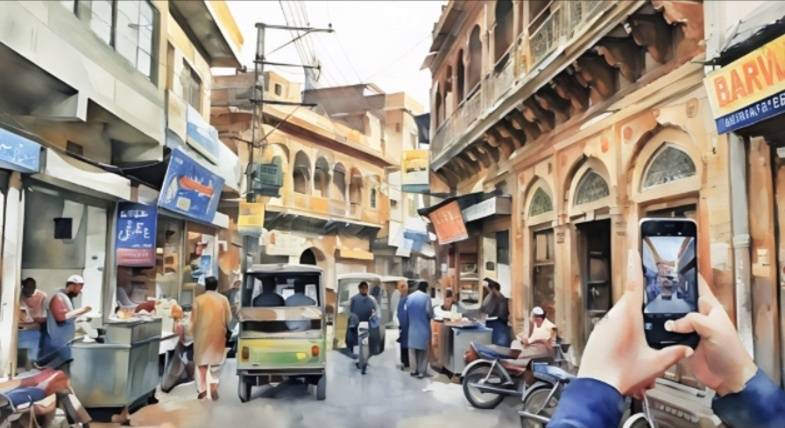
Any visit to Lahore by this scribe is incomplete without galivanting through the galis and bazaars of the walled city; the place where he was born and raised. The sights and sounds of this historic city instil in him a quest for its exploration. This author knows the place since his childhood, but continues to find more charming sites during each trip. Though the character of the walled city has become more commercial than residential since the mid-1980s, when his family moved out to suburbs after a stay of two decades, the bricks and mortar of the walled city continue to bear witness to a millennium of history.
The current sojourn to the city started with a delightful ride in the Orange Train, commencing at the Samanabad Station and terminating at the Railway Station. From there, the first part of this visit, described in this article, took me to the Delhi Gate to start the stroll through the Walled City. Entering the Gate, the walk took me past Shahi Hammam, Dina Nath Well, Wazir Khan Mosque, Kashmiri Bazaar, Chowk Kotwali, Azam Cloth Market and Moti Bazaar till exit to the Fort Road.
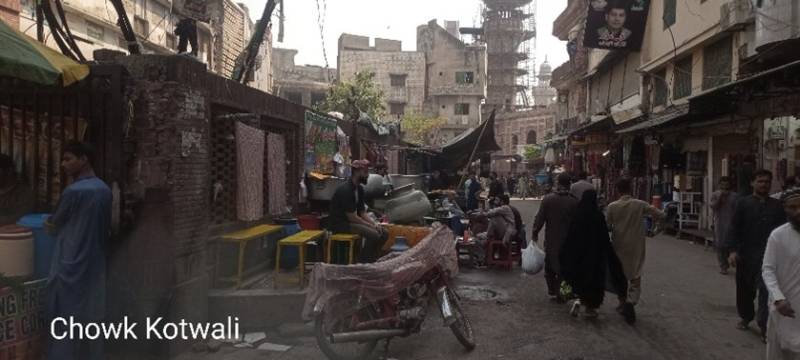
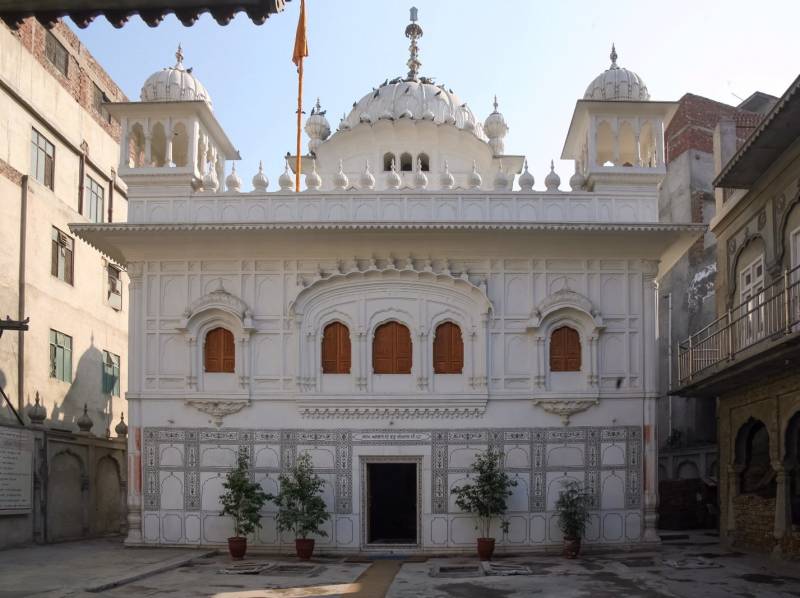
Entering the city through the Delhi Gate, I walked past the Dina Nath well on the right and the Shahi Hammam on the left before reaching Masjid Wazir Khan. Instead of walking straight through Kashmiri Bazaar to my childhood residence opposite Pani Wala Talab, I turned right at Kotwali Chowk into the Kotwali Bazaar. Crossing the initial few yards and food stalls, one goes past the Azam Cloth Market on the left and its newer sister, the Pakistan Cloth Market on the right. These two are the largest cloth markets in Pakistan and were established after independence. The former, with thousands of shops, caters for wholesale deals, while the latter is for retail buyers. At the beginning of the Kotwali Bazaar, there are shops for embroidered cloth including wedding dresses, whose rates I found astonishingly low. A little ahead in this narrow Bazaar, there is a Sikh gurudwara on the left.
The gurudwara is named as “Janam Asthan Guru Ram Das Ji.” Ram Das was the fourth Guru of the Sikh faith, born as Jetha Mal Sodhi at this site in 1534 during the first reign of Emperor Humayun. Due to his devotion to the third Guru, Amar Das, the latter not only married Jetha Mal to his daughter but also proclaimed him as the fourth Guru in 1574. After Ram Das, the office of Guru became hereditary, as all future Gurus after him, till the last or tenth Guru, were his male descendants.
One notes the contrast of British bungalows as opposed to the traditional central courtyard style of Mughal and Sikh havelis found in the Walled City and Gowalmandi
It was Ram Das, who, before his death in 1581, laid the foundations for the holiest of Sikh shrines, the Harmindhar Sahib, also known as the Darbar Sahib, at a place called ‘Guru da Chak,’ and named it as Ramdaspur. The shrine was completed by his son, the fifth Guru Arjan Dev Ji, and was renamed Amritsar; literal meaning being the ‘Pond of Divine Syrup.’
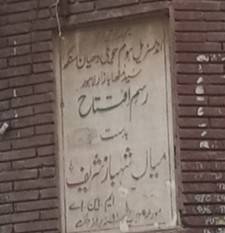
The Gurudwara is small and spread over about 600 sq yards. The bazaar is aligned along southeast and northwest direction. The main Gurudwara building, on the southeast side, is a white double storied structure with three domes on top, with the Nissan Sahib, an indication of a functional gurudwara, flying from the roof. A large Sehdara (three doors/windows with an arc on top) is on the front wall of the first floor with a smaller one in the larger middle dome. A double story administrative and residential building exists on the northwest corner with a tiled floor between the two structures. The site of the gurudwara is hemmed in by houses on three sides. The pleasant fact, though, is that the gurudwara is in good repair and well maintained.
It is known that before Emperor Akbar resided in Lahore for fourteen long continuous years from 1585 to 1599, the town was restricted to its western half between the current Shah Alam Bazaar in the east, the Multan Road in the West, a portion of the circular road between Shah Alam and Bhaati Gates in the south and the line demarcated by Kali Bheri-Hira Mandi-Cheet Ram Bazaar continuum in the North. This amounts to an area of one square kilometre with a circumference of four kilometres. One sector of Islamabad in comparison is three times larger.
The location of the birth place of the fourth Guru indicates that the bazaars now called the Shahi Guzergah along Chuna Mandi and Kotwali Area of Lahore were populated, though perhaps sparsely, before Emperor Akbar erected the Shahi Qila and extended Lahore to east of Shah Alam Bazaar to areas encompassing Mochi, Akbari and Delhi Gates. The Ravi alignment in that era followed a few of hundred meters to the north of this area, and it must have been one of localities flooded in 1662 that prompted Emperor Aurangzeb to construct a 3-mile long protective bund from somewhere in Bhogiwal village to the northeastern corner of the Fort. The book ‘Old Lahore’ mentions that remnants of this embankment were visible as late as late as early years of British occupation of the city. The embankment also forced the river to alter course north to its current location.
During this brief trip, a number of havelis were visited within the city. The design of a modern house, bungalows, literally ‘a house in Bengal style’, surrounded by open spaces, at least on the front and the rear, was introduced by the British. Residential buildings in India before that were built as living spaces spread around a central courtyard. The courtyard was open right to the top of the building providing light and ventilation. In case of small houses, the courtyard was covered on the top floor with iron bars to prevent someone falling through accidentally. All houses in the walled city and Gowalmandi area, where this author lived, are built in this style. Mughal and Sikh havelis also followed a similar architecture, with solid exterior walls embellished with elegant windows or balconies forming the front façade and a large lawn with fruit trees, grassy fields and, where space allowed, fountains in the central courtyard. Nisar Haveli inside Mochi Gate, Nau Nehal Haveli in Mohalla Sathan, Haveli of Mubarak Begum inside Bhaati gate, Barood Khana Haveli on Bazaar Barood Khana, and two havelis named after Syed Wajid Ali Shah, one inside Bhaati Gate and the other inside Mochi Gate are in this style of a central courtyard.
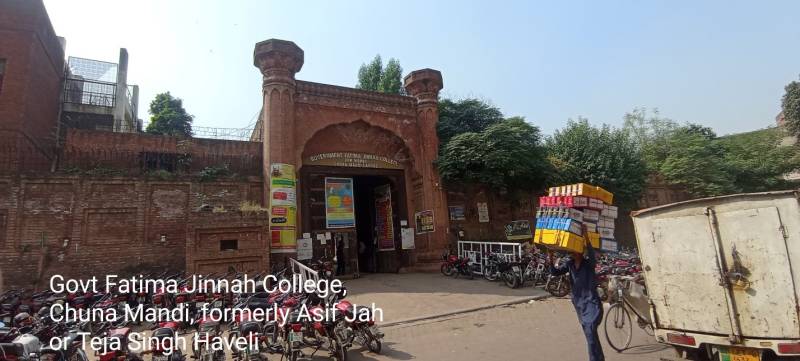
Walking down the Gurudwara Ram Das, there is the large Asaf Khan Haveli on the left that is now a Women’s College. It has a wide and open space in the front. Credit must go the successive Punjab governments that this space whose commercial worth must run into untold billions has not been encroached upon and is used as a parking space for the College. Asaf Khan or Asaf Jah has many claims to fame. He was brother of Empress Noor Jahan, the favourite wife of Emperor Jahangir and her chief influence during her final years. He was the Grand Vizier of Emperors Jahangir and Shahjahan. Importantly, he was the father of Mumtaz Mahal, the beloved wife of Emperor Shahjahan for whom the Taj Mahal was built and paternal grandfather of emperor Aurangzeb. Asaf Khan was rich and owned several expensive properties in Lahore. Two of his havelis can be traced through literature. One of these is this in Chuna Mandi Bazaar along the Shahi Guzergah; the path along which the Mughals travelled from Akbari Gate in the Shahi Qilla to Delhi. This Haveli lies in a triangular space of about 50 Kanals of land enclosed by Kotwaliwala Bazaar, where its main entrance lies, Jamandaran Gali on its south and Moti Bazaar on its back. The tale of the other Haveli has been mentioned by this author in another article.
Deoridar Khushal Singh, the Chamberlain of the Khalsa Darbar, was the person who suggested constructing a Baradari in the Hazuri Bagh Lahore to commemorate the acquisition of Koh-e-Noor diamond by Maharaja Ranjit Singh. Ranjit was initially of the opinion of creating only a garden in the 6 acres of land between the Akbari Fort and the Alamgiri Mosque and was opposed to making the Baradari due to non-availability of white marble. Khushal Singh prevailed and suggested stripping several monuments and tombs of Mughal era to decorate the suggested Baradari; a suggestion accepted by Ranjit Singh. The task of creating the garden and the Baradari was entrusted to Fakir Azizuddin, the foreign minister and confidante of the Maharaja. Architect Tota Sigh designed the structure and Fakir Nuruddin, the youngest of the three Fakir brothers, was entrusted with the task of collecting marble from Mughal Buildings.
The vast Asaf Khan Haveli in the Chuna Mandi remained under the use of the Deoridar during the Sikh Kingdom. This Haveli has erroneously been called Haveli Dhian Sigh and also as the first Church and the initial location of Government College (GC) Lahore. However, Dhian Singh Haveli, which, according to ‘Old Lahore’ by Col Goulding, served as the first church and where the first classes of GC were held, lies off Said Mitha Bazaar in the Hira Mandi area. Dhian Singh Dogra remained the Prime Minister of Sikh Empire from 1818 till his murder in 1843. Long before the name Hira Mandi came to associated with flesh market during the British occupation, it was a grain market established by Hira Singh, son of Raja Dhian Singh and, briefly, a prime minister of Sikh Kingdom in 1843-44, before he too was murdered. Most of the Dhian Singh Haveli has been demolished to construct several houses. Only a small portion remains that has been renovated and utilised as an Industrial home/school for women. By some accounts, the next-door school, originally called Dhian Singh School but renamed in 1947 as City Muslim League High School, was established by the British in a part of this Haveli after GC was shifted to a building now within the Mayo Hospital while its grand buildings on the Lower Mall were under construction. Perhaps finding no way out of internecine Sikh warfare and having lost a lot of family members during these troubles, Raja Dhian Singh, elder brother of Dhian Singh, switched the loyalties of the Dogra clan to the British, and was granted hereditary rule of Kashmir in exchange for a payment of 7.5 million (75 lakh) rupees.
Coming back to the Haveli in Chuna Mandi; after the death of Khushal Singh, his nephew Teja Singh, a general in the Khalsa Army, added new buildings and continued to reside herein. At that time, it came to be known after his name. During the murderous era of Sikh civil war, Teja betrayed the Sikhs to the British. Majid Shaikh has written about the Haveli, Teja Singh and how the latter was appointed Raja of Sialkot by the British for a payment of 2.5 million (25 lakh) rupees. The Haveli was requisitioned by the British as state property.
After independence, the Haveli came under the use of the Crime Investigation Agency (CIA) of Punjab and that’s how this author remembers the place; a feared place along with the other similar establishment inside the Fort; precisely, the cells on the right side of the rising road as one enters the Alamgiri Gate and where the Mughals had their royal kitchen, and whose most famous victim during Ayub Khan dictatorship was Hasan Nasir, a maternal grandson of Nawab Mohsin-ul-Mulk, one of the founders of Muslim League in December 1906. Rule through fear is certainly an old phenomenon exercised by dictators the world over.
In 1986, the Haveli was vacated by the CIA. The Punjab Government of the time converted it to Government College for Women and named it after Fatima Jinnah. The college is still functional and, gladly, the Haveli has been put to good constructive use and the one that will ensure that its buildings are kept in good condition. This author passed by the Haveli and wanted to visit it but the gatekeepers informed me that only the principal of the college can allow that and she was not in the institution. I understand, however, that the college being in session, such a visit was not appropriate.
Resuming my walk through the Chuna Mandi Bazaar, I passed through the extremely busy Moti Bazaar crossing. This whole area is now a thriving wholesale shoe market. It was so crowded that even walking through without forcing one’s way was impossible. The four hundred year old Marium Zamani Mosque lies along this road. Walking past the mosque after a brief look inside, I exited on the Fort Road. The second part of the visit, from Akbari Gate of the Fort through Cheet Ram Street, Bazaar Hakeeman to Bhaati Gate will be given in the next article.