

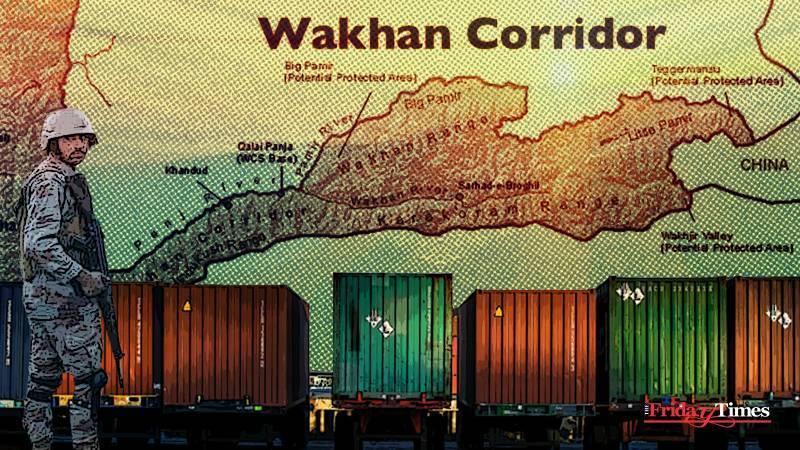
Far from the buzz of political talks, the Wakhan Corridor runs like a narrow land passage between Afghanistan and the surrounding countries of Pakistan, China, and Central Asia. Its role as an unregulated and porous gateway cannot be minimised. However, it remains a vulnerable entry point for Afghan-based terrorist groups. It provides militants with easy access to Pakistan, China, and Central Asia. If not checked, this remote passage could go on to become a key transit hub for extremist organisations on the regional level, contributing to destabilising the entire region.
The origins of the Wakhan Corridor lie deep within the geopolitics of the colonial era. The Wakhan Corridor was carved out in the 19th century as the British tried to create a buffer zone between the British colonial empire in India and the Russian Empire. This decision is still in play in the region’s dynamics today. The British created this division, forcing them to part Company with Central Asia, this cut created a chasm between Pakistan and Central Asia leaving the full economic and regional potential unrealised. The Wakhan region has always historically been linked to what is now Pakistan apart from when it was forced into being the arbitrary land border of Post-First World War Soviet Russia. Wakhan was an area of deep economic, cultural, and familial ties with the tribes and communities across the border. Such a shared history reminds us that colonial interventions have deeply scarred the region which continues to hinder regional cooperation and economic exchange.
In recent times, the Wakhan Corridor has become a focus point of regional instability. The remote location and the absence of any sort of proper security infrastructure in the area lead to it becoming increasingly susceptible to exploitation by terrorist organisations. In particular, through the passage, militants can readily get into Afghanistan, and from there reach Pakistan, China, and the Central Asian states. The unregulated movement of extremists through the Wakhan Corridor also presents itself as a very high risk to regional security, as the groups can spread their influence through this corridor. It is not just a matter of national security concern for Pakistan but also for the corridor – which is why it is struggling to untangle the mess. It has global implications. China’s Belt and Road Initiative stretching through Central Asia raises the possibility that economic and strategic interests will be compromised by instability spilling out from the Wakhan Corridor. Central Asia is also threatened with the possibility of becoming a center for the spread of extremism.
The Taliban have allowed India to access Afghan airbases and trade routes openly, but they have not allowed Pakistan’s own legitimate regional connectivity aspirations
Wakhan Corridor is well known to Pakistan, which has long faced security challenges as a result of the open border between Afghanistan and Pakistan. But rather than looking at this as a corridor encumbered by security issues, it presents an opportunity to turn it into a nation’s economic asset. A secure legal framework to buy or lease the Wakhan Corridor could provide Pakistan with a direct trade route to Central Asia bereft of the instability of Afghan transit routes. This would be a game changer for regional connectivity and open up the commercial might of the Central Asian republics.
The state of Afghanistan’s relations with its neighbors is a serious challenge in itself at the moment. The Taliban have allowed India to access Afghan airbases and trade routes openly, but they have not allowed Pakistan’s own legitimate regional connectivity aspirations. However, it is perplexing that Afghanistan would be reluctant to improve connectivity with Pakistan, as this would be beneficial to Afghanistan’s economic interest. However, this all translates into an untenable situation that pits the Afghan refusal to cooperate against her stability and more generally the economies of the broadest region. Pakistan, however, has to think more strategically now, and that begins with securing full control over the Wakhan Corridor. Given that the region’s width is from 15 to 60 kilometers, it makes practical sense and would do much to improve regional trade and connectivity, to be able to construct a direct tunnel to Central Asia. Afghan hostility should not hold hostage Pakistan’s ambition to regional trade. It is essential to get a secure and efficient route to Central Asia amidst the geopolitical landscape. If controlled or leased by Pakistan, the Wakhan Corridor could be turned into an economic lifeline that will strengthen regional cooperation and ensure that the whole region has a safer and prosperous future.
Suffice to say that the strategic importance of the Wakhan Corridor cannot be overstated in conclusion. Pakistan must exhaust all legal options to enable her to have direct access to Central Asia. Although the risks brought by current instability are high; with the right strategic vision the corridor has the ability to become an engine for economic growth and regional peace.