

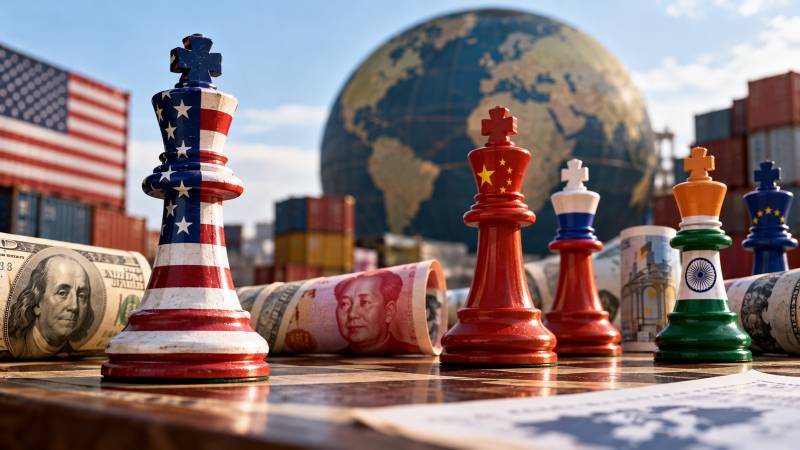
An empire does not become harmless when its authority weakens. It may become more coercive, while those resisting it may reproduce the same appetite for domination. This is the question that must accompany any assessment of Donald Trump’s attempt to reorder the world: how much freedom will ordinary people gain from the redistribution of power among states?
Paramjit Singh’s American Imperialism in the Age of Trump, published in International Critical Thought on September 20, 2026, offers a substantial starting point. His central proposition is that Trump represents a more openly coercive phase of an established imperial project. Tariffs, financial pressure and military power form what Paramjit Singh calls a “New Imperial Deal”, intended to restore American supremacy while transferring its costs to others.
This approach has considerable merit. Reducing American foreign policy to Trump’s personality conceals the institutions and commercial interests that survive changes of administration. Paramjit Singh also refuses to confuse an expanding group of rival powers with an inherently emancipatory order. His concluding demand for cooperation serving working populations deserves serious attention. The difficulty lies in the distance between that demand and parts of his analysis.
His treatment of tariffs is particularly persuasive. A customs barrier can protect corporate margins while raising the costs borne by consumers and manufacturers using imported inputs. Mary Amiti, Stephen Redding and David Weinstein’s research found that the 2018 tariffs were passed through fully into domestic prices of imported goods. The promise that foreigners would pay was contradicted by the incidence of the tax inside America.
Pakistanis should recognise the mechanism. Protection presented as national development must be judged by its effects on productivity, competition, wages and household purchasing power. A politically connected producer’s gain cannot stand as proof of the nation’s gain. Singh correctly directs attention towards these distributional consequences, which disappear when trade disputes are narrated solely as contests between flags.
However, an economically damaging policy can still secure political concessions or enrich its sponsors. Paramjit Singh acknowledges this geopolitical purpose, but his conclusion that the project is self-defeating requires clearer tests.
Failure to restore manufacturing employment, failure to obtain concessions and failure to preserve financial dominance are different outcomes. They need separate evidence. A government may impose losses on society while rewarding the interests sustaining it. The dollar argument also needs qualification. Paramjit Singh explains how demand for dollar assets allows America to finance external deficits on terms unavailable to most countries. He then goes too far in treating persistent trade deficits as a structural necessity for monetary supremacy. The ability to borrow in one’s own currency and the requirement to import more than one exports are distinct propositions.
Economic autonomy must be built through productive investment, wider export capabilities, regional commerce and a tax system that subjects privileged incomes to the same scrutiny as everyone else. Major borrowing, resource concessions and investment commitments should face parliamentary examination and public disclosure.
Research published by the Bank for International Settlements challenges the claim that reserve-currency status requires current-account deficits. Dollar liquidity also emerges through financial transactions and banking, including outside America. The historical relationship between American deficits and dollar dominance is important; it does not establish an iron law that reducing the former must destroy the latter. This distinction strengthens criticism of Trump by placing it on firmer economic ground.
Nor does greater use of alternative currencies, by itself, establish the speed at which American monetary power is eroding. The Federal Reserve’s July 2025 assessment reported that the dollar accounted for 58 percent of disclosed official foreign-exchange reserves in 2024, against 2 percent for the renminbi. These are a dated baseline, not a verdict on subsequent developments. They nevertheless show the scale of the transition Singh anticipates.
Payment channels, reserve assets, trade invoicing and foreign-currency borrowing must be assessed separately. A country can settle more trade in renminbi while retaining substantial dollar liabilities. Alternative arrangements can reduce vulnerability without displacing the dominant currency. The question is how far they provide affordable finance and reliable settlement when conditions deteriorate, especially for weaker economies.
A more serious weakness concerns the treatment of sovereignty. Paramjit Singh describes the Ukraine conflict as a direct outcome of the American imperial project and gives considerable weight to Russian perceptions of encirclement. Western expansion and strategic miscalculation are legitimate subjects of criticism. They cannot absorb the independent choices of Russia’s government or erase the political agency of Ukrainians.
There is also an important factual distinction. The paper’s account of North Atlantic Treaty Organization expansion lists Georgia in 2008. The Bucharest declaration promised eventual membership to Georgia and Ukraine; it did not admit either. In an argument about strategic encirclement, the difference between an accession and a promise matters. Neither Western misconduct nor Russian insecurity should give a great power ownership of a neighbour’s future.
The same consistency is necessary when considering China. Paramjit Singh rightly recognises its industrial achievements and the importance of public coordination. But he applies a sharper examination of corporate interests to the United States than of state and commercial interests to China. Describing the Belt and Road Initiative through its declared developmental purposes cannot establish that every participating society benefits on equitable terms.
Projects must be evaluated through their contracts, financing costs, local employment, environmental consequences and distribution of risks. This is not an argument against Chinese investment. It is the standard that ought to govern every external partnership. Likewise, Paramjit Singh’s claim that expansive fiscal measures are largely unavailable to Western economies understates their capacity for intervention. His own discussion of American industrial subsidies points towards a more complex comparison.
State direction, moreover, does not settle who exercises power over the state. Public investment can advance social welfare or subsidise privileged accumulation. An analysis concerned with working people must examine accountability, labour rights and the allocation of gains within every major power. Otherwise, it risks treating the nationality of capital as a substitute for examining its conduct.
Paramjit Singh is careful to acknowledge the competing interests within BRICS, the grouping originally comprising Brazil, Russia, India, China and South Africa. That qualification should govern the entire argument. A larger number of powerful states may create bargaining opportunities for smaller countries. It may also multiply demands for loyalty, deepen regional rivalries and allow domestic elites to seek competing patrons. Multipolarity describes a distribution of power; justice requires institutions that restrain its abuse.
For Pakistan, this is the most consequential part of the debate. A change of creditor cannot, by itself, transform the conditions that make repeated borrowing necessary. Nor can diplomatic manoeuvring compensate indefinitely for an economy that fails to expand productive capacity and finance public needs fairly. External dependence and domestic privilege must be examined together. Treating all failures as foreign impositions gives our own ruling interests an undeserved acquittal.
Economic autonomy must be built through productive investment, wider export capabilities, regional commerce and a tax system that subjects privileged incomes to the same scrutiny as everyone else. Major borrowing, resource concessions and investment commitments should face parliamentary examination and public disclosure. Citizens need to know the obligations assumed in their name and who receives the benefits. Such scrutiny should apply equally to agreements with Washington, Beijing or any other capital.
These domestic requirements give substance to Paramjit Singh’s call for a progressive multipolarity. Internationally, it would require meaningful debtor participation in restructuring, greater representation in financial institutions and rules protecting smaller states against coercion by any powerful neighbour. At home, it would require governments answerable to their citizens. Without these conditions, greater room for manoeuvre may belong mainly to ruling elites.
Paramjit Singh’s paper usefully exposes the economic interests beneath Trump’s nationalism and the coercion beneath claims of global leadership. Its argument becomes less convincing when American setbacks are too readily read as advances towards a better order. The task is to oppose domination consistently and measure political change by the lives it enables people to lead. For Pakistan, freedom will remain incomplete while governments can bargain with several patrons but citizens cannot hold their own rulers to account.