

Nearly two decades ago, when I arrived in Sweden to pursue higher education and scientific research, I encountered a world remarkably different from the one I had left behind. The Scandinavian winter was severe, the people warm, the streets peaceful and university research wonderfully organised. Yet amid these experiences, I discovered something unrelated to physics or Swedish culture: the extraordinary Pakistani talent for finding a route to almost any corner of the world, regardless of geographical boundaries or bureaucratic obstacles. During those early days, I shared accommodation with a cheerful Pakistani who appeared to be pursuing higher education in Sweden. We spent a few pleasant days together until, one morning, he suddenly disappeared. Assuming he had gone to visit a friend, I thought little of it. But when I eventually enquired about his whereabouts, the reply astonished me. “He has gone to Spain.” “Spain? But he was admitted to a university here!”
My informant greeted my innocence with amusement. “Doctor Sahib, university admission was merely a means of entering Europe, not necessarily an invitation to attend classes. Now, God willing, within ten years he will secure legal residence in Spain or Italy. And then, maujaan hi maujaan, euro hi euro! — endless enjoyment and euros everywhere!” There I was, following the conventional academic route: attending lectures, conducting experiments, writing research papers and working towards a degree. My former roommate had devised a more imaginative arrangement: admission in one country, residence in another and dreams of prosperity in a third.
Of course, thousands of Pakistani students pursue serious academic studies and research abroad. My experience was not representative of them all. Nevertheless, it offered an intriguing glimpse into a mentality in which reaching Europe could become more important than the stated purpose of the journey. Around the same time, a Pakistani researcher from a region known for its adventurous migration stories narrated a joke that left everyone laughing. When Neil Armstrong landed on the Moon, he supposedly discovered a man sleeping peacefully nearby, wrapped in a traditional shawl. Irritated that someone had apparently beaten him to the historic destination, Armstrong woke him and asked where he came from.
“I am from Gujrat, Pakistan,” the man replied. “But how did you reach the Moon?” “An agent dropped me here!”
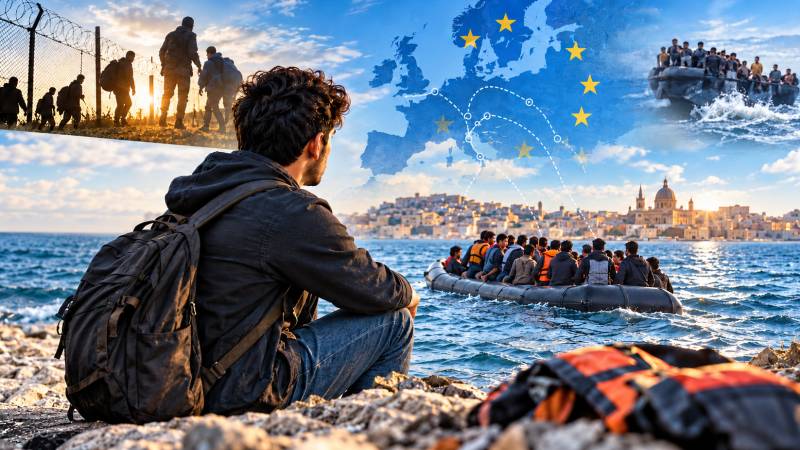
The gathering erupted in laughter. Little did I realise that this seemingly harmless joke about Pakistani ingenuity and immigration agents would one day acquire a tragic meaning. Today, when we hear of migrants drowning in the Mediterranean, dying at borders or suffocating inside sealed containers, the laughter becomes difficult to sustain. The question is no longer how the agent reached the Moon, but how much he charged and how many passengers survived. In Pakistan, the word Dunki has become increasingly familiar in conversations about irregular migration. The term describes dangerous journeys across international borders, often arranged by human smugglers, through which people attempt to reach wealthier countries outside regular immigration procedures. These journeys may involve remote mountain passes, dangerous deserts, concealed truck compartments and overcrowded boats barely capable of staying afloat.
An important distinction must be made: legal migration, seeking asylum and irregular border crossings facilitated by smugglers are not the same. Not every migrant is a criminal, nor is the desire to move abroad inherently wrong. People migrate for education, employment, safety and family responsibilities. Many simply want a better future for themselves and their children. The problem arises when legitimate aspirations are exploited by criminal networks that turn desperation into profit.
The problem is not migration itself, but the transformation of legitimate aspirations into perilous journeys fuelled by deception, desperation and unrealistic expectations.
In parts of Pakistan, reaching Europe has become a symbol of social prestige. Images of apparent prosperity on social media conceal the financial struggles, loneliness and uncertainties of life abroad. Young people see relatives returning with expensive possessions and hear stories of success, while the sacrifices and failures often remain unspoken. Unscrupulous agents exploit these expectations, persuading families to sell property, pawn jewellery or borrow heavily to finance perilous journeys. The success story of someone who reaches Europe travels throughout an entire village; the death of someone who never arrives may remain confined to the grieving walls of a family home.
Human smugglers market dangerous journeys as attractive packages, promising access to Europe while concealing the risks of arrest, deportation, exploitation and death. Whether migrants travel through Iran and Türkiye or across North Africa towards the Mediterranean, every border presents another opportunity for smugglers to profit and another danger for those undertaking the journey. The Mediterranean has become a graveyard for countless migrants whose dreams end beneath its waves. On 14 June 2023, an overcrowded vessel sank near Pylos, Greece, reportedly carrying up to 750 people, including Pakistanis. Only 104 survivors were reported, 82 bodies were recovered and hundreds remained missing.
Such disasters generate familiar government assurances, investigations and promises of action against smugglers. Public attention eventually fades, only to return after another tragedy. Yet behind every statistic lies a shattered family, an unfinished dream and perhaps a mother still waiting for a telephone call that will never come. The dangers extend beyond the sea. Migrants crossing remote land borders face kidnapping, extortion, violence, forced labour and torture. Those packed into sealed trucks and containers risk suffocation and exposure to extreme heat. In this ruthless trade, human beings are reduced to disposable cargo, their lives treated as less valuable than the goods transported across borders.
Nor is this exclusively a Pakistani problem. The International Organization for Migration reported at least 7,667 deaths or disappearances worldwide in 2025, an average of approximately 21 lives lost every day. The actual toll may be higher because many deaths remain undocumented. Governments have legitimate reasons to protect their borders and enforce immigration laws. But border security cannot substitute for a broader response to the economic inequalities, conflicts, limited legal migration opportunities and criminal networks that drive these tragedies. Protecting borders must not mean abandoning the responsibility to protect human life. This brings us to an uncomfortable question: why are young Pakistanis willing to risk death simply to reach another country?
Are they driven by the desire for luxury, or have they lost affection for their homeland? The reality is considerably more complicated. Unemployment, economic insecurity, limited professional opportunities and family responsibilities all play a part. Some young people feel trapped in a society where material possessions have become measures of individual worth. Others believe that one successful migrant can transform the fortunes of an entire family. It would be unjust to accuse everyone seeking a future overseas of lacking patriotism. Migration has been part of human civilisation for centuries, transforming individuals and communities through education, trade, employment and cultural exchange. The problem is not migration itself, but the transformation of legitimate aspirations into perilous journeys fuelled by deception, desperation and unrealistic expectations. Rather than condemning young people for wanting a better life, we must ask why so many believe that such a life is beyond their reach at home.
Families, too, need to recognise the risks. One household hopes to build a house, another wants to clear its debts, while a third dreams of transforming its financial circumstances through a son's success abroad. There is nothing wrong with hope, but hope becomes dangerous when divorced from reality. When communication suddenly ends, the nightmare begins. Desperate parents visit agents' offices, police stations, government departments and embassies, searching for missing children. Telephone calls go unanswered, agents disappear and investigations become entangled in administrative and legal complications.
Arresting smugglers after every tragedy is necessary, but it cannot provide a lasting solution. Pakistan needs stronger action against organised smuggling networks, reliable public information about lawful migration, better access to education and vocational training, and meaningful employment opportunities. Young people must be able to distinguish genuine international opportunities from fraudulent promises. No one should have to gamble with their life because reliable information was unavailable, a dishonest agent offered an attractive illusion or their society failed to provide a credible path towards a dignified future.
Sometimes I wonder what became of my former roommate in Sweden. Did he reach Spain, obtain legal residence and achieve the prosperity he imagined? Or did years of uncertainty, temporary employment and immigration difficulties extinguish his optimism? I have no answers. Perhaps he succeeded, and I sincerely hope he did. But his story reminds me that the declared purpose of a journey and its real destination can be entirely different. At the time, his disappearance seemed an amusing example of Pakistani resourcefulness. Two decades later, it has acquired an uncomfortable aftertaste. An agent is no longer merely a colourful character in a traveller's anecdote. He may be the person to whom a family entrusts its savings, its hopes and, ultimately, the life of a son. I return, therefore, to the old joke about Neil Armstrong discovering a Pakistani sleeping peacefully on the Moon. “An agent dropped me here!”
It was quintessential Pakistani humour: an exaggerated tale with an unexpected punchline, celebrating our extraordinary ability to navigate geographical and bureaucratic obstacles. But imagine that same traveller lying unconscious beside a remote border, suffocating inside a sealed container or desperately reaching for help as an overcrowded boat disappears into the Mediterranean. Would we still laugh? Sometimes a nation's jokes lose their innocence because reality becomes more terrible than satire.
The culture of Dunki reflects not merely irregular migration, but economic anxiety, family expectations, social competition and the cruelty of those who turn desperation into profit. Pakistan must offer its young people credible opportunities through education, research, skills and dignified employment, without denying them the right to seek a future abroad. Migration should be a free and informed choice, not a gamble imposed by hopelessness or social pressure. Above all, no mother should spend her days waiting for news of a son she sent away expecting to hear of his success, only to learn that he has drowned thousands of miles from home. The tragedy is not that our young people dream of distant shores; it is that too many feel they must risk drowning before they can begin to live.