

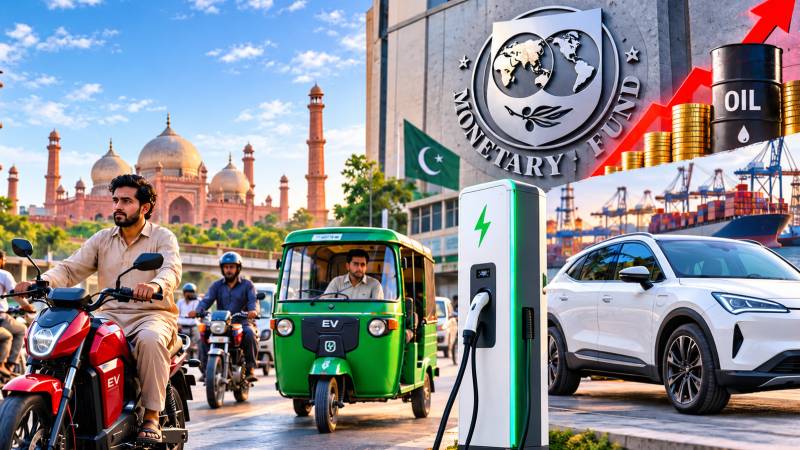
The IMF has 'asked' Pakistan to end the concessional tax rate on electric vehicles (EVs). The fundamental rationale reportedly offered is that electric vehicles are a luxury item rather than a necessity for low-income consumers, prompting a call for the concessional rates to be entirely withdrawn, this could result in the sales tax on electric vehicles rocketing from 1% to a standard 18%. To understand the gravity of this proposed rollback, we must examine the glaring incoherence it creates between two of the Fund’s own parallel programs: the Extended Fund Facility (EFF) and the Resilience and Sustainability Facility (RSF).
The RSF is designed specifically to help vulnerable nations build macroeconomic resilience against climate shocks and reduce systemic reliance on imported fossil fuels. Under RSF Reform Measure 10, Pakistan committed to a revenue-neutral green-mobility framework, a deliberate architecture designed to pair EV incentives with additional taxation on internal-combustion-engine (ICE) vehicles. The explicit goal was to incentivize EV uptake to meet national targets of 30% penetration for new passenger EVs and 50% for two- and three-wheelers by 2030. These concessions the architectural foundation of a policy meant to ease the upfront cost of electrification and systematically slash the nation's crippling petroleum import bill.
The fundamental flaw in the reported IMF position is the rigid application of a single yardstick to a highly stratified mobility market. The news reports correctly note the mathematical reality for high-end consumers: the tax on an EV worth Rs10 million could rise from Rs100,000 to Rs1.8 million. Taxing a Rs10 million luxury vehicle at an 18% standard rate could be a defensible fiscal measure. However, blindly applying that same 18% standard rate to a locally assembled electric motorcycle, an e-rickshaw, or a commercial electric three-wheeler is economically destructive. By conflating premium four-wheelers with commuter two- and three-wheelers, this blanket policy risks crushing Pakistan's green transition at the grassroots level before it can even mature.
Consider the immediate market reality and the fierce battleground of the two-wheeler segment in Pakistan. The traditional 70cc ICE motorbike is an institution! It is deeply entrenched in the societal fabric because it excels in areas that heavily dictate consumer behavior for a Pakistani commoner: sheer durability on unforgiving roads, tested reliability, and an unparalleled, decentralized aftermarket ecosystem.
An electric bike, conversely, is a nascent technology attempting to break into a highly skeptical market. It naturally introduces new anxieties for the consumer regarding battery degradation over extreme summers, the scarcity of charging infrastructure, and a heavy reliance on a fragmented supply chain for specialized spare parts like hub motors and controllers. Currently, the 1% concessional sales tax is the vital, artificial counterbalance that makes an EV bike's higher upfront cost somewhat palatable against the deeply established 70cc alternative.
Treating the electric motorcycle of a daily wage earner, a factory worker, or a delivery rider with the same fiscal hostility as a premium imported SUV is a profound failure of policy imagination.
If this tax is abruptly hiked to 18%, the retail price of an electric motorcycle will surge, destroying its only competitive edge. When faced with a substantially higher upfront cost for an EV bike, alongside the lingering doubts about long-term reliability and spare parts availability, a consumer will inevitably fall back on the ICE option. The economic calculus for the average citizen is ruthless and highly rational: why pay a massive premium for an unproven technology with a fragile maintenance network when the trusted, highly liquid, and easily repairable 70cc bike is cheaper at the dealership?
Furthermore, the policy misstep extends to the broader ecosystem. Sources indicate that the sales tax on EV charging stations could also be increased from 1% to 18%. Charging infrastructure is the critical enabler of the entire green mobility transition. Taxing it as a luxury good ensures that capital investment in public charging networks stalls, meaning range anxiety will remain a permanent feature of the Pakistani EV experience, further suppressing adoption rates.
The irony of this fiscal tightening is that it actively works against the IMF's core mandate of stabilizing Pakistan's balance of payments. The country's economic vulnerability is inextricably tied to volatile global oil markets and a structurally unsustainable petroleum import bill. Electric two- and three-wheelers represent a strategic, highly actionable pathway to systematically reduce this import reliance. A competitively priced electric motorcycle charged via a domestic grid, or increasingly, via localized rooftop solar, represents permanently preserved foreign exchange. By making EV bikes unaffordable and uncompetitive against the 70cc status quo, the IMF is effectively guaranteeing that millions of daily commuters remain tethered to imported petrol. This sustains the very external account vulnerabilities and macroeconomic fragility that the EFF is ostensibly meant to cure.
What is urgently required is not a blanket withdrawal of concessions, but a sophisticated, stratified tax regime that understands the nuances of the Global South's mobility dynamics. The IMF and the Government of Pakistan must differentiate between luxury consumption and transition infrastructure. Concessions on high-end, private electric cars can be phased out or replaced with the standard 18% rate, as their buyers are relatively price-inelastic. However, the 1% concessional rate must be fiercely protected, and ideally locked in over a long-term horizon, for electric two-wheelers, three-wheelers, public transport buses, local manufacturing components, batteries, and charging stations.
The transition to electric mobility in Pakistan should not be a vanity project; it is a macroeconomic survival imperative. Treating the electric motorcycle of a daily wage earner, a factory worker, or a delivery rider with the same fiscal hostility as a premium imported SUV is a profound failure of policy imagination. If the EFF's rigid revenue targets are allowed to carelessly cannibalize the RSF's climate resilience goals, the only guaranteed outcome will be a poorer, more polluted, and chronically oil-dependent Pakistan. It is time to implement a genuine trade-off analysis that accounts for these structural realities, ensuring that our road to economic stabilization isn't paved with the fatal mistakes of short-sighted, single-yardstick taxation.