

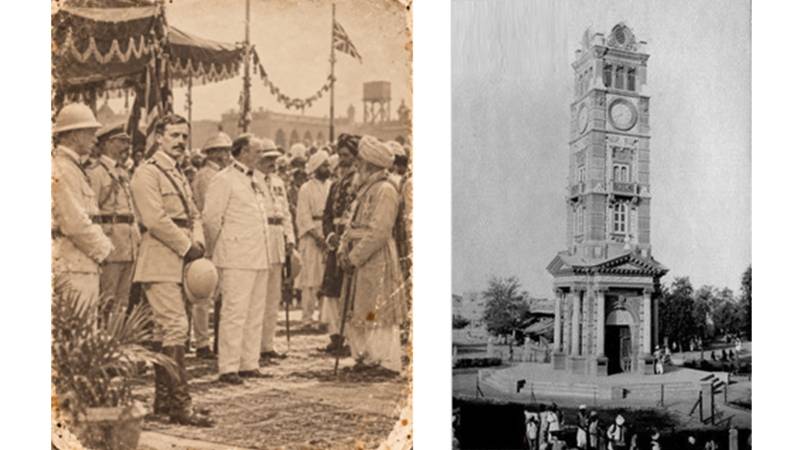
There are men who leave their names upon the pages of history, and there are those who leave them upon the face of the earth. The former are remembered in books; the latter in the landscapes they have created. Sir F Popham Young belonged to that group whose lives become so intimately woven into the destiny of a place that the story of one can scarcely be told without the other.
Long before the Clock Tower rose against the Punjab sky, before the eight bazaars became bustling arteries of commerce, and the whistles of railway engines filled the air, there stretched across the Rachna Doab an immense countryside known as the Sandal Bar. It was a land of far horizons, thorn and scrub, and wandering herds, where deer and jackals moved through a landscape untouched by perennial irrigation. Yet the Bar was no empty wilderness—it possessed its own people, pastoral traditions, ancient pathways, and a rich inheritance of folklore.
The Colonisation of the Sandal Bar
Frank Popham Young was born in India on the 24th of December 1863, the son of Colonel Gordon Young. Educated at Bradfield and the Royal Military College at Sandhurst, he entered the Army in 1884 before moving into the civil service. In 1892, he was entrusted with the appointment that would define his legend: Colonisation Officer of the Lower Chenab Colony. The newly completed Khanki Headworks on the River Chenab near Wazirabad had transformed the Lower Chenab Canal from dependence on the river’s seasonal moods to an enduring flow of water into the Sandal Bar. Land had to be surveyed, watercourses aligned, agricultural holdings distributed, settlers selected, villages established, roads constructed, and markets created.
Captain Young had emerged singularly suited to the task, as he possessed an affection for order tempered by a willingness to improvise. He helped introduce a remarkable geometric arrangement of agricultural squares and smaller killas to the Chenab Colony, bringing field, boundary, and watercourse into a carefully coordinated system. Behind this orderly landscape, however, lay a world of human endeavour, courage, and occasional absurdity, where Young's personality was to reveal itself most vividly.
Many years later, Malcolm Lyall Darling encountered some of the original colonists, now magnificent old Sikhs with flowing white beards. They recalled how three hundred of them had travelled on foot from Lahore, following their bullock carts towards their potential new homes. There they found no houses, little shelter, and none of the comforts of settled village life. Cholera broke out, killing eight or ten men, while others, overcome by hardship, abandoned the venture and returned. One elderly settler demonstrated how they used to fashion shelter by simply lifting a chaddar over their heads.
A blind Punjabi poet named Kána wrote a tribute, with a simple chorus at its heart: “Young Sahib has peopled the land”
Then came the Janglis. The newcomers complained how these locals were stealing from their encampments. Young’s advice, according to the old settler, consisted of precisely two words: “Beat them.” There was no committee, elaborate inquiry, or lengthy memorandum. The anecdote, however uncomfortable to modern sensibilities, captures the practicality of the former soldier. He was not an administrator whose acquaintance ended at his office door; he knew the daily anxieties of his settlers and preferred immediate solutions to elaborate proceedings. His approach was paternalistic and sometimes rough, unmistakably reflecting the assumptions of colonial authority, but it was also personal. Maud Diver later praised his “untiring energy, patience, tact” and empathy for the colonists, among whom he lived long enough to establish genuine relationships. An admiring tradition bestowed upon him the affectionate title “Father of the Chenab Colony.”
Building the City of Lyallpur
Making communities flourish, however, required more than protecting them from thieves. He would inspect their hands to gauge their experience in farming and, on one occasion, even ordered an impromptu wrestling match to determine who should be given preference in the allocation of land. Irrigation water provoked arguments as readily as it produced wheat. A farmer's turn of water might determine whether his crop survived or failed; neighbours quarrelled over boundaries, channels, and holdings; families arriving from different districts had to learn the difficult art of living together. Young encouraged village panchayats and arbitration, preferring local settlements to endless litigation.
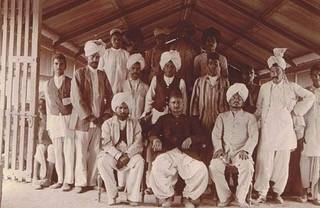
This magnificent undertaking was not the work of one man. The engineers, surveyors, revenue officers, labourers, and cultivators were indispensable to its success. Among Young's colleagues were Chaudhri Aurangzeb Khan (Assistant Colonisation Officer), Lala Pindi Das (Tahsildar), and Munshi Fateh Din (an influential settler), while Sidney Preston looked after the engineering side of the enterprise. The settlers supplied the determination, agricultural knowledge, and enormous physical labour that turned the engineers' channels into productive fields and surveyed holdings into flourishing villages. Sir Ganga Ram also advised, but Young remained the presiding personality of this transformation: the man whose responsibility was to turn an immense irrigation enterprise into a functioning human society.
As the Colony expanded, the need for a commercial and administrative centre became urgent. With characteristic candour, Young declared: “The Colony is now far too big and populous to be a mere adjunct to the District of Jhang.” A headquarters at Lyallpur, he insisted, was “most urgently required.” Thus, in 1896, the plan of Lyallpur took shape. At its centre lay a square from which eight bazaars would radiate in an extraordinary geometric arrangement. Later generations would delight in comparing the design to the Union Jack. There is a lovely tradition of Young and his colleagues (Khan, Das, Din, Ganga Ram, Preston) “burning the midnight oil” over the plans. One imagines the lamplight falling upon maps and measuring instruments, officials bending over lines and calculations, while beyond their windows lay the darkness and silence of the Sandal Bar.
By 1899, the achievement was sufficiently impressive to attract the attention of the Viceroy of India. On the 3rd of April that year, Lord Curzon arrived by a special train. The railway station had been decorated, engineers and officials assembled, and Young accompanied the Viceroy through the Colony. A large gathering assembled at Young's bungalow where Curzon praised his agricultural arrangements, his panchayat system, and his personal influence over the colonists. Yet, perhaps the most eloquent testimony was the gathering itself; the people whose beginnings had been marked by uncertainty, cholera, makeshift shelters, and the struggle to wrest a living from unfamiliar ground. Now their Colony had acquired roads, markets, railway connections, and an emerging town called Lyallpur.
Young’s reports seldom betrayed the grand language of a founder. He preferred the restrained vocabulary of an administrator, counting acres, classifying holdings, and recording problems requiring attention. Yet, beneath this unadorned prose there was sometimes an unmistakable affection. Looking back upon its transformation, he described the Colony’s inhabitants as “the most happy and contented” and “the most prosperous community in British India.” The judgement inevitably reflected the paternal assumptions of his age, and cannot represent every settler's experience, but it reveals the standard by which Popham Young measured his undertaking.
Perhaps the most beautiful tribute paid to him came not from a Viceroy or a senior British official, but from a blind Punjabi poet named Kána. When Young departed from Lyallpur in 1899, the poet composed a forty-three-stanza ballad celebrating the transformation of the Sandal Bar. It recalled the old country of thieves, deer, and jackals, the arrival of canals, the measurement of lands, the establishment of settlements, markets, and railways. At the heart of his tribute stood a chorus of extraordinary simplicity: “Young Sahib has peopled the land.” There could scarcely have been a finer farewell.
A Private Man Acquainted with Sorrow
In December 1898, while still associated with the Chenab Colony, Young married Winifred Ethel Montgomery in Lahore. She was twenty, and he was thirty-five; her grandfather being Sir Robert Montgomery, a former Lieutenant-Governor. Their marriage coincided with the culminating years of Young's great undertaking. Yet history permits no such romantic certainty, and what it records is infinitely sadder. On the 1st of November 1902, Winifred died at Ambala, only twenty-four years old. Their marriage had lasted less than four years. Behind the public figure of the energetic administrator stood a private man acquainted with sorrow.
His distinguished career continued. He served as a Settlement Commissioner in Patiala, undertook political responsibilities in the Phulkian States, and rose to become Commissioner of the Rawalpindi Division. During the First World War, he was also involved in recruitment and military organisational duties. Honours followed: the CIE in 1899, the CBE in January 1918, and the KBE in June of that year. The young Captain of Lyallpur had become Sir Frank Popham Young.
Literature and the London Stage
Following his retirement in 1919, Young turned towards literature. He had married an American, and his life now moved between England and America. In 1922, he published a volume bearing the unconventional title A Ménage à Trois Across the Styx and Other Adventures in Verse. It was a witty, philosophical, and sometimes melancholic collection, concerned with love, religion, ambition, mortality, and the strange contradictions of human existence.
In California, Popham Young found himself beside the Pacific Ocean, yet his thoughts travelled across to India. He remembered the gardens nestled beneath the eternal mountains, the distant sound of camel bells, and traders from Samarkand and Bokhara. Though separated from those scenes by more than half the world, Young hears the imagined cry of a thirsty country: “Assuage our thirst, enrich our fields…” These words seem almost providentially suited to the work of his youth. Had not the great undertaking of Lyallpur been an answer to that very cry? The channels that carried water into thirsty country, the fields that flowered under irrigation, and the villages that arose beside them had once been the practical substance of his days.
Elsewhere, he writes: “I had believed I marched and conquered. I had merely drifted.” These are not literal confessions about his Punjab career, but they reveal an older man prepared to question the certainties of youth. The younger Popham had measured land and organised communities; the older Young was beginning to measure the meaning of accomplishment itself. In his poem Kismet, he considers the impermanence of things built by mortal hands and the more enduring significance of human relationships. It is a poignant philosophy for a man who had devoted some of his finest years to building something so tangible as a city.
In November 1923, an American radio programme announced, “Sir Frank Popham Young will give early morning readings.” What a delightful transformation: the officer whose voice had once been heard among cultivators and surveyors beneath the Punjab sun was now speaking through one of the newest inventions of the twentieth century. Then came the theatre. His play A Dog's Chance was performed at the Q Theatre, Kew Bridge, in 1926; The One-Eyed Herring reached Wyndham's Theatre in 1927; and The Accomplice appeared at London's Arts Theatre in 1931. There is something wonderfully incongruous, and therefore delightfully human, about this progression from Sandhurst to the Sandal Bar, from canal administration to high office, and finally from the bungalow at Lyallpur to radio studios and the London stage.
Young's life was full of curious and attractive contradictions. The colonists remembered his accessibility, the old settlers his bluntness, Curzon his paternal authority, and his colleagues his energy and administrative ability. His reports reveal an affection for order; his poetry reveals doubt, tenderness, and reflection; his plays suggest humour, imagination, and an appetite for the theatre of human life. He could be impatient and sympathetic, authoritarian and generous, practical and philosophical.
The Enduring Monument
On the 12th of December 1940, Sir Frank Popham Young's remarkable journey ended abruptly on the Marlow-Henley road in England, where he died following an apparent road accident. He was seventy-six. There is melancholy in such an unceremonious conclusion to a life that had embraced so many worlds. His most enduring monument, however, was neither a decoration nor a published work. It lay thousands of miles away, beneath another sky, in a city he had last known during its infancy.
Lyallpur continued to grow. Its agricultural hinterland flourished, its markets expanded, industries arose, and the modest colonial settlement became a great city. The British Empire vanished, political boundaries were redrawn, generations came and went, and the little town became a centre of commerce, industry, and learning. If one stands today beneath the Clock Tower of Faisalabad and looks towards Rail Bazaar, Katchery Bazaar, and Montgomery Bazaar, one is standing within an idea conceived more than a century ago. Perhaps the most fitting epitaph had already been sung in 1899 by the blind poet Kána: “Young Sahib has peopled the land.”
There are men whose monuments stand over their graves, and there are men whose monuments are places. Sir Frank Popham Young belongs to the latter. His true memorial is not in England, where his life ended, but in Lyallpur, where the most consequential chapter of that life began. And somewhere, beneath the immense and restless Faisalabad of today, there remains the memory of a young English officer standing in the Sandal Bar, a map in his hands, and a city still unborn before him. The sun is setting over the plains, the first canal waters are finding their way towards the fields, and the eight roads of Lyallpur are beginning to take shape.
He came to organise a colony. He helped give it a city. And the city became his immortality.