

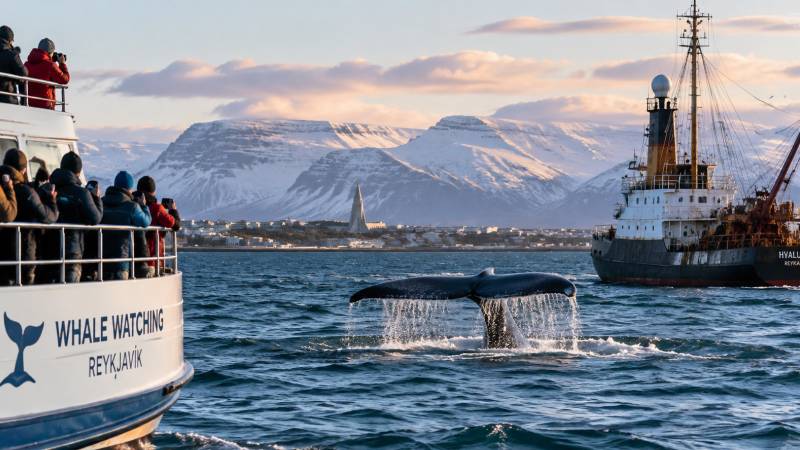
There is something almost paradoxical about Iceland’s relationship with the whale. Around Reykjavík and the northern town of Húsavík, visitors board boats to search the North Atlantic for the dark arch of a back, a sudden blow of vapour or the improbable sight of a whale breaking the surface. Whale watching has become woven into the country’s international image: an encounter with a wild Arctic landscape that Iceland markets to millions of visitors. Yet elsewhere in the same waters, two ageing catcher vessels have spent the summer pursuing fin whales with explosive harpoons. Few countries embody so visibly the collision between an older extractive relationship with the sea and a newer economy built partly upon leaving its great animals alive.
That contradiction may now be approaching a political conclusion. Iceland’s government intends to place legislation before the Alþingi in February 2027 that could permanently prohibit commercial whaling. If parliament ultimately approves such a ban, Iceland would leave Norway and Japan as the principal countries still conducting commercial hunts, while indigenous subsistence whaling permitted under international arrangements would remain a separate category. The proposal would be historically significant, but it would also formalize a transformation that has been underway for years: whaling in Iceland is no longer a mass national industry. It has become a narrow, contested enterprise whose survival increasingly depends on legal permission, political endurance and the determination of one company.
The immediate facts are striking. After two seasons in which no whales were taken, the vessels Hvalur 8 and Hvalur 9 returned to sea in June 2026. By September 14, Iceland’s sole remaining commercial whaling operator, Hvalur hf., had caught 85 fin whales from an annual quota of 150. The company employs roughly 150 seasonal workers and remains led by Kristján Loftsson, the veteran businessman who has become almost synonymous with Icelandic whaling. Far from preparing for surrender, Loftsson has publicly expressed confidence that political efforts to outlaw the industry can still be defeated. This is therefore not simply a story of environmentalists overcoming an archaic practice. It is a more complicated struggle over what counts as sustainability, what constitutes humane treatment of animals, how much cultural tradition should weigh in modern policy, and whether an activity can remain politically defensible after its economic importance has sharply diminished.
It is impossible to understand the debate without understanding Iceland itself. This is an island nation whose political history, food security and economic development have been inseparable from the North Atlantic. The sea was never scenery alone. It was livelihood. Fisheries remain central to the Icelandic understanding of national sovereignty. The country fought the so-called Cod Wars with Britain in the twentieth century to secure control over surrounding fishing grounds. Marine science, catch limits and national control of living resources therefore occupy an unusually important place in Icelandic political thought.
Whaling fits partly within this tradition of harvesting marine resources, but its historical position is more complicated than romantic descriptions of an uninterrupted ancient national custom sometimes suggest. Iceland halted large-whale hunting in 1915 after concerns about overexploitation, resumed later in the century, ceased commercial whaling after the International Whaling Commission’s moratorium took effect in 1986, and eventually returned to commercial hunting in 2006.
Nor is Iceland simply ignoring marine science. Its Marine and Freshwater Research Institute advised that catches of fin whales in 2026 should not exceed 150 animals, 28 percent below the previous advice. That recommendation applies the International Whaling Commission’s Revised Management Procedure and incorporates a precautionary reduction because the newest abundance estimates have not yet been fully approved. That matters because it complicates one of the easiest arguments in the debate.
Fin whales are globally classified as vulnerable, and their twentieth-century exploitation was devastating. Yet scientists assessing the North Atlantic population around Iceland do not describe it as a stock on the immediate verge of collapse. Whaling supporters therefore argue that a scientifically calculated harvest can be biologically sustainable. The case for prohibition has consequently moved beyond the simple question: are there enough whales? Increasingly, Iceland is asking a different one: even if a limited hunt can be sustained numerically, should it continue? That is a far more difficult question, because science can estimate populations and calculate catch limits, but it cannot by itself decide what kind of relationship a modern society should have with an intelligent, long-lived marine mammal.
This is therefore not simply a story of environmentalists overcoming an archaic practice. It is a more complicated struggle over what counts as sustainability, what constitutes humane treatment of animals, how much cultural tradition should weigh in modern policy, and whether an activity can remain politically defensible after its economic importance has sharply diminished.
For much of the twentieth century, wildlife debates were dominated by population conservation. If a species was abundant enough and harvesting did not threaten its survival, utilization could be described as sustainable. Whaling has exposed the limits of that argument. The controversy in Iceland increasingly concerns not merely conservation but animal welfare. An official investigation of the 2022 hunting season examined 148 fin whales and found that 36—about 24 percent—had to be shot more than once. Some were struck three or four times, while one wounded whale was pursued unsuccessfully for five hours. Iceland’s Animal Welfare Council subsequently concluded that the method used to hunt large whales was inconsistent with the objectives of the country’s animal-welfare legislation.
The same issue returned almost immediately when hunting resumed in 2026. The first fin whale killed by Hvalur 8 was struck with four explosive harpoons and took approximately 31 minutes to die. The Icelandic Food and Veterinary Authority investigated the incident and concluded that the crew had followed the prescribed procedure and had done what was reasonably possible to kill the animal quickly. That finding is important: it did not establish a regulatory violation. But the incident simultaneously demonstrated the deeper problem. A hunting method may comply with the rules and still produce a death lasting half an hour. This changes the nature of the political argument.
If suffering occurs because hunters break the rules, regulators can impose better rules. If prolonged suffering can occur even when crews follow the rules, society confronts a harder ethical question about the activity itself. Technological improvements to explosive harpoons, monitoring and killing procedures may reduce suffering. They cannot guarantee the instantaneous death of an animal that can weigh tens of tons, dive beneath the sea and move unpredictably after being struck. The welfare argument has therefore become more difficult to answer with the traditional language of sustainable quotas. There is another reason the debate has changed: commercial whaling occupies a very different economic position from the one it once did.
Iceland’s whaling industry is now extraordinarily concentrated. Hvalur is effectively the remaining commercial operator hunting fin whales. Its Japanese export market has become less secure, and domestic demand is limited. The very fact that two vessels and one company dominate the national controversy reveals how far the industry has contracted. Iceland Review has described the sector as facing severe market deterioration rather than representing a broadly distributed pillar of the national economy.
That does not mean its workers can simply be ignored. Around 150 seasonal jobs matter to the people who depend upon them. Governments contemplating the termination of any legal industry have an obligation to think about transition, retraining and alternative employment rather than treating workers as collateral damage in an ethical argument. But Iceland’s wider economic transformation is impossible to miss. Tourism accounted for an estimated 8.8 percent of Icelandic GDP in 2025 and generated nearly one in ten working hours. During May and June 2026, turnover in passenger transport by sea or water (i.e., largely associated with whale-watching activities) rose by about 13 percent compared with a year earlier.
In places such as Húsavík, the living whale has itself become part of the local economy. Icelandic operators have even experimented with electric and wind-powered vessels for quieter, lower-carbon whale watching. Here, ironically, is where technology genuinely enters the story, not as the mechanism behind the proposed ban, but as part of an alternative relationship with the whale. The technological choice is no longer simply about improving the harpoon. It can also be about improving the boat that follows the whale without killing it.
Campaigners outside Iceland sometimes make the mistake of imagining that opposition to whaling is simply modernity confronting barbarism. That caricature explains very little. Iceland is already among the world’s most modern, educated and technologically advanced societies. Its marine resource management is sophisticated. Its whaling debate takes place within a democracy, with scientists, veterinarians, businesses, environmental groups, politicians and citizens arguing publicly over evidence and values.
Public opinion itself is not unanimous. A June poll cited by Reuters found 41 percent opposed to whaling, roughly one-third supportive and 26 percent neutral. That is a country in transition, not one in which the outcome is culturally predetermined. For supporters, the argument often rests on sovereignty and consistency. Why, they ask, should a scientifically monitored whale hunt be treated as morally unacceptable while industrial fishing, livestock slaughter and other forms of animal consumption continue? Why should foreign activists decide how Iceland uses abundant marine resources?
There is something politically unusual about an entire national argument becoming concentrated around one company and two vessels. Hvalur’s persistence has transformed Kristján Loftsson into a symbol to both sides. To supporters, he embodies independence, maritime experience and resistance to outside moral pressure. To opponents, he represents an industry surviving beyond its economic and ethical time. Neither description is entirely sufficient.
The company operates under licenses legally granted by the Icelandic state. A five-year license was issued in 2024. If parliament now wishes to prohibit an activity it previously authorized, questions of legal certainty and transition cannot simply be brushed aside. This is one reason the government has proceeded cautiously and why a statutory prohibition would be more consequential than a minister merely declining to grant another annual permit.
The planned bill will therefore have to do more than declare an ethical preference. It will need to withstand legal and parliamentary scrutiny, deal with existing rights and licenses, and persuade legislators that permanent prohibition is preferable to increasingly strict regulation. Loftsson is betting that parliament will once again hesitate. He may not be wrong to assume the vote will be harder than the international headlines imply. A government proposal is not yet a ban.
If Iceland ultimately prohibits commercial whaling, the global symbolism would be considerable. The International Whaling Commission agreed in 1982 to impose a moratorium on commercial whaling from the 1985-86 season. Iceland later returned to commercial hunting under its reservation to the moratorium. Norway resumed commercial hunting in 1993, while Japan withdrew from the IWC and restarted commercial whaling in its own waters in 2019.
A withdrawal by Iceland would therefore narrow the club of commercial whaling nations further. But it would not end whaling everywhere, nor should commercial whaling be confused with indigenous subsistence hunts. International rules recognize limited whaling by certain indigenous communities, including in Greenland and Alaska, where the practice can have nutritional, cultural and subsistence significance quite different from an export-oriented commercial industry. That distinction matters. Conservation policy becomes intellectually weak when fundamentally different activities are placed into the same moral category.
Iceland still depends enormously on fishing. It will continue harvesting marine resources. There is no suggestion that the country is abandoning the sea as an economic foundation. What may be changing is the boundary around one particular form of harvest. That is how environmental history often advances not through the sudden rejection of an entire economic worldview, but through specific practices gradually losing legitimacy. The harpoon does not disappear because a nation forgets its past. It disappears when the present no longer finds the old justification sufficient. For the moment, the whaling vessels continue to operate, the industry remains legal and a permanent ban remains a proposal rather than accomplished law. By mid-September, 85 fin whales had already been taken in the 2026 season. The parliamentary test lies ahead. That distinction should not be lost beneath triumphant headlines. Yet the direction of travel is difficult to ignore.
If Iceland eventually legislates commercial whaling out of existence, the significance will not be that Iceland suddenly became environmentally virtuous. Nations are rarely transformed so neatly. Its importance will lie elsewhere. It will show how a society can retain respect for its maritime history while deciding that history does not impose an obligation to repeat every practice inherited from it. For decades the argument surrounding whales was largely about numbers: how many remained, how many could be taken and how many a population could replace. Iceland’s present debate is moving towards a more difficult question. Science can help count them. Economists can estimate their contribution to tourism. Veterinarians can document suffering. Legislators can regulate the hunt. But the final answer belongs to society. And in Iceland, after years of hesitation, that answer may finally be changing.