

In February 1965, Malcolm X, or El-Hajj Malik el-Shabazz, delivered a speech at the University of Birmingham, where I had been an undergraduate until the previous year. He was hosted by the university’s Islamic Society, which was very active. I had been president of the Pakistan Society at the University of Birmingham, and in this role, I helped promote Malcolm X’s event among our members and the larger student body.
Shortly before speaking at the university, Malcolm X had visited Smethwick, just outside of Birmingham, at the invitation of Indian workers, to raise awareness of the problem of racism there. He toured a street which local English residents, opposed to immigrants, sought to reserve for whites only. It was a situation Malcolm X likened to the way Blacks were treated in Alabama—the location of the other famous Birmingham—and the way "Hitler treated the Jews."[1]
While there was certainly interest in Malcolm X’s speech, and he was making waves with his undeniable charisma, he was not yet the iconic figure he is today. His event, which I drifted in and out of, received a modest reception at the university. While I and the other Muslim students were excited at Malcolm X’s visit—and even more so that he had dinner at a local curry house, Chaman, after asking for a good Pakistani meal—we were more in awe of Muhammad Ali. At the time, Muhammad Ali overshadowed Malcolm X in the media. In Malcolm X’s celebrated The Autobiography of Malcolm X, he recounted how, in his trips in Asia and Africa, he had learned that "every man, woman and child in the Muslim world" knew Muhammad Ali, and he was repeatedly mistaken for him.[2]
I was shocked to hear that within two weeks of his speech at our university, Malcolm X would be dead from assassins’ bullets. His violent demise, the publication shortly afterwards of his Autobiography, described by one historian as "one of the most influential books in late-twentieth-century American culture,"[3] and later Spike Lee’s film based on the Autobiography, Malcolm X (1992), helped Malcolm X’s star to grow and grow. The film played a similar role to Richard Attenborough’s film about Gandhi. While both leaders were already well known, particularly in their home countries, the films helped introduce them to subsequent generations and pushed their global celebrity to ever greater heights.
Slowly, the larger public in the US and around the world began to absorb and reflect on the enormity of Malcolm X’s contribution and significance. He continues to be an inspiration, including for young people, many of whom we have met in our numerous travels in the US and around the world. Along with his popularity have been continuing debates on the meaning of Malcolm X and his relevance for the struggle for civil rights in the US, and as Malcolm X would come to frame his movement, for "human rights" for Blacks, Muslims, and all people wherever they may live, particularly those facing poverty, oppression, and violence. This is especially so following the rise to prominence of the Black Lives Matter movement which was heavily influenced by Malcolm X.[4] From a controversial figure feared by many Americans, he came to be honoured by the US government with a postage stamp, thus joining "the official ranks of Americana."[5]
Much of the debate about Malcolm X has endured due to his own personal evolving views and the fast pace of his life. He said of the experience working on his Autobiography, "events concerning my life happen so swiftly, much of what has already been written can easily be outdated from month to month," and "even by sunset on the same day."[6] Malcolm X interpreted these changes in himself philosophically, stating, "In life, nothing is permanent; not even life itself."[7] The sense that the meaning of Malcolm X’s life is still in motion and unfinished was captured by the scholar Louis A DeCaro, who wrote, "Always a few steps ahead, Malcolm X is hard to catch up to, though one is surely a better human being for the pursuit, no matter what religious worldview one happens to embrace."[8]
By any metric, Malcolm X’s life transformations and achievements are remarkable. From a hustler, drug addict, and criminal who served years in prison, he became the most prominent spokesman and a central figure in the Black nationalist religious group the Nation of Islam, led by Elijah Muhammad. In the last few years of his life, he would repudiate the Nation of Islam and its philosophy, particularly concerning whites, who he had described as evil and devils. After a life-altering Hajj pilgrimage to Makkah, he embraced mainstream Sunni Islam and its message of human equality.
In Malcolm X’s remaining months, he focused on a twofold agenda: to teach and promote orthodox Islam in America, and to work for equality and liberation for Black Americans and for the millions around the world fighting oppression and struggling to emerge from the forces of racism and colonisation. During our extensive fieldwork for Journey into America, we observed firsthand the indelible impact of Malcolm X on these twin efforts. He would no doubt be pleased to learn that Islam has become an American religion practised by millions. For African American Islam particularly he proved to be a trailblazer. In 1975, Imam W D Muhammad, son of Elijah Muhammad, moved the vast majority of the Nation of Islam into mainstream Sunni Islam, following Malcolm X’s journey of over a decade prior. And while in the 1960s on the Hajj pilgrimage, Saudi officials were so shocked to encounter a Muslim with an American passport that they held Malcolm X for additional screening, today the world is aware that Malcolm X’s New York City has a Muslim mayor.
In terms of the Civil Rights Movement, Malcolm X and Martin Luther King Jr are commonly understood to represent the two main contrasting philosophical and tactical approaches: violent versus non-violent resistance, separatism and nationalism versus multiracial integration and inclusion, and adversarial versus accommodating views of American identity. In reality, as scholars came to argue, the visions of both were not as contrary as they appeared, and actually converged in important ways.[9] This is particularly the case given Malcolm X’s late-life thinking and philosophical trajectory.
For our purposes, what is noteworthy about Malcolm X is his evolution, moving from a position we can associate with anti-Mingling to one of Mingling. In this, he joins Minglers such as Ashoka who experienced life transformations and came to embrace and embody the Oneness of the world and humanity. It is a journey from a perspective of exclusion and a limited love, devotion, and pride in one’s own people, to an unlimited and all-inclusive love of humanity. Here, we will begin by describing Malcolm X’s initial views of ethno-racial exclusion, his path to embracing Mingling, and his lessons for the world and humanity. Understanding how he came to embrace human inclusion makes Malcolm X shine ever brighter as a Mingler.
The Early Life of Malcolm X
The Autobiography of Malcolm X begins with a dramatic scene. In Omaha, Nebraska in the 1920s, a party of hooded and armed Ku Klux Klan members approach Malcolm X’s family home looking for his father, a Christian preacher and follower of Marcus Garvey’s "back to Africa" Black nationalist movement. Malcolm X’s mother, pregnant with Malcolm, faces the Klansmen, telling them her husband was not home, and in response, they "galloped around the house, shattering every window pane with their gun butts. Then they rode off into the night, their torches flaring, as suddenly as they had come."[10]
Malcolm X’s father, who had seen three of his own brothers killed by whites in Georgia, including one by lynching, decided to move the family after Malcolm, born Malcolm Little, was born. They went first to Milwaukee and then to Lansing, Michigan, where they were targeted by the Black Legion, a KKK offshoot who wore black robes. Malcolm X’s first vivid memory was awakening at night to the sound of gunfire, smoke, and flames—his house had been set alight by whites. Then, at the age of six, his father was killed, he was told, by the Black Legion: "My father’s skull, on one side, was crushed in…he was attacked, and then laid across some tracks for a streetcar to run over him. His body was cut almost in half. He lived two and a half hours in that condition."[11]
Malcolm X’s distraught mother, with eight children to look after, was psychologically crushed and eventually had to be committed to a mental institution, where she grew unable to recognise her own children. The state took control of Malcolm’s life. He went into a foster home and then, after being expelled from the school he was attending for bad behaviour, to a detention home, during which he attended the local junior high school. In history class, he noticed how the section on "Negro history" was only one paragraph long. When his white English teacher asked him what career he wanted to pursue, and he replied that he was thinking he might like to be a lawyer, the teacher replied, "A lawyer—that’s no realistic goal for a nigger. You need to think about something you can be," and he suggested carpentry.[12]
When Malcolm X had the opportunity to visit his sister in Roxbury, Boston, he took it, and the next phase of his life began. He relocated to Roxbury, where he spent his time in the city’s "ghetto," a "world of grocery stores, walk-up flats, cheap restaurants, poolrooms, bars, storefront churches, and pawnshops."[13] Through his teenage years and into his early twenties, first in Roxbury and then in Harlem in New York City, Malcolm X recalled, "I lived and thought…like a predatory animal."[14] He moved from one hustle to the next, engaging in gambling, thievery, prostitution, and transporting bootleg liquor. As he describes in his Autobiography, his close friends included characters such as Sammy the Pimp. Of his drug use, Malcolm X said, "I viewed narcotics as most people regard food," and "I wore my guns as today I wear my neckties."[15] Eventually, he was arrested for participating in a burglary ring and was sentenced to ten years in prison.
Malcolm X and the Nation of Islam
In prison, his rage, which he focused against God and the Bible, was such that he was nicknamed "Satan" by inmates.[16] It was in prison that Malcolm X first encountered the Nation of Islam, initially through his family members who had begun to join the sect. As discussed in Journey into America, the Nation of Islam is an indelible element of the story of Islam in America. It is part of the long tradition of African Americans discovering or rediscovering aspects of Islam which, they were aware, was the faith practised by a considerable number of the enslaved Africans brought to the Americas. While the Nation of Islam featured elements of Muslim culture, including crescent iconography and the wearing of fezzes, theologically it differed from orthodox Islam in its programme of Black nationalism and separatism, its promotion of the inherent evil nature of the white race, and its teachings that its founder, Wallace Fard Muhammad, was Allah and its second leader, Elijah Muhammad, was the divine Messenger of Allah.
In a memorable account of a prison visit with his brother Reginald, who had joined the Nation of Islam, Malcolm X recounted that Reginald, gesturing towards white inmates who were speaking with their own visitors, told him, "Them…the white man is the devil."[17] This message that the white race was evil clicked with Malcolm X, given the harm that he had experienced from white Americans. His journey towards the Nation of Islam had now begun, an intellectual odyssey that also involved reading books from the prison library about a range of subjects. He essentially taught himself to become literate.
His interest in particular topics was driven by the Nation of Islam’s emphasis on Black unity and pride and its teachings that the glory of past African civilisations had been erased from history by the white man. Malcolm X became fascinated in obtaining any book he could about such subjects, given that prior to this period, his image of Africa "was of naked savages, cannibals, monkeys and tigers and steaming jungles."[18] In other words, it had reflected common white perceptions. Months passed with Malcolm engrossed in books, and he stated, a "new world opened to me."[19] He recalled, "I read most of the old philosophers, Occidental and Oriental. The Oriental philosophers were the ones I came to prefer; finally, my impression was that most Occidental philosophy had largely been borrowed from the Oriental thinkers."[20]
Despite the fact that he was imprisoned, Malcolm X affirmed, "I never had been so truly free in my life."[21] As he put it, "I was going through the hardest thing, also the greatest thing, for any human being to do; to accept that which is already within you, and around you."[22] While, he noted, "I do not now, and I did not then, liken myself to [Saint] Paul…I do understand his experience" of a religious conversion.[23]
In 1948, he wrote a letter to Elijah Muhammad, and soon became a member of the Nation of Islam. He adopted the code of living of the group, which included refraining from eating pork. He followed the practice of the Nation of Islam when he dropped his last name for "X," explaining, "The Muslim’s ‘X’ symbolized the true African family name that he never could know. For me, my ‘X’ replaced the white slavemaster name of ‘Little’ which some blue-eyed devil named Little had imposed upon my paternal forebears."[24] In 1952, Malcolm X was released from prison after serving nearly seven years, and dedicated his new life to the Nation of Islam.
Malcolm X was appointed a minister and soon rose to prominence within the organisation, becoming the Nation of Islam’s chief spokesman and minister of Harlem’s Temple No. 7. He played a key role in expanding the Nation of Islam and threw himself into the challenges of addressing the problems of the Black community which he stated was "trapped in a vicious cycle of ignorance, poverty, disease, sickness, and death. There seems to be no way out."[25]
Malcolm X founded the Nation of Islam’s newspaper, Muhammad Speaks,[26] and asserted that he increased the Nation’s membership from 400 to 40,000.[27] He also said that he "either directly established, or I had helped to establish, most of the one hundred or more mosques in the fifty states."[28] According to his daughter, Ilyasah Al-Shabazz, as a result of Malcolm X’s "determination, dedication, and unparalleled work ethic…the NOI [Nation of Islam] owned and operated one of the largest Black businesses in the United States—during this country’s crippling Jim Crow era."[29] It was Malcolm X who, the scholar Louis A DeCaro affirmed, "expanded the Nation of Islam from a virtual back-street cult to a prominent new religion."[30]
Malcolm X was full of grateful appreciation for Elijah Muhammad, who he said had "virtually raised me from the dead,"[31] and saved him from his prior "life of evil."[32] Speaking of himself and the other Blacks who joined the Nation of Islam, Malcolm X stated, "Mr. Muhammad teaches us the knowledge of our own selves, and of our own people. He cleans us up—morally, mentally and spiritually—and he reforms us of the vices that have blinded us here in the Western society. He stops black men from getting drunk, stops their dope addiction if they had it, stops nicotine, gambling, stealing, lying, cheating, fornication, adultery, prostitution, juvenile delinquency."[33]
Malcolm X electrified audiences with his messages of Black empowerment and pride. In one well-known speech, for example, he asked, "Who taught you to hate the texture of your hair? Who taught you to hate the color of your skin, to such extent that you bleach to get like the white man? Who taught you to hate the shape of your nose and the shape of your lips? Who taught you to hate yourself from the top of your head to the soles of your feet? Who taught you to hate your own kind? Who taught you to hate the race that you belong to? So much so that you don’t want to be around each other. Before you come asking, Mr. Muhammad, does he teach hate, you should ask yourself, who taught you to hate being what God made you? We teach you to love the hair that God gave you."[34]
In his numerous teachings and public statements, Malcolm X embodied and promoted the Nation of Islam’s teachings that race was the central framework in understanding human events, society, history, and culture. As Malcolm X put it, "not ideologies, but race, and color, is what binds human beings."[35] Originally, Malcolm X taught, all the world’s people were Black. They were "the wisest beings in the Universe"[36] who founded Makkah. While Blacks were "gods"[37] and "Muslims by nature,"[38] Malcolm X explained, the white race was a creation of Yacub, a scientist who thousands of years ago engineered it. The race he created was "devilish," "diabolical,"[39] "wicked,"[40] "bloodthirsty,"[41] and not fully human—instead it consisted of "blue-eyed, blond-haired, white things."[42] White people also smelled like dogs, Malcolm X stated, a result of whites interbreeding with dogs while living in "the caves of Europe."[43] The "white man by nature," Malcolm X affirmed, "wants to murder off the black, brown, and yellow" peoples of the world.[44]
In response to this white threat, Malcolm X conveyed Elijah Muhammad’s demand that the US government allow Blacks to either return to Africa or grant Blacks American territory which "we can call our own and where we can live in peace among ourselves…immediate and complete separation is the only solution."[45] Land was of paramount importance for Malcolm X because, he believed, "Land is the basis of all independence. Land is the basis of freedom, justice, and equality."[46] Malcolm X was adamant that "I’m not an American,"[47] and stated that if the US government did not meet these demands for a separate nation, "your entire race will be destroyed and removed from this earth by Almighty God, Allah."[48]
Announcing that the destruction of America and the West was nigh, Malcolm X argued that, "before God can set up his new world, the Muslim world, or world of Islam, which will be established on the principles of truth, peace, and brotherhood, God himself must first destroy this evil Western world, the white world...The hour of judgment and doom is upon White America."[49] The bottom line was that the races must "live apart from each other, since we certainly don’t get along peacefully while we are together."[50] Anything less than this, Malcolm X predicted, would result in "violence and bloodshed."[51] "A revolutionary wants land so he can set up his own nation," Malcolm X affirmed, and stated, "Revolution is bloody, revolution is hostile, revolution knows no compromise, revolution overturns and destroys everything that gets in its way."[52]
Malcolm X was dismissive of the non-violent movement of Martin Luther King, ridiculing it by discussing the effort to desegregate spaces such as bathrooms: "you can sit down next to white folks—on the toilet. That’s no revolution."[53] Malcolm X described King as an "Uncle Tom,"[54] a "traitor to the Negro,"[55] and a puppet who was "trained by the whites."[56]
Malcolm X additionally believed that it was impossible for whites to assist in the Black struggle for rights and freedom. In one episode which captures his attitudes on the subject, a white female student who had heard him speak in her New England college was so motivated to try and join the cause that she travelled to New York, located the Harlem restaurant owned by the Nation of Islam, and found Malcolm X there. She asked him, "What can I do?" and told him she wanted to "help the Muslims and the whites get together." Malcolm X replied, "Nothing." The student burst into tears and ran out of the restaurant.[57]
One of the effects of Hajj was to introduce an element of human experience that had been missing from Malcolm X’s life and perspective: the notion of pursuing an ideal
The Nation of Islam did establish contacts with the Ku Klux Klan, however. In order to secure independent Black territory in the Southern United States, Malcolm X represented Elijah Muhammad in high-level negotiations with the Klan, and Malcolm X reported, "From that day onward the Klan never interfered with the Black Muslim movement in the South…Nor would the Black Muslims bother the Klan."[58] The Klan proposed working together with the Nation of Islam to assassinate Martin Luther King, but Malcolm X declined this offer.[59] Malcolm X was additionally aware that Elijah Muhammad regularly corresponded with George Lincoln Rockwell, founder of the American Nazi Party, and Rockwell attended Nation of Islam rallies.[60] At one Washington, DC rally, Rockwell sat with 20 Nazis in full uniform to listen to Malcolm X give a speech entitled "Separation or Death."[61]
In 1962, Malcolm X received national media attention when, following a plane crash in France which killed over a hundred white Americans from Georgia, he exclaimed, "I’ve just heard some good news!"[62] and called the crash "very beautiful."[63] He made these comments in Los Angeles several weeks after Los Angeles police shot seven unarmed Nation of Islam members and killed Ronald Stokes, a close friend of Malcolm X. Then, following the assassination of President John F Kennedy, Malcolm X, in remarks which created a national uproar, said the killing was an example of "chickens coming home to roost" which "never did make me sad; they’ve always made me glad."[64]
The Hajj to Makkah
The backlash to Malcolm X’s "chickens" comment was so immense that Elijah Muhammad suspended his star spokesman. Yet the tensions between the two men went beyond such public controversies. Despite appearances in the early 1960s, Malcolm X was beginning to have inner conflicts regarding Elijah Muhammad and the Nation of Islam. An example was given by Alex Haley, Malcolm X’s collaborator for his Autobiography, who recounted that one day while he was stopped at a red light in a car with Malcolm X, a white man recognised Malcolm and gave him words of encouragement, saying "Keep up the fight!" Malcolm X responded sincerely, "I wish I could have a white chapter of the people I meet like you." As they drove away, Malcolm X quickly turned to Haley and said, "Not only don’t write that, never repeat it. Mr. Muhammad would have a fit."[65]
Malcolm X also heard rumours concerning Elijah Muhammad’s immoral conduct with teenage female secretaries of the Nation of Islam, rumours which were confirmed to Malcolm X by Elijah Muhammad’s son W D Muhammad—and also by Elijah Muhammad himself. Increasing tensions between the two men also were attributed to concerns from Nation of Islam leadership that Malcolm X, with his undeniable charisma, speaking talents, and his tendency to display an independence of thought and strategic vision, was overshadowing Elijah Muhammad himself.[66] Additionally, Malcolm X had grown close to W D Muhammad, and the two were discussing theological matters relating to the Nation of Islam and its divergence from Islamic teachings. Malcolm X recounted that W D Muhammad "expressed to me his conviction that the only possible salvation for the Nation of Islam would be its accepting and projecting a better understanding of Orthodox Islam."[67] W D encouraged Malcolm X to broaden his knowledge of Islam, which he did by taking a trip to Makkah to perform the Hajj.
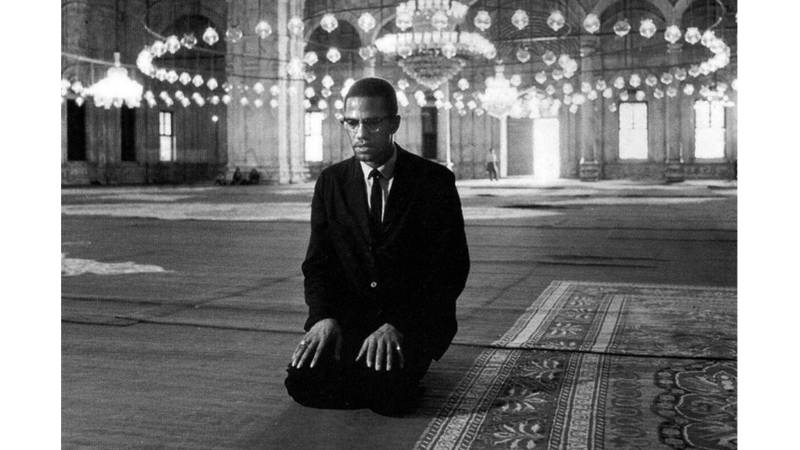
In March 1964, Malcolm X announced he was officially leaving the Nation of Islam, and the following month flew to Saudi Arabia to perform the Hajj. There, he said, he experienced a "spiritual rebirth."[68] He was now face to face with the diversity of the Muslim world, including people from Europe such as Bosnians and Albanians.[69] In a letter he wrote from Jeddah, Saudi Arabia, he described the experience:
"Never have I witnessed such sincere hospitality and the overwhelming spirit of true brotherhood as is practiced by people of all colors and races here in this ancient holy land, the home of Abraham, Muhammad and all the other prophets of the Holy Scriptures…There were tens of thousands of pilgrims from all over the world. They were of all colors, from blue-eyed blonds to black-skinned Africans, but were all participating in the same ritual, displaying a spirit of unity and brotherhood that my experiences in America had led me to believe could never exist between the white and non-white…Before America allows herself to be destroyed by the ‘cancer of racism’ she should become better acquainted with the religious philosophy of Islam, a religion that has already molded people of all colors into one vast family, a nation or brotherhood of Islam."[70]
For the remainder of 1964, Malcolm X travelled widely in Africa and the Middle East, meeting many heads of state and ordinary people alike, and holding frequent public speeches, including to national parliaments, and media events. He had the opportunity to meet and learn from some of the titans of the postcolonial world, figures like Gamal Abdel Nasser of Egypt, Julius Nyerere of Tanzania, Jomo Kenyatta of Kenya, Kwame Nkrumah of Ghana, Ahmed Sékou Touré of Guinea, and Faisal of Saudi Arabia.
In Africa, he learned that many people did not share the anti-Western and anti-white sentiments he had possessed—as he assumed they would—and that racism was a broader problem of intolerance and hatred of members of one group for another which was global. He observed, "If there is any anti-European feeling it is directed at individuals—it’s not a collective feeling. I was quite shocked."[71] In his journeys and meetings with heads of state, "I realized racism isn’t just a Black and white problem. It’s brought bloodbaths to about every nation on earth at one time or another."[72] Malcolm X also noted that Muslims he met had informed him that descendants of the Prophet of Islam, who are highly regarded in Islamic society, "were both black and white."[73]
Malcolm X even decided to stop using the phrase "Black nationalism" after an Algerian diplomat whom he respected asked him the following question: if Malcolm X’s programme was Black nationalism, and as an Algerian he appeared white, "where did that leave him?" The diplomat, Malcolm X explained, "showed me where I was alienating people who were true revolutionaries dedicated to overturning the system of exploitation that exists on this earth by any means necessary."[74]
Malcolm X concluded, "The true Islam has shown me that a blanket indictment of all white people is as wrong as when whites make blanket indictments against blacks."[75] He also determined that Elijah Muhammad, as Malcolm X stated, "was teaching the same form of segregation that the Ku Klux Klan and these other racists in the South teach."[76] He announced, "I totally reject Elijah Muhammad’s racist philosophy."[77] Malcolm X expressed regret for some of his previous attitudes, behaviours, and statements, including, he specifically mentioned, his comments on the plane crash in France,[78] and the incident where he dismissed the white college student: "I’ve lived to regret that incident."[79] "I wish that now I knew her name, or where I could telephone her, or write to her," he said, and noted, "In many parts of the African continent I saw white students helping Black people…I did many things as a Muslim that I’m sorry for now."[80]
The embrace of Malcolm X, now also known as El-Hajj Malik el-Shabazz, by the Islamic world could be seen in the honours he was bestowed by senior religious authorities. The Makkah-based Muslim World League designated Malcolm X as official representative to the United States, and Sheikh Hassan Ma’moun, the rector of Al-Azhar University in Egypt, the most prestigious in the Islamic world, accredited Malcolm X with a "duty to propagate Islam and offer every available assistance and facilities to those who wish conversion to Islam."[81] Sheikh Muhammad Harkon, the Saudi judge of the Hajj Committee Court, gave Malcolm X a mission he took seriously: "He told me, ‘I hope you will become a great preacher of Islam in America.’ I said that I shared that hope, and I would try to fulfill it."[82]
Malcolm X on God and Unity
As a Mingler, Malcolm X’s philosophy centred on the Unity of God, the world, and the universe. As he explained, different religions have different names for this same divine Unity, the One who created the universe. This universal creator is the same in Islam and Christianity, Malcolm X attested, with "the only difference being you call him God and we call him Allah. The Jews call him Jehovah. If you could understand Hebrew, you would probably call him Jehovah too. If you could understand Arabic, you would probably call him Allah."[83]
The nature of divine unity, Malcolm X argued, also means that there is unity among what he called "the Human Family of Mankind."[84] All people constitute "one family, brothers, sisters to each other."[85] And if another person is harmed, one’s self is also harmed, because all are part of the same Unity. As Malcolm X wrote, "because the True Believer recognizes the Oneness of all humanity the suffering of others is as if he himself were suffering, and deprivation of the human rights of others is as if his own human rights (right to be a human being) were being deprived."[86] For Malcolm X, the experience of the Hajj was a physical manifestation of the nature of the Unitary Reality. There, he said, "All ate as One, and slept as One. Everything about the pilgrimage atmosphere accented the Oneness of Man under One God."[87]
The Hajj also introduced an element of human experience that had been missing from Malcolm X’s life and perspective: the notion of pursuing an ideal. In his own case, nothing in his experience "had served to give me any idealistic tendencies."[88] Instead he "automatically examined the reasons, the motives, of anyone who did anything they didn’t have to do for me," and particularly if he was dealing with a white person—there was always a selfish motive to be unearthed.[89] On the Hajj, this was not the case. There, he observed, it was possible to give and receive the ideals of love and compassion in a state of equality. Malcolm X noted that on the Hajj, "Love, humility, and true brotherhood was almost a physical feeling wherever I turned."[90] He thus experienced these human values in both words and deeds—not only in words.[91]
A second insight that Malcolm X received on the Hajj concerned human groups. While he perceived a common Unity among the pilgrims, he also observed that they did not simply dissolve into the Unity without distinction. People who felt similar to one another tended to group together and were happy among themselves. Malcolm X noted that there was no compulsion in people congregating in such group identities, it simply occurred: "Africans were with Africans. Pakistanis were with Pakistanis. And so on."[92] Thus, in an environment where there was "no ‘superiority’ complex" and enforced social segregation, "voluntarily, naturally, people of the same kind felt drawn together by that which they had in common."[93]
After the Hajj, Malcolm X’s personal life was altered as his heart was opened to people of all backgrounds. He attested, "Since I learned the truth in Mecca, my dearest friends have come to include all kinds—some Christians, Jews, Buddhists, Hindus, agnostics, and even atheists! I have friends who are called Capitalists, Socialists, and Communists! Some of my friends are moderates, conservatives, extremists—some are even Uncle Toms! My friends today are black, brown, red, yellow, and white!"[94] "It takes all these religious, political, economic, psychological and racial ingredients (characteristics)," Malcolm X said, "to make the Human Family and the Human Society complete."[95] The Unity of all thus encompasses a tremendous diversity, as it necessarily must.
Now operating from a perspective of Unity, he challenged the frameworks of concepts such as "integration" and "intermarriage" as almost being unnecessary or unhelpful, considering they connate the existence of separate entities: "when you are dealing with humanity as a family there’s no question of integration or intermarriage. It’s just one human being marrying another human being, or one human being living around and with another human being."[96]
He dedicated himself to fighting against racism, a pernicious threat to the Unity of the ideal he wished to pursue—and achieve. Racism, he said, is "the earth’s most explosive evil…the inability of God’s creatures to live as One."[97] And he asserted, "I’m for justice, no matter who it is for or against. I’m a human being first and foremost, and as such I’m for whoever and whatever benefits humanity as a whole."[98]
The Global and Local in Malcolm X’s Thinking
Malcolm X’s agenda after returning to the US, his mind buzzing with ideas, captures the tendency among the Minglers to promote the embrace and welfare of the world and humanity in addition to that of their own group or area. They reject any notion that one must choose between them. As Malcolm X stated, his "belief in brotherhood" and Islam’s universalist ideals "doesn’t alter the fact that I’m also an Afro-American, or American Negro as you wish, in a society which has very serious and severe race problems."[99]
In Malcolm X’s case, his approach could be seen in the two organisations he established in Harlem: Muslim Mosque, Inc. and the Organization of Afro-American Unity (OAAU). The Muslim Mosque would preach orthodox Islam in America and its ideals of human unity, while the OAAU would focus on particular issues affecting Black Americans and the Black peoples of the world. The aim of the OAAU, Malcolm X stated, "is to use whatever means necessary to bring about a society in which the 22 million Afro-Americans are recognized and respected as human beings."[100] For example, he was committed to registering "as many of our people as we can" to vote,[101] and addressing the problems of the inner cities including creating "meaningful, creative, useful activities for those who were led astray down the avenues of vice."[102] His twin initiatives intersected and overlapped with each other, but they also could be seen distinctly. Among the OAAU, Malcolm X projected himself as a Black leader and among Muslims a Muslim leader, but these two core components of his identity came together in the same Malcolm X.
As a Black organisation, the OAAU also was based in humanistic and universalist ideals. Indeed, Malcolm X affirmed, while launching the OAAU, "the Charter of the United Nations, the Universal Declaration of Human Rights, the Constitution of the United States and the Bill of Rights are the principles in which we believe…these documents if put into practice represent the essence of mankind’s hopes and good intentions."[103] He added, now associating himself with American identity, "I wish nothing but freedom, justice and equality: life, liberty and the pursuit of happiness—for all people. My first concern is with the group of people to which I belong, the Afro-Americans."[104] The Quran, he noted, "compels the Muslim world to take a stand on the side of those whose human rights are being violated, no matter what the religious persuasion of the victims is."[105] Thus we see the overlapping nature of Malcolm X’s dual programmes and concerns.
An important element of Malcolm X’s programme was promoting a global perspective, the ability to see the world as an interconnected whole with common problems such as racism and intolerance. He was a believer in the United Nations and global institutions of law and governance, and sought to take the case of Black rights before the UN because, he said, racism in the US "is a problem for humanity. It’s not a Negro problem; it’s not an American problem" but instead "a world problem."[106] This was also the response that he gave while visiting locations such as Gaza and remarking on the similarities between the struggles of Black Americans and Palestinians: "Our problem in America is a problem that is worldwide."[107] Malcolm X affirmed, "People in power have misused it, and now there has to be a change and a better world has to be built, and the only way it’s going to be built is with extreme methods. And I for one will join in with anyone, I don’t care what color you are, as long as you want to change this miserable condition that exists on this earth."[108]
On the use of violence, Malcolm X emphasised, "I do not advocate violence" and stated that violence was only justified in defence from violence.[109] Of the non-violence movement, Malcolm X stated, "I’m not criticizing those here who are nonviolent. I think everybody should do it the way they feel is best, and I congratulate anybody who can be nonviolent in the face of all that kind of action."[110] In Selma, Alabama, he personally delivered a message of support to Martin Luther King, who was then in jail, via his wife Coretta Scott King, hoping that his own approach might make it "easier for whites to accept Martin’s proposals."[111]
The Importance of Education
In some ways, Malcolm X felt that the American Civil Rights Movement was essentially putting the cart before the horse—it was demanding civil rights from people who did not view Blacks as fully human. Additionally, Blacks themselves lacked a consciousness that would empower them to love and appreciate their own identity and history and assert their full humanity, with all the rights it necessarily affords, with confidence. It is on this point of a common humanity that Malcolm X sought to unite the different sections of the Civil Rights Movement. There was much disagreement within the Black community about tactics, strategy, and the best way to achieve civil rights. But, he stated, whatever one’s stance on civil rights, "we found that all of them would agree on the necessity of our people in this country being respected and recognized as human beings."[112] Hence Malcolm X’s primary focus was on the recognition of Black human rights. As he contended, "We must have human rights before we can secure civil rights. We must be respected as humans before we can be recognized as citizens."[113]
An important element of his agenda was education, which he believed could wake up oppressed people "to their humanity, to their own worth, and to their heritage."[114] In the case of Blacks and Muslims, Malcolm X taught, there must be education of the history of African and Islamic civilisations. With knowledge of history and the great contributions of one’s people in the past, feelings of "inferiority" dissipate and are replaced by a "balanced knowledge" of oneself and confidence in one’s abilities.[115] As he put it, "As long as you can be convinced that you never did anything, you can never do anything."[116]
Speaking of the history of African and Islamic cultures, Malcolm X asserted, "Mali and Ghana and Songhai and Moorish civilization—all of these civilizations existed on the African continent before America was discovered."[117] When Europe was in the "Dark Ages," Malcolm X stated, the Moors of the Iberian Peninsula represented "the only light of learning, that existed on the European continent at that time."[118] Illustrious leaders of history such as Mansa Musa, the famed Muslim ruler of the Mali Empire in the fourteenth century, and the importance of Timbuktu, "a center of learning where they had colleges and universities," should be taught.[119] Then, of course, there were the vast achievements of ancient Egyptian civilisation.[120]
Malcolm X believed that there is a direct relationship between knowledge of the past and securing human and civil rights, because with education, the broader society gains a more accurate knowledge of the different peoples who make up the society. He argued, "If the entire American population were properly educated—by properly educated, I mean given a true picture of the history and contributions of the black man—I think many whites would be less racist in their feelings. They would have more respect for the black man as a human being."[121]
Another important element of education was an awareness of how one’s local situation is directly linked to global events. No one is isolated from the wider world. This meant that as an American, he argued, paying attention to US foreign policy is of crucial importance because the US has immense power to shape the world. Too often, it engaged in wars that made little sense and resulted in mass suffering, commonly of non-white populations that the American public must gain knowledge about. As Malcolm X put it, "I come from a country that is busily sending the Peace Corps to Nigeria while sending hired killers to the Congo…The government is not consistent; something is not right there."[122] But a person who understands the world and its interconnectedness, Malcolm X argued, "realizes that what happens in South Vietnam can affect him if he’s living on St. Nicholas Avenue, or what’s happening in the Congo affected his situation on 8th Avenue or 7th Avenue or Lenox Avenue."[123]
On the issue of Vietnam, the context and history of the conflict was crucially important to comprehend. As he argued, "If France, with all types of heavy arms, as deeply entrenched as she was in what then was called Indochina, couldn’t stay there, I don’t see how anybody in their right mind can think the U.S. can get in there—it’s impossible. So it shows her ignorance, her blindness, her lack of foresight and hindsight and her complete defeat in South Vietnam is only a matter of time."[124]
Malcolm X also stressed, as part of his programme of education, the importance of understanding how the global media operates, particularly in shaping public opinion, including concerning foreign policy. If one observes intelligently, they will detect longstanding racist and imperialist narratives which still heavily influence how people see the world. "The press is so powerful in its image-making role," he argued, "it can make a criminal look like he’s the victim and make the victim look like he’s the criminal…If you aren’t careful, the newspapers will have you hating the people who are being oppressed and loving the people who are doing the oppressing."[125]
In the Congo, for example, Malcolm X observed that when the locals are discussed, they are described as savages or cannibals.[126] This meant that if they are bombed, as was occurring at the time by American planes, the public would not sympathise or identify with them.[127] On the other hand, the American public sees its own "side" as humane, and "As long as they’re American planes, that’s humanitarian."[128] Also, when non-whites die in such countries, the press often does not report it, but when whites are threatened, the press will raise alarm and concern. We have seen in such cases, Malcolm X said, that "a white life, one white life, was of such greater value than a Black life, than a thousand Black lives."[129]
Another matter of extreme urgency for Malcolm X was communicating the dire situation of America’s urban ghettos, which he characterised as essentially a ticking time bomb. Blacks were living in what he called a "police state,"[130] and were no longer "willing to suffer brutality at the hands of someone just because he has on a uniform."[131] He warned, "It takes no one to stir up the sociological dynamite that stems from the unemployment, bad housing, and inferior education already in the ghettoes. This explosively criminal condition has existed for so long, it needs no fuse; it fuses itself; it spontaneously combusts from within itself."[132] The situation demanded, he urged, "real meaningful actions, sincerely motivated by a deep sense of humanism and moral responsibility to remove once and for [all] the very basic causes that produce the ‘materials’ for these explosive conditions."[133]
Malcolm X’s Lessons for the World
At the end of his life, Malcolm X was in a state of agitation. Though his perspective and outlook had undergone substantial transformations, he told Alex Haley, he was aware that "no one wanted to accept anything relating to him except ‘my old “hate” and “violence” image.’ He said ‘the so-called moderate’ civil-rights organizations avoided him as ‘too militant’ and the ‘so-called militants’ avoided him as ‘too moderate.’"[134] He exclaimed, "I’m caught in a trap!"[135] He was under relentless pressure from sources including the Nation of Islam and the American security services, who viewed him as a dangerous radical. Muhammad Speaks, the Nation of Islam’s newspaper established by Malcolm X, ran a drawing of his severed head with devil horns bouncing on the ground.[136]
Malcolm X understood that he had been marked for death, and noted in his Autobiography, "If I’m alive when this book comes out, it will be a miracle."[137] He stated, "I know that societies often have killed the people who have helped to change those societies. And if I can die having brought any light, having exposed any meaningful truth that will help to destroy the racist cancer that is malignant in the body of America—then, all of the credit is due to Allah."[138] "Sometimes," he said, "I have dared to dream to myself that one day, history may even say…my voice helped to save America from a grave, possibly even a fatal catastrophe."[139] "It’s a time for martyrs now," he affirmed, "And if I’m to be one, it will be in the cause of brotherhood."[140]
On the 14th of February 1965, his house was firebombed, with he, his wife, and their four young children inside. While they survived this attack, his predicted death came a week later as he addressed a meeting of the OAAU in Harlem. While two Nation of Islam members created a diversion in the crowd, three other Nation of Islam members opened fire on Malcolm X, killing him in a hail of bullets in front of his family.[141]
Our world today, like Malcolm X’s, is in turmoil and full of hatred and conflict. Given this reality, we can gain guidance from Malcolm X. As he said, "Whether you go to church, the mosque, the synagogue, or are just a plain atheist and go to the pool room, or someplace else, there’s one thing that everyone has to agree upon, and that is that the world is in trouble."[142]
Across the decades, his words reach us with a forceful clarity and give us a direction to proceed. We have already heard Malcolm X’s exhortations to seek and acquire knowledge about the world, its peoples, and their histories and their great contributions to human knowledge and culture. Malcolm X’s own insatiable curiosity and thirst for knowledge leaps off the pages of his Autobiography, where he notes, "People don’t realize how a man’s whole life can be changed by one book."[143] We have also heard of the importance he placed in being conscious of a humanistic and unitary ideal, while also having a clear-eyed awareness of our human reality, and being motivated to change it in accordance with the ideal.
In terms of politics and leadership, Malcolm X called on politicians and governments to lead not with raw power or force, but with what he called "spirit": "the true criterion of leadership is spiritual. Men are attracted by spirit. By power, men are forced. Love is engendered by spirit. By power, anxieties are created…The only true world solution today is governments guided by true religion—of the spirit."[144]
For us as individuals, Malcolm X advises, "see for yourself and listen for yourself and think for yourself. Then you can come to an intelligent decision for yourself."[145] Even with the distortions of the media, he counsels, "Read everything…You never know where you’re going to get an idea."[146] He also savoured and urged intellectual debate, affirming, "I think all of us should be critics of each other. Whenever you can’t stand criticism you can never grow."[147] In terms of relations between Blacks and whites, Malcolm X said both "have to be able to sit down at the same table. The white man has to feel free to speak his mind without hurting the feelings of that Negro. And the so-called Negro has to feel free to speak his mind without hurting the feelings of the white man. Then they can bring the issues that are under the rug out on top the table and take an intelligent approach to get the problem solved."[148]
If possible, he additionally advised, we should travel, given the impact that travelling to visit other cultures and peoples had on his life. "Travel broadens your scope," he attested, as well as "one’s soul."[149] The education we gain through travel enables us to grow as human beings. In the case of his experiences during the Hajj, Malcolm X said, "they…broadened my mind…my scope…my outlook."[150] "I pray that you will grow intellectually," he told youth activists, "so that you can understand the problems of the world and where you fit into, in that world picture. And I pray that all the fear that has ever been in your heart will be taken out."[151]
For Americans, the challenge is to work to make the nation that which Malcolm X believed it could be, in accordance with its humanistic egalitarian ideals: "if racism could be removed, America could offer a society where rich and poor could truly live like human beings."[152] And globally, Malcolm X asserted, "America has the wealth and the technical know-how and equipment to turn the world into a paradise, if ever the people in the power structure become moralists and humanists (i.e. morally obligated to help humanity). With world power goes world responsibility and obligation."[153]
Crucial to this sense of morality is a vision of the common Unity, and if Americans "could accept the Oneness of God, then perhaps, too, they could accept in reality the Oneness of Man."[154] We can apply this lesson beyond Americans and the white population to all human beings, keeping in mind the Minglers’ focus on viewing all of humanity in a single framework.
Despite the challenges ahead, Malcolm X called on us to help build "a society in which people can live like human beings on the basis of equality."[155] He was confident, as he said, that "it is possible for brotherhood to be brought about among all people."[156]
The cycle had been completed: the man who had been driven by racial animosity and lived on the fringes of society and the law had found his destiny and ended by preaching unity and harmony.
References
- ^ Aina Khan, “When Malcolm X visited Smethwick after racist election,” Al Jazeera, the 21st of February 2018.
- ^ Malcolm X and Alex Haley, The Autobiography of Malcolm X (New York: Ballantine Books, 1973), pp. 377, 394.
- ^ H Bruce Franklin, ed., Prison Writing in 20th-Century America (New York: Penguin Books, 1998), p. 147.
- ^ See, for example, Neetha Rani P, “The Legacy of Malcolm X: Unabating Influence on Black Lives Matter,” Journal of African American Studies, vol. 30, no. 2, 2026, pp. 233–253.
- ^ Zerline A Hughes, “Black Heritage Stamp to Honor Malcolm X,” Los Angeles Times, the 27th of December 1998.
- ^ Alex Haley, “Epilogue.” In Malcolm X and Alex Haley, The Autobiography of Malcolm X (New York: Ballantine Books, 1973), pp. 467, 475.
- ^ Haley, “Epilogue,” p. 475.
- ^ Louis A DeCaro, Jr, Malcolm and the Cross: The Nation of Islam, Malcolm X, and Christianity (New York: New York University Press, 1998), p. xi.
- ^ See, for example, Peniel E Joseph, The Sword and the Shield: The Revolutionary Lives of Malcolm X and Martin Luther King Jr (New York: Basic Books, 2020).
- ^ Malcolm X and Haley, The Autobiography of Malcolm X, p. 3.
- ^ Malcolm X and Haley, The Autobiography of Malcolm X, p. 13.
- ^ Malcolm X and Haley, The Autobiography of Malcolm X, p. 43.
- ^ Malcolm X and Haley, The Autobiography of Malcolm X, p. 51.
- ^ Malcolm X and Haley, The Autobiography of Malcolm X, p. 155.
- ^ Malcolm X and Haley, The Autobiography of Malcolm X, p. 159.
- ^ Malcolm X and Haley, The Autobiography of Malcolm X, p. 177.
- ^ Malcolm X and Haley, The Autobiography of Malcolm X, p. 184.
- ^ Malcolm X and Haley, The Autobiography of Malcolm X, p. 10.
- ^ Malcolm X and Haley, The Autobiography of Malcolm X, p. 200.
- ^ Malcolm X and Haley, The Autobiography of Malcolm X, p. 206.
- ^ Malcolm X and Haley, The Autobiography of Malcolm X, p. 199.
- ^ Malcolm X and Haley, The Autobiography of Malcolm X, p. 189.
- ^ Malcolm X and Haley, The Autobiography of Malcolm X, p. 189.
- ^ Malcolm X and Haley, The Autobiography of Malcolm X, p. 229.
- ^ Bruce Perry, ed., Malcolm X: The Last Speeches (New York: Pathfinder, 1989), p. 65.
- ^ Malcolm X, By Any Means Necessary (New York: Pathfinder, 1992), p. 27.
- ^ Haley, “Epilogue,” p. 472.
- ^ Malcolm X and Haley, The Autobiography of Malcolm X, p. 334.
- ^ Ilyasah Al-Shabazz, “Epilogue.” In Herb Boyd and Ilyasah Al-Shabazz, eds., The Diary of Malcolm X (El-Hajj Malik El-Shabazz) 1964 (Chicago: Third World Press, 2013), p. 182.
- ^ DeCaro, Jr, Malcolm and the Cross, p. 98.
- ^ Malcolm X and Haley, The Autobiography of Malcolm X, p. 343.
- ^ Malcolm X and Haley, The Autobiography of Malcolm X, p. 106.
- ^ Alex Haley, “The Playboy Interview with Malcolm X,” Playboy, May 1963: https://www.playboy.com/read/entertainment-culture/the-playboy-interview-with-malcolm-x/?srsltid=AfmBOoqLMN14Rul5Ci6WJYYis9NjSt2BbcGYNsUVcqZkZauxTuPRymRu
- ^ “Malcolm X Speaks at Ronald Stokes Memorial Rally in Los Angeles on May 5, 1962,” YouTube.com, Activist News Network, the 18th of February 2025: https://www.youtube.com/watch?v=NtGrG5Dnl_8
- ^ Malcolm X and Haley, The Autobiography of Malcolm X, p. 328.
- ^ Malcolm X, The End of White World Supremacy: Four Speeches. Edited by Imam Benjamin Karim. (New York: Arcade Publishing, 1971), p. 66.
- ^ Malcolm X, The End of White World Supremacy, p. 88.
- ^ Malcolm X, The End of White World Supremacy, p. 109.
- ^ Malcolm X, The End of White World Supremacy, p. 70.
- ^ Malcolm X, The End of White World Supremacy, p. 83.
- ^ Malcolm X, The End of White World Supremacy, p. 98.
- ^ Malcolm X, The End of White World Supremacy, p. 88.
- ^ Malcolm X,