

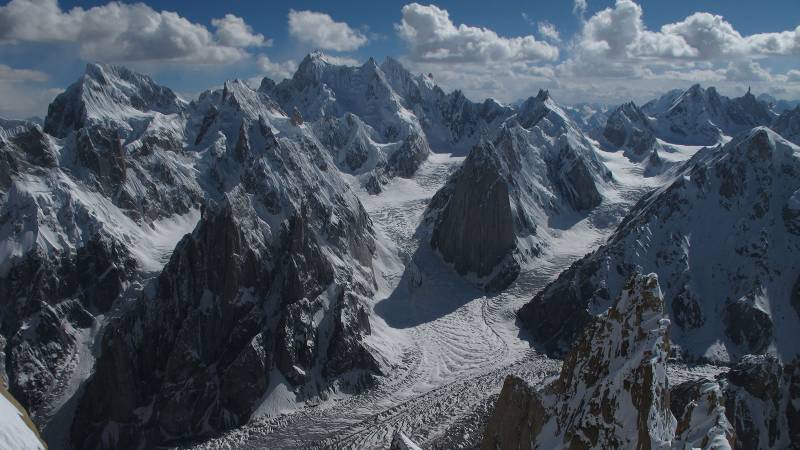
When we speak of the Earth’s atmosphere and climate system, we often focus on the air, oceans, and land. Yet there’s a fourth, often overlooked but incredibly critical component: the cryosphere—the frozen parts of our planet, including glaciers, ice caps, snow cover, permafrost, and frozen ground. This icy realm doesn’t just help regulate the planet’s temperature by reflecting sunlight and keeping Earth cool—it also serves as a time capsule, storing atmospheric gases, including carbon content from thousands of years ago, offering scientists vital clues about Earth’s climate history.
What’s truly fascinating—and deeply relevant for Pakistan—is that our country possesses one of the world’s most unique and strategically important cryospheric systems. From the towering peaks of the Karakoram and Himalayas to the vast glaciers feeding the mighty Indus River, Pakistan’s cryosphere is not only ecologically and hydrologically vital, but also geopolitically significant, especially in the context of climate change and water security along the China-Pakistan Economic Corridor (CPEC).
It was with this background that I had the honor of participating in the International Training Workshop on Climate Change and Water Safety Effects along CPEC, held from April 9 to 14, 2024, at the Pakistan Academy of Sciences (PAS) in Islamabad. This intensive, five-day event brought together top cryosphere scientists from the Chinese Academy of Sciences and Pakistani climate experts to delve into the changing dynamics of our frozen frontiers.
The cryosphere is not just frozen water—it is our memory, our future, and our warning
As someone who has worked in climate and environmental fields for over two decades, I thought I had seen most of the climate-related challenges. But this training was an eye-opener. I was in awe—I had no idea how deeply the cryosphere influences our climate, ecosystems, and water systems. The team of highly learned scientists from China shared in-depth, cutting-edge knowledge with great clarity and passion. It was an overwhelmingly rich experience, intellectually and professionally.
The sessions covered everything from glacial change and permafrost dynamics to cryospheric chemistry and space-based monitoring of glaciers. Prof. Dr. Kang Shichang initiated the training with a powerful talk on “Climate and Cryospheric Changes,” followed by experts like Dr. Zhang Yaonan, Dr. Wu Xiaodong, and Dr. Zhang Yulan, who took us deep into topics such as cryospheric disasters, hydrology, glacier retreat, and chemical processes within the ice.
One of the standout lessons for me was the idea that cryospheric change is not isolated—it ripples across entire ecosystems and river basins, directly influencing water availability, agriculture, disaster risks, and long-term sustainability.
The significance of the training was heightened by its direct relevance to Pakistan’s climate vulnerabilities. Our glaciers are among the fastest-melting in the world. The Indus River—lifeline to Pakistan’s agriculture and population—is fed by these glaciers and snowpacks. Yet, until now, cryosphere science has received limited attention in national climate planning.
Sessions by Pakistani experts like Dr. Muhammad Naveed Anjum and Dr. Gulraiz Akhter connected the dots between extreme climate events, changing river flows, and the urgent need to integrate cryospheric data into our climate adaptation and water governance frameworks.
The training emphasised the need for regional cooperation, cross-border data sharing, and enhanced local capacity to monitor and manage our cryospheric resources. As part of the CPEC initiative, this becomes even more crucial, given the infrastructure development occurring in environmentally fragile mountain areas.
I returned from the training not only with a notebook full of scientific insights but also with new ideas, renewed curiosity, and a strong sense of responsibility. Cryospheric knowledge must be mainstreamed—not just within scientific circles but also in policymaking, education, and public discourse.
Our glaciers are melting. Our rivers are shifting. But with knowledge, collaboration, and swift action, we can still protect what remains. The cryosphere is not just frozen water—it is our memory, our future, and our warning.
“My heart trembled, hearing centuries of stories buried in the ice;
Knowledge revealed a vision my eyes had never imagined.”