

The word “genocide,” coined by Polish lawyer Raphael Lemkin in 1944, has lost its pain due to its live transmission on our TV screens. This op-ed is certainly not about the “alleged” genocide in Gaza, because I do not wish to diminish my chances of getting a US visa. Also, I am not Mamdani. Above all, if Malala is so cautious about this and the rest of the living Nobel Peace laureates are silent, I have no responsibility to take up the issue. I wouldn’t even get three minutes of fame out of it. All the hype is destined for Roy, Thunberg, and now Albanese. Therefore, this matter is not for me.
I have already “wasted” my best years in “unpaid and unacknowledged activism” in Pakistan. I was such a fool that during my stay in Amsterdam for my post-graduation, I used to watch on BBC the tyrannies of Albanian Muslims and the Kosovo genocide, besides visiting the Anne Frank House and spending my guilders buying her books and videos. I used to cry about the Jewish Holocaust, and when in New York, I visited the Holocaust Museum to show my humanity. While attending fellowships by the United Nations, I found it difficult to detach from the horrific images of the 1994 Rwandan genocide — the country where the first conviction for genocide occurred after it was recognised as an international crime in 1948, when the United Nations adopted the Convention on the Prevention and Punishment of the Crime of Genocide.
Perhaps Rwanda was “lucky” compared to many others. For example, Bosnia, where in 1995 over 8,000 Muslim men and boys were executed in Srebrenica, and it took years for the term “genocide” to be applied by international courts; Darfur, in the early 2000s, where hundreds of thousands were slaughtered while the UN hesitated to use that same term; or the Rohingya in Myanmar. The “civilised” world eventually conceded the carnage, even if justice remains unconvincing. In an era where might is right is the ultimate order of the day, and the wisest act is to abandon all moral convictions, I repeatedly struggle to detach my heart, mind, and spirit from the abandonment of my community by Pakistan and the stigma placed upon them by Bangladesh.
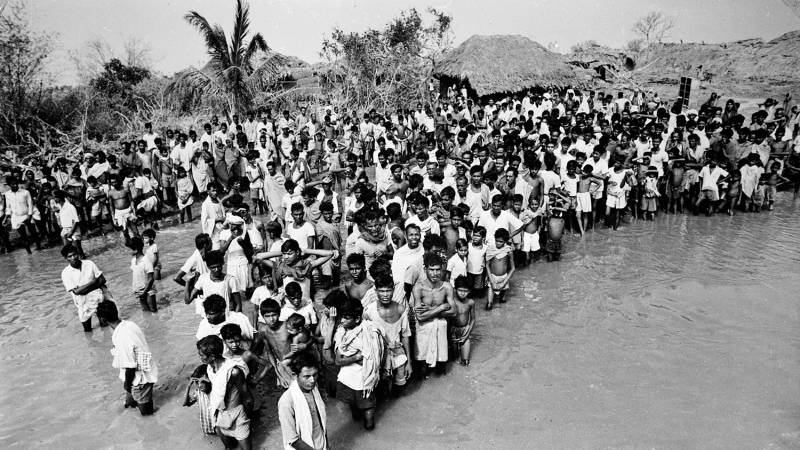
Without rebuffing the injustices borne by Bengalis in the Eastern province — which constituted 56% of Pakistan — it remains a reality that the wrath of the Bengali freedom fighters, or Mukti Bahinis, was not directed against the elites who mistreated them, but callously targeted the pro-Pakistani, non-Bengali Urdu speakers — largely consisting of Bihari Muslims. The genocide of this community in 1971 is different from the more documented tragedies, not because it was less ferocious, but because it was deliberately rendered invisible, principally due to five factors.
As of this 14 August, 19,884 days of an undocumented and ongoing genocide will have lapsed, counted from 7 March 1971, the day Jinnah’s Pakistan was gangrened
First, it was strategic, not accidental. Different lobbies operated diligently to conceal this chapter. Unlike the more publicly documented accounts of violence against pro-liberation and anti-Pakistan Bengalis by the Pakistan Army — some of which may be exaggerated or contested — the mass killings of pro-Pakistan civilians, including women and children from the Urdu-speaking community, were largely hidden from global attention.
Second is the refusal by international institutions, journalists, and human rights bodies to classify these killings and ethnic cleansings as genocide. It did not suit dominant political narratives to view these stateless people as victims.
Third is the branding of this group as “traitors,” “collaborators,” or “outsiders.” The alleged or actual atrocities by the Pakistan Army — though many myths have now been debunked — have been used by Bangladesh and by proponents of Hasina Wajid, including those in present-day Pakistan, to tirelessly promote a one-sided account of the “genocide” of Bengalis, flattening the complexity of a merciless civil war. The fact remains that pro-Pakistani Muslims were massacred by their own Muslim Bengali brothers, who had become Mukti Bahinis — a Bengali nationalist militia supported by the Indian government.
Fourth is a moral failure. The silence of Pakistani intellectuals, artists, writers, poets, activists, and feminist champions is “criminal” to me. Many who speak eloquently about Palestine, Kashmir, and the rights of minorities have chosen to disregard the plight of these stranded Pakistanis. The selectivity of empathy is its own form of complicity.
Fifth, a propaganda plot has taken root — that the stranded Biharis and other non-Bengali Urdu speakers are now Bangladeshi citizens and that their suffering ended long ago. This is a precarious lie. In 2008, a petition filed by a handful of Bengali youth led to a limited court ruling granting voting rights, not full citizenship, to a small group of Biharis born after 1971. That narrow legal interpretation has since been weaponised to claim that the problem is solved. It is not. Properties of Biharis are still classified and treated as “enemy property.” Repatriation froze decades ago. No moral, financial, or legal compensation has ever been extended to these five generations of stateless, abandoned people who remain caged in 7x7 squalid “camps.” They are denied the right to choose, the capability to sustain, and dignity — the core values of human development. The youth have inherited not only poverty of income and opportunity but also the disgrace of being born unwanted by both countries.
As of this 14 August, 19,884 days of an undocumented and ongoing genocide will have lapsed, counted from 7 March 1971, the day Jinnah’s Pakistan was gangrened (its official amputation came on 16 December 1971). So what? Australia took over two centuries to accept in 2008 that its colonisation of Indigenous peoples was genocidal. This 14 August, as the nation celebrates its 78th Independence Day with renewed vigour following the recently won war against India, I see myself praying for the inculcation of empathy among Pakistanis.
I wonder if we can ever truly stand with humanity. Because if we only stand up for our own, then we are not moral — merely tribal. In the slaughterhouse of genocide, truth is the first fatality. Its resurrection takes time. Some truths emerge late; others never surface at all. Some roar; others remain buried in the ruins of biased political writings.
I hope that whenever it does reach Pakistan, it finds its youth cognisant of this real, yet undocumented, genocide.