

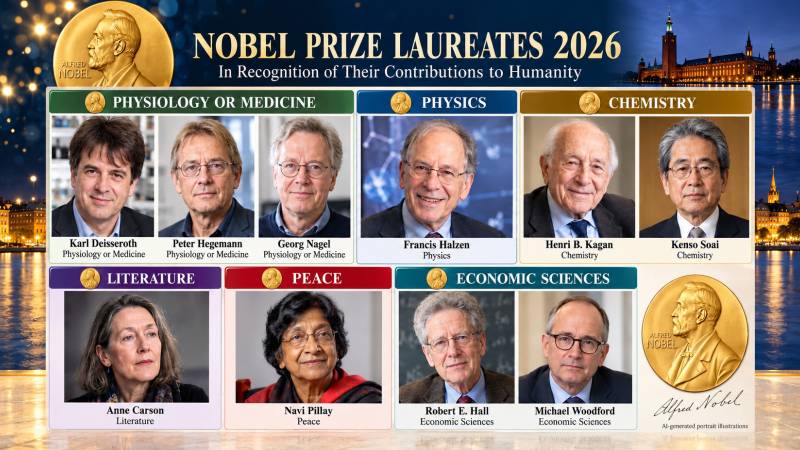
Every year, the announcement of the Nobel Prizes brings scientists, writers, economists and advocates of peace into the global spotlight. Newspapers, television channels and social media celebrate individuals whose research, creativity and humanitarian contributions have advanced human understanding. The true greatness of these awards, however, lies not in their gold medals, international fame or monetary value, but in their recognition of contributions that make human life healthier, safer, more enlightened and prosperous.
The Royal Swedish Academy of Sciences selects recipients in Physics, Chemistry and Economic Sciences. The Nobel Assembly at Karolinska Institute selects the Medicine laureates, while the Swedish Academy chooses the Literature laureate. The Norwegian Nobel Committee decides the Peace Prize. The awards are formally presented on 10 December, the anniversary of Alfred Nobel’s death. Five categories are presented in Stockholm, Sweden, while the Peace Prize ceremony takes place in Oslo, Norway. A Nobel Prize includes a medal, a diploma and monetary recognition. When multiple laureates share a prize, the monetary award is divided according to the arrangements determined for that category. The amount may change over time. The awards have established themselves as among the world’s most respected international honours, although their history also demonstrates that recognition is not immune to controversy.
Several Peace Prize recipients have faced substantial criticism over their subsequent actions or broader political records. Henry Kissinger received the 1973 Peace Prize for efforts to negotiate a ceasefire in Vietnam, despite intense criticism of his role in American military operations, including the bombing of Cambodia. Two Nobel Committee members resigned in protest. Barack Obama received the award in 2009 in recognition of his efforts to strengthen international diplomacy. Nevertheless, military operations in Afghanistan and drone strikes continued during his presidency.
Aung San Suu Kyi, awarded the Peace Prize in 1991 for her struggle for democracy, later faced international condemnation over her response to atrocities against Rohingya Muslims in Myanmar. Ethiopian Prime Minister Abiy Ahmed received the 2019 Peace Prize for his efforts to achieve peace with Eritrea, but a devastating conflict subsequently erupted in Ethiopia’s Tigray region. These cases do not negate the importance of genuine peace initiatives. They do, however, raise a fundamental question: should the award recognise a specific achievement, or should it also consider a recipient’s broader record on human rights and lasting peace? The question is particularly important because political circumstances change, and the consequences of a leader’s decisions may become apparent only years after the award has been presented.
The true greatness of these awards lies neither in the gold medals, international fame nor the millions of rupees awarded to the winners. Rather, it lies in the discoveries and contributions that make human life safer, healthier, more enlightened and prosperous.
Women have made extraordinary contributions across all six Nobel categories, although they remain underrepresented among laureates. Marie Curie remains one of the most celebrated examples. She received the Nobel Prize in Physics in 1903 and Chemistry in 1911, becoming a pioneering figure in scientific research and an inspiration for generations of women. Her achievements demonstrate that intellectual excellence is not confined by gender. Yet the continued imbalance in Nobel recognition reflects broader inequalities in access to education, research funding, academic leadership and professional opportunities. Recognising women’s achievements is therefore not simply a matter of celebrating individual success. It also highlights the importance of creating institutions in which talent can flourish regardless of gender or social background.
South Asia has produced several distinguished Nobel laureates. Among them are Rabindranath Tagore, awarded the Literature Prize in 1913; C. V. Raman, awarded the Physics Prize in 1930; and Dr Abdus Salam, who received the Physics Prize in 1979 and became Pakistan’s first Nobel laureate. Other prominent figures include Mother Teresa, awarded the Peace Prize in 1979; Amartya Sen, who received the Economics Prize in 1998; Muhammad Yunus and Grameen Bank, jointly awarded the Peace Prize in 2006; Malala Yousafzai and Kailash Satyarthi, jointly awarded the Peace Prize in 2014; and Abhijit Banerjee, who received the Economics Prize in 2019. Some laureates were born in South Asia but pursued their careers abroad, illustrating the international nature of scientific and intellectual achievement. Their successes also demonstrate the region’s considerable human potential. Yet an important question remains: why has South Asia, particularly Pakistan, produced relatively few Nobel laureates in scientific disciplines? The answer is not a shortage of intelligence. It lies largely in the conditions under which talent is developed and research is conducted.
Pakistan’s scientific future depends on addressing persistent weaknesses in its education and research systems. These include inadequate research funding, insufficiently equipped laboratories, weak institutional support, limited academic freedom and the migration of talented researchers to countries offering better opportunities. An education system heavily dependent on memorisation compounds the problem. Students may learn textbook definitions and pass examinations without acquiring the practical skills needed to investigate unfamiliar problems, test hypotheses or develop original ideas.
Scientific progress requires curiosity, experimentation and the freedom to question established assumptions. Where laboratories are unavailable or poorly equipped, and where students are discouraged from independent thinking, the conditions necessary for discovery remain limited. Pakistan must therefore prioritise modern laboratories, well-funded universities, research partnerships and merit-based appointments. Scientists need reliable financial support, access to advanced equipment and opportunities to collaborate with international research communities. Academic freedom is equally important. Researchers must be able to investigate difficult questions, challenge prevailing ideas and publish findings without inappropriate interference. Institutions should evaluate scholars on the quality, originality and impact of their work rather than simply counting publications. The same principles apply to the humanities and social sciences. A society needs writers, historians, philosophers and economists who can examine its assumptions, challenge injustice and develop new ways of understanding its problems.
The relative scarcity of Nobel laureates in scientific fields from many Muslim-majority countries has prompted considerable debate. However, religious identity alone cannot explain these differences, and estimates of laureates’ religious backgrounds vary depending on whether classification is based on personal beliefs, family background or cultural identity. Structural factors offer a more useful explanation. Inadequate research investment, weak universities, political instability, restrictions on intellectual freedom and the migration of talented scholars have constrained scientific development in several countries.
The intellectual history of the Muslim world includes remarkable figures such as Ibn al-Haytham, Al-Biruni, Al-Khwarizmi and Ibn Sina. Their achievements demonstrate a tradition of observation, mathematics, medicine and philosophical inquiry. The challenge today is to transform pride in this historical legacy into a living culture of scientific reasoning and original research. Historical accomplishments cannot substitute for modern laboratories, rigorous education and sustained investment. Pakistan must also resist the temptation to measure scientific success through national prestige alone. The objective should be to develop knowledge that improves lives, solves practical problems and contributes to humanity.
Modern medicines, computers, mobile phones and artificial intelligence are part of everyday life. Yet the scientific discoveries underlying these technologies often emerge from research conducted decades earlier. The work of generations of scientists demonstrates that discovery requires patience, sustained investment and institutional confidence. Some research produces immediate results; other investigations yield their greatest benefits only after many years. Scientific research should therefore not be treated as an unnecessary financial burden. It is an investment in future generations.
Pakistan should encourage students to experiment, make observations, ask questions and learn from failure. Universities should strengthen research collaboration, provide modern facilities and establish transparent systems for evaluating academic performance. Government, industry and educational institutions must work together to turn research into practical benefits for society. Alfred Nobel’s legacy offers a powerful lesson: human greatness should not be measured merely by wealth, political authority or public recognition, but by contributions that improve the lives of others. Behind every major discovery stand not only extraordinary minds, but also societies and institutions that allow those minds to question, experiment and learn. If Pakistan wishes to produce internationally recognised scientists, writers and intellectuals, it must first create an environment in which knowledge is valued, creativity is encouraged and talent receives a fair opportunity to flourish. Nobel Prizes are not won through national aspirations alone. They emerge from intellectual freedom, decades of dedicated effort and extraordinary contributions to humanity. The real task is not simply to win a Nobel Prize, but to build a society in which discoveries worthy of such recognition can emerge.