

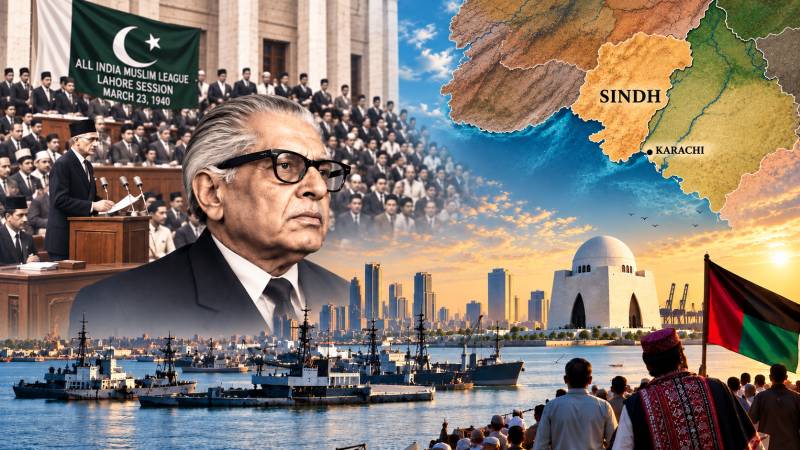
Famous politician, diplomat, and intellectual par excellence, Pir Ali Mohammad Shah Rashdi, recalls in his autobiography Uhe Deenhan, Uhe Sheenhan that he was one of the principal drafters of the All India Muslim League resolution passed on March 23, 1940, in Lahore, the resolution that later came to be known as the Lahore Resolution, or Qaraardaad‑i‑Pakistan. The second paragraph of that historic resolution stated: “…that the areas in which the Muslims are numerically in a majority, as in the North‑Western and Eastern Zones of India, should be grouped to constitute ‘Independent States’ in which the constituent units shall be autonomous and sovereign.” Relying on the promises embedded in this resolution, G. M. Syed, today condemned as a traitor by Pakistan’s self‑appointed guardians, but then a member of the Central Committee/Council of the All India Muslim League and President of its Sindh Chapter presented a resolution in the Sindh Legislative Assembly on March 3, 1943.
G. M. Syed’s resolution, which paved the way for Sindh to join the proposed Dominion of Pakistan, declared: “This House recommends to the government to forward to His Majesty’s Government for the adoption of His Majesty in Council that this province of Sindh, forming a separate dominion as an independent sovereign state, adopted in exercise of its inherent and inalienable right, has joined and been admitted as a sovereign state constituting the Dominion of Pakistan.” However, as soon as the country came into being, the intentions of the first Establishment changed. It began evicting and harassing the indigenous population of Sindh’s largest city, Karachi, a city it had borrowed from Sindh as the temporary capital of the newly formed state.
Sensing the predatory designs of the Establishment, the Sindh Legislative Assembly passed a historic private member’s resolution on February 10, 1948, strongly opposing the central government’s plan to detach Karachi from Sindh and convert it into a Federal Capital Territory (FCT). The central government, however, brazenly ignored the Sindh Assembly’s explicit resolution and went ahead, declaring Karachi the Federal Capital Territory in July 1948 through The Pakistan (Establishment of the Federal Capital) Order, 1948, issued by the Governor‑General.
The solution, in the rulers’ eyes, is simple: divide them into smaller pieces and rule them. It is far easier to point a gun at a weaker, fractured target and molest it.
Recent times have thoroughly debunked the aura of intelligence and wisdom worn by many an Apollo, the Greek god of reason — in Pakistan. The latest claptrap comes from Mr. Anwar Mansoor, a former Attorney General of Pakistan, who proclaimed — worthy of inscription in gold, “Karachi was given to Sindh as a directive, and a directive can be retracted.” Easy‑peasy. One does not need a law degree to spot the fatal flaw in Mr. Mansoor’s logic. When General Yahya Khan dissolved One Unit and restored Karachi to Sindh via the Legal Framework Order (LFO) on March 30, 1970, Pakistan was under martial law and entirely without a constitution. Rulers could redraw geography by executive fiat.
Today, however, we live under the 1973 Constitution, the supreme law of the land. Under Article 1, Karachi is a permanent, constitutionally recognized part of Sindh. Moreover, Article 239(4) explicitly bars the federal government from altering any provincial boundary without a two‑thirds majority vote from that province’s own assembly. Mr. Mansoor’s fantasy of a federal “retraction” is not merely legally impossible; it is an outright dismissal of the Pakistani Constitution.
The first Grand Reset culminated in 1971. The small provinces of the western wing did not suit the Establishment, so the ruling junta merged them into a single, monstrous province. Today, the existing provinces again fail to serve the rulers’ designs. Hence the brilliant idea of smaller provinces, the second Grand Reset. Will the result be any different? Before the 1971 Grand Reset, the rulers arrogantly declared in East Pakistan: “We are not interested in your history. We are only interested in your geography.” The result? They tried to disregard history and ended up losing geography as well.
Today, too, the history, culture, language even the people of the provinces mean nothing to the rulers. What matters is the land, the oil and gas reserves, the rare minerals, and the ports they covet. With Baloch resistance making access to Gwadar perilous, the Establishment fully understands Karachi’s importance for Pakistan’s survival and its own wellbeing. East Pakistan, undoubtedly a golden goose with its jute and resources was distant. Its population outnumbered West Pakistanis, and the Damocles sword of Bengali electoral dominance hung low over the rulers’ heads. With no direct land link between the two wings, it was easier and more convenient to rid themselves of East Pakistan sooner rather than later.
Karachi, too, is a golden goose: the country’s premier port and its highest revenue‑generating city. But unlike East Pakistan, Karachi cannot be let go. It is too precious to lose. The problem is that between Karachi and “real Pakistan” lie the badlands of the rest of Sindh and its people. And with the most troublesome, uncouth, illiterate, good‑for‑nothing Sindhis, fiercely protective of their land, language, culture, and history, Karachi and the rest of the country cannot progress. Worse for the rulers, Sindhis are numerous, making them difficult to simply wipe out. The white man’s burden of ruling the “uncultured, uneducated” people of India has now fallen squarely upon the shoulders of the Brown man from the North, who firmly believes that Karachi or rather, its immense wealth can be better governed by him than by its rightful owners, the Sindhis.
Sindhis resisted the Establishment’s grand scheme in 1947 to forcibly occupy Karachi. They were shunted out of the city through a government order. They revolted again against One Unit and were beaten black and blue until the provinces were restored. They stood up once more during the MRD movement in 1983. They were taught a harsh lesson. Yet even after losing more than 970 lives, they did not learn the “lesson.” They continue to resist, time and again. Just last year, they staged a historic 16‑day sit‑in against the proposed canals on the upstream Indus at the Sindh–Punjab border, effectively paralyzing the entire country. They are equally unwilling to surrender their rightful share of the NFC Award, depriving the rulers of the lion’s share of the financial pie they greedily covet. So, what to do about them?
The solution, in the rulers’ eyes, is simple: divide them into smaller pieces and rule them. It is far easier to point a gun at a weaker, fractured target and molest it. Isn’t it? The target is Sindh. The Constitution is clear about carving out smaller provinces. There are at least two provinces whose assemblies have already approved the formation of new provinces. Had the rulers been sincere, they would have begun by carving provinces out of Punjab and Khyber Pakhtunkhwa. But those are not the targets. Sindh is. So forget the sovereignty promised in the 1940 Lahore Resolution. Pakistan was created to be a corporate grazing ground for the Establishment, and that is exactly what it remains. The Sindh Assembly’s resolutions have been trampled before, and history is poised to repeat itself. As the Viceroy proclaimed, the Grand Reset will happen, come what may. Before 1970, East Pakistan was the biggest obstacle in the Establishment’s path. When the Establishment resolved to act, it achieved its goal, regardless of the cost. Today, too, the Establishment is determined. Why should it care about the price? To hell with the resolutions of the Sindh Assembly. To hell with the will of the people of Sindh.