

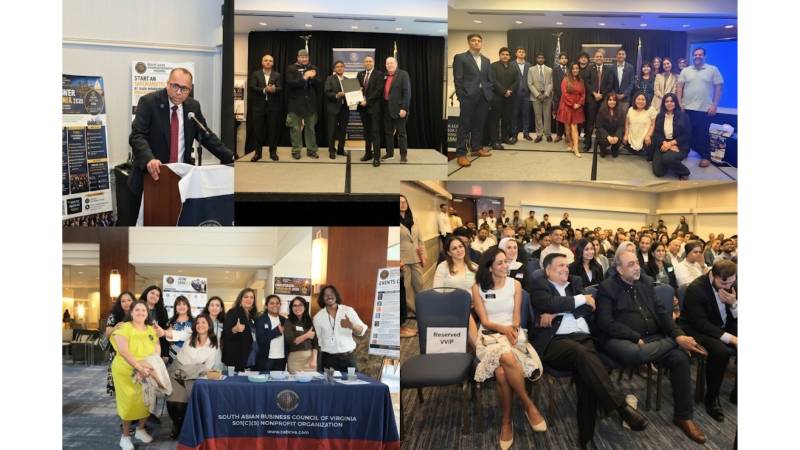
On Sunday, September 20, more than 1,500 CEOs, entrepreneurs, investors, government officials, federal contractors, recruiters and business leaders are expected to gather at the Hyatt Regency Dulles in Herndon, Virginia, for Empower Virginia 2026, the flagship conference of the South Asian Business Council of Virginia. As Empower Virginia 2026 approaches, SABCVA Chairman Mansoor Qureshi speaks exclusively with The Express Tribune about the vision behind the organization, immigration, entrepreneurship, technology, workforce development and the idea of building opportunity collectively.
Syed Zahoor Raza: EMPOWER VIRGINIA 2026 is approaching, and the conference is expected to bring together hundreds of CEOs, entrepreneurs, investors, government officials, federal contractors, recruiters, and business leaders. What does the scale of this gathering represent to you personally, and what does it say about how SABCVA has evolved since its founding?
Mansoor Qureshi: For me, it represents a dream coming true. SABCVA started with a simple idea: to bring people together and help them grow. We wanted to create a platform where entrepreneurs, professionals, business leaders, young people, government officials, and community members could connect and support one another.
Now, seeing hundreds of CEOs, entrepreneurs, investors, recruiters, government officials, federal contractors, prime integrators, and professionals coming together is incredibly meaningful. It shows that people believe in our mission.
SABCVA has grown from a simple idea into a powerful community platform, but our purpose has not changed. We still believe that when one of us rises, we all rise together.
SZR: You immigrated to the United States and later became the first Pakistani-American to serve as an adviser to a Virginia governor through your appointment to the Virginia Asian Advisory Board. How did your immigrant experience influence the way you think about leadership, opportunity, and civic participation?
MQ: When I immigrated to the United States, I came with dreams, ambition, and the desire to build a better future. Like many immigrants, I had to learn a new system, build a professional network, and understand how opportunities are created. My experience taught me not to wait for opportunities to come to me. Sometimes, you have to create the platform yourself. That experience shaped the way I think about leadership and opportunity. I believe that when we succeed, we also have a responsibility to help others find their way and create opportunities for the next generation. It is also one of the reasons I believe strongly in civic participation. If we want to shape our future and have a voice in our communities, we must participate in the process. We cannot remain on the sidelines.
SZR: When you founded SABCVA, what specific need did you see within the South Asian business and professional community that you believed existing organizations were not fully addressing?
MQ: I saw talented people everywhere, but many were working in isolation. They had skills, education, and ambition, but often lacked access to the right information, mentors, professional networks, clients, and opportunities.
I wanted to build a bridge. A bridge between entrepreneurs and clients. Between young professionals and mentors. Between job seekers and employers. Between small businesses and government opportunities.
As SABCVA has grown, I have realized that the greatest need is not simply networking. People need meaningful relationships and access to opportunities. A business card alone may not change someone’s life, but one meaningful relationship can.
SZR: SABCVA recently celebrated the graduation of more than 120 participants from its Artificial Intelligence and Cybersecurity Internship Program. The interns worked in teams to develop functioning applications, with several teams now taking the next step by registering companies or developing their projects into entrepreneurial ventures. What did you hope participants would gain from this hands-on experience that they might not have gained through a traditional academic or classroom setting, and what do these outcomes tell you about the talent, creativity and entrepreneurial potential within the community?
MQ: We did not just create internships. We created a space where young people could experiment, collaborate, build products, and dream bigger.
Our young people have incredible potential when they are given the right opportunity. We wanted them to gain experience, confidence, and real-world exposure.
In a traditional classroom, students learn concepts. In our program, they worked in teams, solved problems, built applications, communicated with others, and presented their work. We wanted them to leave saying, “I have actually built something.” That creates a completely different level of confidence.
SZR: You often describe your philosophy with the phrase, “When one of us rises, we all rise together.” How do you translate that philosophy into concrete opportunities rather than allowing it to remain simply an inspirational message?
MQ: That philosophy has to become action. That is why we created networking events, mentorship opportunities, workforce development programs, internships, business education, civic engagement initiatives, women’s programs, youth initiatives, and community partnerships.
Our goal is to create an ecosystem where people help one another. If you are successful, become a mentor. If you own a company, consider hiring an intern. If you have experience, share it. If you have connections, open a door for someone else. That is how a community becomes stronger.
SZR: SABCVA has assembled a robust leadership team with expertise across artificial intelligence, cybersecurity, federal digital transformation, project management, law, taxation, real estate, data science, and fundraising. What qualities do you look for when selecting people to lead the council’s committees, and how do you ensure that such a diverse group remains aligned around a common mission?
MQ: SABCVA has talented professionals from many industries. The most important qualities are passion, integrity, commitment, and a genuine desire to give back. We do not expect everyone to think the same way. In fact, diversity of thought makes us stronger. But we must remain united by our common mission: connecting people, empowering communities, and creating opportunities for others.
SZR: When you look five or ten years into the future, what would success for SABCVA look like? What lasting change would you like the organization to have created in Virginia’s South Asian business community and the broader region?
MQ: I hope SABCVA becomes a lasting institution that continues empowering people long after the current leadership has moved on. I want to see thousands of young people receive internships, jobs, mentorship, and opportunities. I want to see more South Asian entrepreneurs building successful companies. I want to see more women and young leaders in leadership positions, and more community members participating in civic life. But most importantly, I want the culture of helping one another to become stronger. If someone gets a job because of a connection they made through SABCVA, I hope they come back and help the next person. If an intern builds a successful company, I hope that person hires future interns. That is the vision. We are not building an organization only for today. We are building an ecosystem for the next generation.