

Every so often, a question arises that appears deceptively simple yet unsettles the entire architecture of one’s political understanding: what truly constitutes a political journey? Is politics merely a pathway that culminates in office, authority, or victory? Or is it, at its core, a deeper intellectual and moral process, one that reshapes an individual’s worldview, transforms personal purpose, and redefines responsibility towards society?
If politics is reduced solely to the pursuit of power, it becomes transactional and hollow. But if understood as a journey of learning, self-discovery, and collective responsibility, it acquires meaning. In its truest sense, political engagement is not about the self; it is about rising above the self. It is about expanding one’s moral horizon from personal ambition to public good, from individual success to national and human welfare.
Life itself is governed by evolution. Societies evolve, institutions evolve, and political systems evolve. Yet history also teaches us that certain foundational principles remain immutable. Truth and falsehood, justice and oppression, integrity and deception are not subject to historical revision. They transcend time and geography. While political strategies, systems, and structures may change, these moral constants do not. Politics, regardless of how modern or pragmatic it claims to be, ultimately operates within this moral universe.
The crisis of contemporary politics lies in the deliberate distortion of this reality. In many societies today, manipulation is celebrated as intelligence, deceit is framed as strategy, and dishonesty is defended as realism. Truth, meanwhile, is often dismissed as naïvety. But politics is neither the exclusive domain of truth nor the permanent refuge of falsehood. Politics, at its best, is the discipline of improvement, the craft of creating possibilities where none seem to exist, of opening doors that appear permanently sealed, and of navigating complexity without surrendering moral clarity.
Politics is not merely a contest of dominance; it is a continuous exercise in dialogue. It demands patience, listening, and the capacity to engage with disagreement without dehumanisation. Genuine political engagement reduces polarisation rather than deepens it. It seeks convergence, not annihilation. It is a dialogue so principled that it can soften hardened positions and reconcile deeply divided societies.
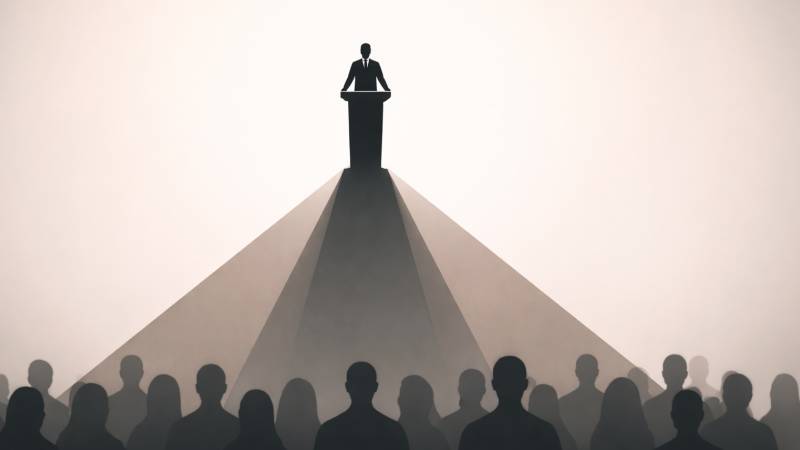
This understanding brings into sharp focus the essential distinction between a politician and a leader. A politician often enters politics driven by personal incentives—power, status, wealth, or relevance. These motivations are not uniform, but they are almost always self-referential. A leader, by contrast, enters politics in the service of an idea. Leadership is not motivated by personal survival but by historical responsibility. Leaders do not merely seek to win; they seek to redefine what winning means.
A true leader does not govern for personal legacy or familial advantage. He governs with the understanding that the nation is his family and the citizens his responsibility
Leadership, therefore, is not measured by uninterrupted success or constant triumph. The true test of leadership lies not in the ability to secure every objective but in the capacity to elevate collective consciousness. Leaders expand the intellectual and moral boundaries of a society. They encourage citizens to think beyond fear, beyond cynicism, and beyond resignation. Long before leaders transform institutions, they transform minds.
This inevitably raises a fundamental question: how are leaders formed? Are leaders born, or are they shaped? Does history select them, or do they emerge from lived experiences of injustice, deprivation, and struggle? The answer likely lies in convergence. Some individuals possess innate moral clarity, but leadership is ultimately forged through experience. Hardship refines purpose. Suffering sharpens empathy. Repeated confrontation with injustice produces the resolve to challenge it.
Yet leadership cannot exist in abstraction. It must operate within the political arena. Without engaging in politics, leadership remains philosophical rather than consequential. Politics is where ideals are tested, where courage is measured, and where character is exposed. It is here that the difference between tactical manoeuvring and principled leadership becomes unmistakable.
Equally important is the role of the intellectual environment. The scope of a leader’s vision is shaped by the conversations he engages in and the ideas he consumes. Those confined to parochial debates focused solely on personalities, short-term gains, and local rivalries rarely transcend politics as a profession. Those who engage with ideas, vision, national trajectories, and global realities cultivate the intellectual depth required for leadership. Vision, by its very nature, demands altitude.
Yet exposure alone does not create leadership. Books do not substitute for courage. Discussion does not replace decision. Leadership requires action—often difficult, frequently unpopular, and sometimes costly. It requires the willingness to bear consequences without surrendering principle. Moral courage, not convenience, defines leadership.
This brings us to the question of judgment: what distinguishes a good leader from a bad one? Is it personal conduct or public performance? Character or competence? The honest answer is both. A leader’s ethical compass inevitably shapes decision-making, and decisions reveal character more reliably than rhetoric. Private integrity and public responsibility are not separate domains; they are mutually reinforcing.
In democratic systems, elections are the primary mechanism through which leadership is legitimised. Public trust is the foundation of authority. When elections are transparent, even flawed leaders retain legitimacy because they remain accountable. But when electoral processes are manipulated—when outcomes are engineered, and public will is subverted, leadership collapses into imposition. Authority without consent cannot inspire loyalty, sacrifice, or reform.
Democracy allows people to err. That is not its weakness; it is its strength. The capacity to correct mistakes through subsequent choice is what grants democratic systems resilience. But when this corrective mechanism is disabled, governance decays. Institutions hollow out. Cynicism replaces participation. Politics loses its moral centre.
Finally, leadership is never a solitary endeavour. Even the most visionary leader requires a capable, ethical team. The ability to select competent and principled individuals is itself a core leadership skill. Errors in judgment do not automatically negate leadership, provided the overarching vision remains intact, and self-interest does not dominate decision-making.
A true leader does not govern for personal legacy or familial advantage. He governs with the understanding that the nation is his family and the citizens his responsibility. Power, in such a framework, is not an entitlement; it is a trust.
And perhaps this is the quiet yet decisive distinction between a politician who occupies office and a leader who shapes history.