

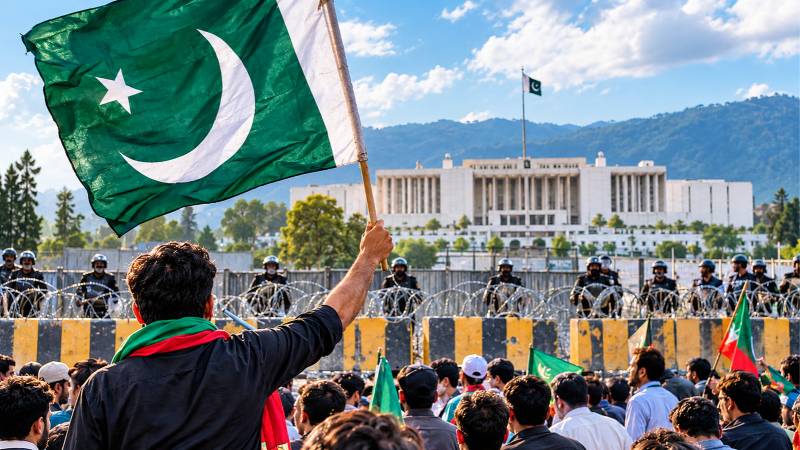
Pakistan’s danger today lies in the assumption that because its people have endured so much, they can always endure a little more. For nearly eight decades, the country has absorbed constitutional interruptions, disputed political settlements, economic disappointments and repeated promises of renewal. Institutions have survived, governments have changed and ordinary life has continued. That endurance is remarkable. It can also mislead those in authority into treating the absence of rupture as evidence that the underlying arrangements remain acceptable.
The imprisonment of Imran Khan and the suspension of the elected government in Khyber Pakhtunkhwa have sharpened a larger question. Where can political grievances now be resolved credibly? The government invokes security and lawful authority. Its opponents describe exclusion and the erosion of constitutional protection. Those competing claims require independent examination. They become especially combustible when the institutions responsible for examining them struggle to command public confidence.
Chinua Achebe’s Things Fall Apart offers an unsettling way to understand this danger. The novel portrays a community whose institutions, loyalties and internal tensions are transformed by an expanding authority convinced of its own civilizing purpose. Achebe neither romanticizes that community nor excuses its failings. His achievement is to show how a society can be misunderstood by those who possess the means to reorganize it. The officials in that world see resistance through the categories of administration. They bring courts, messengers and punishments, alongside the conviction that order requires obedience. The people whose lives are being rearranged possess a different understanding of belonging and legitimate authority. What appears manageable from an official residence can be experienced elsewhere as humiliation, dispossession or the destruction of a familiar world.
Pakistan’s history gives such questions particular resonance. Independence in 1947 promised people a state in which they would possess political agency after generations of imperial rule. Building that state amid displacement and violence required extraordinary effort. Yet the habits of commanding a population have repeatedly competed with the obligations of representing it. Citizens are too often expected to accept decisions whose authors remain insulated from their consequences. The struggle has continued across changes of government and regime. Political leaders have demanded constitutional protection while out of office and found reasons to narrow it once secure in power.
Alliances have shifted around access, advantage and survival. Each accommodation may make sense to its participants at the time. Their cumulative effect is to leave citizens uncertain whether institutions serve established principles or the requirements of the prevailing arrangement. The tragedy of 1971 remains the most devastating warning. The Awami League’s national majority in the 1970 election failed to produce an accepted transfer of power. Political exclusion, repression, armed resistance and war culminated in Bangladesh’s independence. Shared religion and the assertion of national unity could not repair a settlement that had lost acceptance among much of the population it sought to govern.
Pakistan’s endurance is not consent. As political grievances deepen and institutions lose credibility, the country edges closer to a dangerous breaking point.
Invoking that history requires restraint. Today’s Pakistan is different, and another territorial rupture cannot responsibly be presented as inevitable. The enduring lesson concerns the limits of control. A state can possess substantial coercive capacity while losing the cooperation on which its cohesion depends. Grievances that institutions fail to accommodate do not disappear because their expression becomes more difficult. The courts carry a special responsibility because they are supposed to keep disagreement within constitutional bounds. Their history makes that task harder. Judicial validation of extraordinary interventions has repeatedly weakened confidence that the constitution will restrain power when restraint matters most. The consequences endure beyond individual judgments, shaping expectations about whether the next crisis will be resolved through rules or another exception. Bhutto’s fate illustrates the cost of recognizing failure too late. Executed in 1979, he received an acknowledgment in the Supreme Court’s 2024 advisory opinion that his trial and appeal had not met the requirements of a fair trial and due process. That acknowledgment mattered, but it could not restore his life. Institutions must demonstrate their independence while their decisions can still protect people from irreversible harm.
Khan’s case requires its own scrutiny. The no-confidence vote that removed his government in 2022 was a constitutional mechanism. The serious questions surrounding subsequent prosecutions, detention and political restrictions must be assessed on their evidence. The UN working group on arbitrary detention found the detention it examined in 2024 arbitrary and recommended release. Later UN interventions raised concerns about his treatment and medical care. These findings warrant substantive answers. His popularity does not place him above accountability. Equally, calling him a convicted prisoner does not settle whether the proceedings were independent or his continuing treatment fair. Courts must distinguish credible prosecution from the use of legal processes to prolong political exclusion. Their ability to make that distinction convincingly matters to every citizen who may one day need protection against an influential opponent.
The intervention in KP adds another burden because it reaches beyond an individual to an elected provincial administration. Security threats demand effective action, but they also demand clarity about responsibility, necessity and constitutional limits. When authority is concentrated further during a political confrontation, the public needs credible assurance that the purpose is to restore lawful government. Otherwise, an administrative response can deepen the political grievance it is expected to contain.
Economic pressure makes this confrontation more dangerous. A family struggling with bills, a graduate searching for work or a small business navigating uncertain rules experiences governance through consequences. Political manoeuvring becomes harder to tolerate when it appears detached from daily hardship. The perception that access and loyalty determine protection can join economic frustration to a broader rejection of the way the country is governed. This does not establish that Pakistan stands on the verge of revolution which it could one day. Anger can produce mobilization, but also fear, withdrawal and emigration. A society may endure prolonged instability without a decisive uprising or formal takeover. The danger includes quieter losses where citizens cease expecting fairness, talented people leave, businesses postpone investment and institutions continue functioning while their credibility drains away.
Achebe understood how official accounts can conceal such losses. At the end of Things Fall Apart, the District Commissioner considers reducing Okonkwo’s life and death to a small passage in his projected account of pacification. A human tragedy becomes material for an administrator’s narrative. The warning is relevant wherever citizens’ experiences are compressed into categories that make their grievances easier to dismiss. Official language can describe a silenced street as peaceful, a restricted political field as stable or an exhausted population as reconciled. Each description may overlook what people have stopped saying publicly. Silence provides limited evidence about consent when speaking carries risks. A government that loses access to honest criticism also loses information it needs to govern effectively.
Further control can therefore weaken the very capacity it is intended to strengthen. If political participation becomes less meaningful, courts less convincing and peaceful protest more difficult, fewer institutions remain able to mediate conflict. Officials may gain another instrument of enforcement while losing another source of cooperation. An apparently successful intervention can leave the next dispute more difficult to contain. The appeal of a comprehensive reset is understandable in such circumstances. Neither expertise nor concentration of authority resolves the underlying problem of legitimacy. Competent administration needs lawful limits and mechanisms through which citizens can contest decisions. Without those protections, another arrangement can reproduce the grievances that discredited its predecessor.
Achebe took his title from Yeats’s poem The Second Coming, with its warning that “the centre cannot hold”. For Pakistan, the centre that matters is the accepted framework within which competing interests can coexist. It is strengthened when an opponent receives a fair hearing, a province can defend its constitutional rights and a judgment is respected despite political inconvenience. Concentrating authority cannot compensate indefinitely for weakening that framework. Pakistan still may have choices before it’s too late. Timely judicial scrutiny, humane detention, meaningful political participation and credible dialogue could reduce the pressure. Those exercising power must accept that concessions to constitutional principle protect the country’s capacity to manage future disputes. Opposition leaders, in turn, must defend procedures and rights that will bind them if they return to office. The responsibility of government is to recognize the accumulated burden and restore ways of resolving grievances before another assertion of control produces a rupture that nobody can contain and things simply fall apart.