

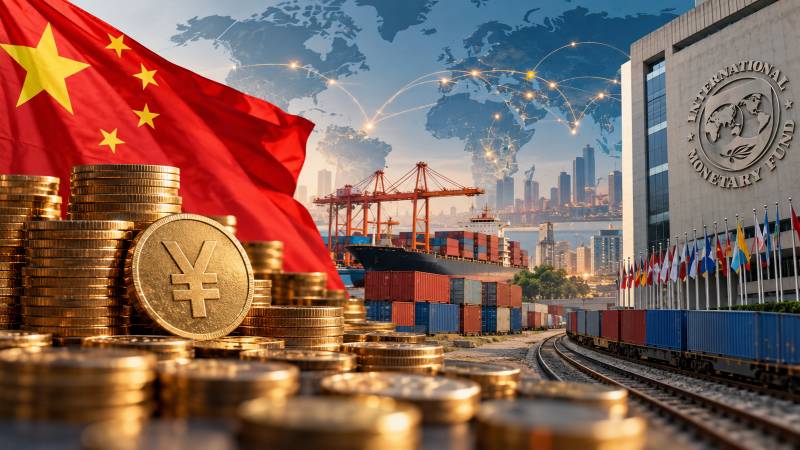
When countries with weak financial systems face a shortage of foreign exchange, are unable to repay external debts or facing dangers of default, one question becomes pertinent: which country or financial system will provide emergency lending? During the Cold War era and much of the post-war period, the United States and the Bretton Woods systems were the prominent ‘Lenders of Last Resort’. China is rapidly challenging that position. Not by replacing the incumbent system, but by creating an alternative financial system, which can provide economic partnerships, emergency lending and development finance.
The concept of ‘international Lender of Last Resort’ emerged to prevent financial panic from spreading during economic crises. Charles Kindleberger's ‘Hegemonic Stability Theory’ supports an international economic hegemon to prevent the repetition of ‘Great Depression’ like economic situations. At the international level, it means providing liquidity to countries facing severe external financial pressures and balance of payments issues. Traditionally, the IMF occupied that position. China’s emerging financial role is supported by commodity-backed financing, assistance to countries facing financial issues, central-bank currency swaps, and loans from state-owned banks.
According to a study by Bradley Parks, Sebastian Horn, Christoph Trebesch, Lukas Franz, and Carmen Reinhart, estimates that during the period between 2000 and 2021, China provided $250 billion in short-term liquidity. The research identified a robust system of cross-border financing of countries having close political and economic ties with Beijing. This figure shows China’s growing role as the ‘Lender of Last Resort’, which may potentially contribute to a parallel financial order.
The investments must aim to increase industrial competitiveness, generate greater foreign exchange, and support small-scale trade initiatives. All the agreements related to trade must be transparent and must have long-term sustainability.
China’s growing financial influence is further strengthened by the initiation of the ‘Belt and Road Initiative’ in 2013. Christoph Nedopil’s research, “China Belt and Road Initiative Investment Report 2025”, published by the Green Finance and Development Centre and Griffith Asia Institute in January 2026, found that China’s projects reached $213.5 billion in 2025. This wealth includes $ 85 billion in investment and $213.5 billion in construction contracts. In cumulative terms, since 2013, China’s economic engagement has reached $1.399 trillion; it consists of both construction contracts and non-financial investment. Multilateral development institutions also promote China’s influence. According to the 2025 report of the Asian Infrastructure Investment Bank (AIIB), the bank approved $3.171 billion in financing across fifty-seven countries across the globe. In the same year, the BRICS Development Bank provided approximately $3.171 billion in seventeen projects. By the end of the year, it reached $35.593 billion.
Neither of these institutions is supposed to completely replace the IMF and other Western countries. The purpose of these institutions is to provide alternative options to countries facing balance of payments and other issues. By providing this option, it contributes to inclusivity and competition in the global economic order. For developing countries, it reduces their dependence on Western countries. For China, provision of economic support is a viable option to expand its role in global financial institutions. The rise of China in the economic domain shouldn’t be regarded as the creation of an entirely new financial system, or replacement of the IMF as the ‘Lender of Last Resort’. Rather, it's an attempt to provide options to third-world countries. China's economic lending position is based on a fragmented financial network, while the IMF possesses a multilateral framework which is different from China’s one. Thus, it's not a replication, but a new and distinct system.
The evolution of China as an international ‘Lender of Last Resort’ has several implications. Pakistan’s deteriorated energy security, the issue of external liquidity, and Chinese infrastructural support can be greatly addressed through China’s help. Similarly, Pakistan’s access to multiple sources can improve the country's negotiating position. However, the domestic course correction is Pakistan’s job because no external lender can improve it. Pakistan needs to take financial help, which is needed for productive sectors. The investments must aim to increase industrial competitiveness, generate greater foreign exchange, and support small-scale trade initiatives. All the agreements related to trade must be transparent and must have long-term sustainability.
To conclude, China’s emergence as a global financial giant is one of the most important economic miracles of the 21st century. It successfully challenged the historically Western-dominated economic system and financial relations. China is also providing an alternative system based on inclusive avenues of cooperation for developing countries. The challenges associated with China’s provision of an alternative are predictable, transparent and sustainable. The world financial system is moving towards a multipolar one. Where competition and effectiveness are the prerogative for attracting countries to have economic relations.