

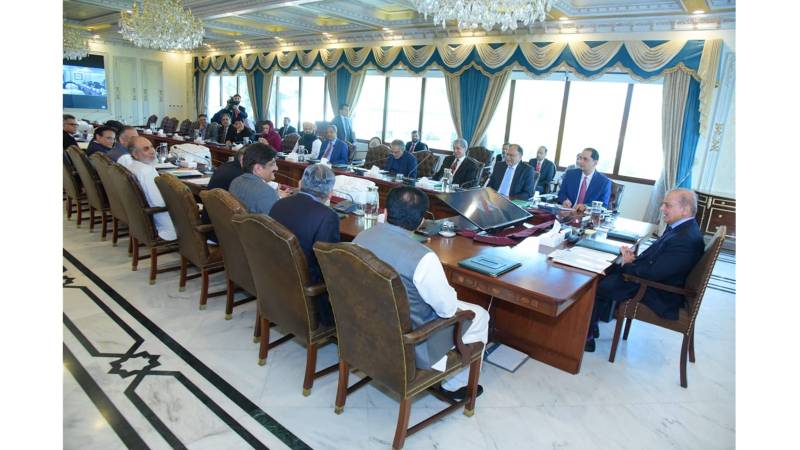
Pakistan's military leadership has reportedly floated a proposal to raise the number of provinces in Pakistan. Interior Minister Mohsin Naqvi has said Pakistan’s current administrative system has collapsed and called for the creation of new administrative units or provinces. The proposal for redrawing the provincial boundaries is gathering steam, but it is also coming in for criticism, with some arguing there is a hidden agenda at work: enhance the power of the federation and dilute the power of the provinces.
Creating new provinces in Pakistan has touched a nerve, since there are deep political, ethnic, and economic fractures in the country. Any change in the provincial composition of the country will create winners and losers. The guardians of the status quo will do everything to resist change, since they benefit from the current provincial lineup. They would lose a lot of their privileges. Redrawing internal borders risks reigniting bitter local arguments over the allocation of river water, taxation, land, and natural resources.
Opponents question whether redrawing the provincial map can bring power, resources, and accountability closer to its people, and whether such a transformation can be achieved without creating new political and ethnic tensions.
The debate is riven with emotional overtones, with everyone questioning each other’s motives. Let’s step back from the brink and benchmark Pakistan’s provincial composition against the provincial composition of the world’s biggest countries.
Historical and Comparative Context
At independence in 1947, Pakistan had four provinces in the West and one in the East. On the 14th of October 1955, the Federal Government combined the four western provinces into a single province called West Pakistan. This was designed to be a counterweight to East Pakistan. After the 2nd of July 1970, Pakistan went back to having four provinces in the West, since West Pakistan became associated with military dictatorship. On the 16th of December 1971, East Pakistan seceded from the country.
Today, Pakistan has the fifth-largest population in the world, as seen in the map.
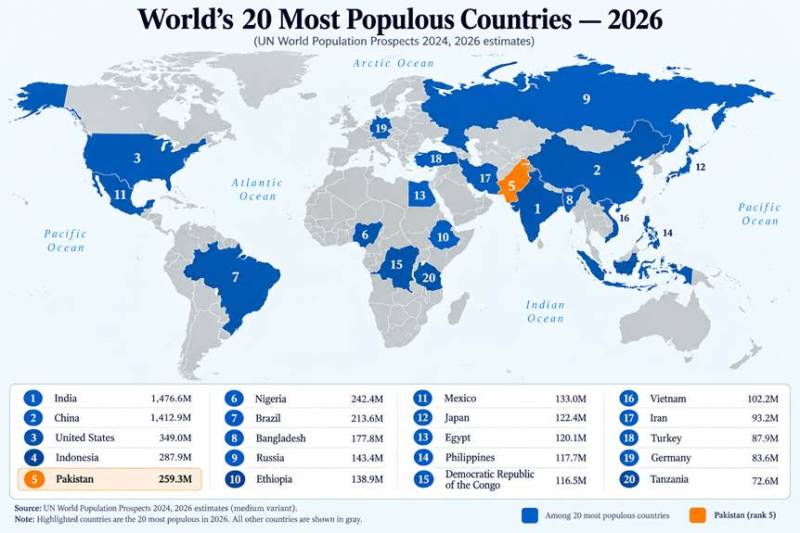
Analysis of the data from 2026 national population estimates reveals that the average size of Pakistan’s four provinces is unusually large compared with the first-level administrative divisions (states/provinces) of the other 19 most populous countries.
| Country | Largest first-level unit | Approx. national share |
|---|---|---|
| Pakistan | Punjab | 53% |
| India | Uttar Pradesh | 17% |
| China | Guangdong | 9% |
| United States | California | 11% |
| Indonesia | West Java | 17% |
| Nigeria | Kano State* | 7% |
| Brazil | São Paulo | 22% |
| Bangladesh | Dhaka Division | 27% |
| Russia | Moscow (federal city) | 9% |
| Ethiopia | Oromia | 35–38% |
| Mexico | State of Mexico | 13% |
| Japan | Tokyo Metropolis | 12% |
| Egypt | Cairo Governorate | 10% |
| Philippines | Cavite | 4% |
| DR Congo | Kinshasa | 15–17% |
| Vietnam | Ho Chi Minh City | 9–10% |
| Iran | Tehran Province | 15% |
| Türkiye | Istanbul Province | 18% |
| Germany | North Rhine-Westphalia | 22% |
| Tanzania | Dar es Salaam Region | 8% |
Pakistan has the fewest provinces/states among these 20 countries, despite having the world’s fifth-largest population.
As a consequence, Pakistan’s average of 64.8 million people per province is approximately 1.6 times that of India or China, 9.3 times that of the United States, and 9.9 times that of Nigeria. That comparison is particularly relevant because India, Nigeria, and the United States are federal systems with constitutionally significant subnational governments.
Pakistan stands out as having the largest share of the national population in the largest province, which is Punjab.
| Country | Largest first-level unit | Approx. national share |
|---|---|---|
| Pakistan | Punjab | 53% |
| India | Uttar Pradesh | 17% |
| China | Guangdong | 9% |
| United States | California | 11% |
| Indonesia | West Java | 17% |
| Nigeria | Kano State* | 7% |
| Brazil | São Paulo | 22% |
| Bangladesh | Dhaka Division | 27% |
| Russia | Moscow (federal city) | 9% |
| Ethiopia | Oromia | 35–38% |
| Mexico | State of Mexico | 13% |
| Japan | Tokyo Metropolis | 12% |
| Egypt | Cairo Governorate | 10% |
| Philippines | Cavite | 4% |
| DR Congo | Kinshasa | 15–17% |
| Vietnam | Ho Chi Minh City | 9–10% |
| Iran | Tehran Province | 15% |
| Türkiye | Istanbul Province | 18% |
| Germany | North Rhine-Westphalia | 22% |
| Tanzania | Dar es Salaam Region | 8% |
The contrast between Pakistan and India is especially revealing. Punjab contains more than half of Pakistan’s population, whereas Uttar Pradesh, India’s largest state, contains roughly one-sixth of India’s population.
The central finding is that Pakistan is an extreme outlier in the average population governed by each province, and that Punjab’s demographic dominance raises additional questions about federal balance and political representation.
What If Pakistan Expanded Its Four Provinces?
Using Pakistan’s projected 2026 population of 259.3 million, we can model the effect of increasing the number of provinces. For example, if the number of provinces is raised from 4 to 16, the average provincial population would be 16.2 million.
| Proposed provinces | Average population (millions) |
|---|---|
| 4 (current) | 64.8 |
| 8 | 32.4 |
| 12 | 21.6 |
| 16 | 16.2 |
| 20 | 13.0 |
| 24 | 10.8 |
| 30 | 8.6 |
| 36 | 7.2 |
A Pakistan with 24 to 36 provinces would have average provincial populations much closer to those in several other large countries, but that may not be a viable option. The appropriate number of provinces will depend on geography, language, economic viability, institutional capacity, and constitutional design—not population alone.
Three conclusions emerge from the benchmarking.
First, Pakistan is administratively under-divided by international population benchmarks. Its average population per province exceeds that of every other country in comparison. This is the strongest quantitative finding.
Pakistan’s average of 64.8 million people per province is approximately 1.6 times that of India or China
Second, Punjab’s demographic dominance creates an unusually asymmetric federation. Its population majority matters for the National Assembly and may influence the distribution of political power. However, population concentration alone does not establish that Punjab dominates the military or civil service; those questions require separate evidence.
Third, provincial subdivisions could address two different problems: reducing the population served by individual provincial governments and reducing the concentration of political power in one province. These are related but distinct objectives.
The Experience of Other Countries
India reorganised its states extensively after independence, partly in response to linguistic and administrative demands. With a population of a billion people, India has continued to divide the nine states it inherited at independence to retain a national balance. To accommodate inter-regional conflicts, India created a States Reorganization Commission that suggested the creation of additional states along linguistic lines.
Initially, this proposal was met with apprehension by the leaders in the Centre, who feared it would lead to the breakup of the Indian Union. However, ultimately, they realised that not dividing the provinces posed an even bigger threat. In 1956, most of the states were redrawn along linguistic lines. This has been an ongoing process, and the Indian Union now consists of 26 states.
Bombay was reorganised in 1960 to create Maharashtra and Gujarat for Marathi and Gujarati speakers respectively. Not all Gujaratis were happy with the creation of their state, since they lost Bombay to Maharashtra. Punjab was split in 1966 to create a smaller Punjab and Haryana. In the smaller Punjab, Punjabi speakers have a slender majority. Haryana is also a Punjabi-speaking state but one dominated by Hindus, while the Sikhs dominate Punjab. Assam was parted a few times to create Nagaland and Manipur, effectively reigning in the separatist tendencies in those regions. In the year 2000, three new states were created from parts of Bihar, Madhya Pradesh, and Uttar Pradesh.
Today, the largest state in the Indian Union is Uttar Pradesh, which accounts for 16 per cent of the population, followed by Bihar with 10 per cent, and West Bengal, Andhra Pradesh, and Madhya Pradesh with about 8 per cent each. There is continued talk of further subdividing the states to accommodate regional aspirations. In one scenario, that was put forward in 1992, India would consist of 52 states.
Other nations have found ways to deal with ethnic domination. For example, to deal with the domination of Germans who account for 70 per cent of the population, Switzerland, with a population of only 7 million, is divided into 26 administrative cantons, each with its own constitution.
Iran, with a population of 69 million, consists of 28 provinces. Tehran is the largest province, accounting for 17 per cent of the population. Like in most countries, the number of provinces remains flexible. A law was passed in the parliament in May of this year to divide the province of Khorasan into three new provinces.
Türkiye, also with a population of 69 million, consists of 81 provinces. The largest, Istanbul, accounts for 13 per cent of the population. Afghanistan, with a much smaller population of 29 million, has 34 provinces.
The US is a federation of 50 states and the District of Columbia. While some states like California, New York, and Texas are much larger than other states like North Dakota and Rhode Island, no single state accounts for more than 12 per cent of the national population. In addition, the states are given significant political and financial rights relative to the federation, as part of the US constitution.
Making the Transition in Pakistan
Admittedly, Punjab is not a monolith and is riven with sub-cultural and sub-ethnic rivalries. However, it is the perception of its dominance—demographic, economic, political, and even linguistic—that triggers insecurities in the other provinces. Moreover, a disproportionately large share of federal spending appears to benefit the residents of Punjab. This problem can be solved, as seen by the experience of other countries.
Inter-provincial problems arise when there are substantial differences in size between provinces, a small number of provinces, and a dominant elite in the federation.
Provincial boundaries in Pakistan are outdated and do not reflect the geographical and strategic diversity of the country. Even the Pakistan army has divided itself into nine Corps, of which six are in Punjab, and one each in Balochistan, Sindh, and KPK.
The Government should establish a Provincial Reorganization Commission to examine the issue. This commission may wish to take a staged approach to the division of provinces, based on linguistic, ethnic, demographic, and administrative criteria.
According to Professor Tariq Rahman, there are 6 major languages in Pakistan and 57 minor languages. Punjabi is spoken by 44 per cent of the people, followed by Pashto (15 per cent), Sindhi (14 per cent), Saraiki (11 per cent), Urdu (8 per cent), and Balochi (4 per cent). This suggests that a point of departure for reorganising the provinces would be to review the administrative districts within each province. For example, the most populous Hazara district in the NWFP is dominated by Punjabi speakers while Dera Ismail Khan includes Saraiki speakers.
It may make sense to reorganise Punjab into five provinces, centred on Bahawalpur, Faisalabad, Lahore, Multan, and Rawalpindi. Punjabi is the primary language in the second, third, and fifth provinces, and Saraiki in the first and fourth. Sindh would be reorganised into four provinces, centred on Hyderabad, Karachi, Khairpur/Nawabshah, and Sukkur. In the first and fourth, Sindhi is the primary language, in the third a good percentage of the population speaks Saraiki, while Urdu dominates in the second. At a later stage, following the same principles, Balochistan could be reorganised into two provinces, centred on Quetta and Khuzdar, and the Frontier into three provinces, centred on Dera Ismail Khan, Mardan, and Peshawar.
There would still be a need to ensure that new provinces do not recreate a problem of local domination, since none would be ethnically homogeneous. This problem may be avoided through the promotion of consociation-based decision-making rules that rely on consensus building, pluralism, and bargaining rather than majoritarian rule-making.
Reorganising the provinces would not solve Pakistan’s various security dilemmas, but by bringing harmony to inter-provincial ties, it would resolve a very important and obdurate one. Subdividing the existing provinces, accompanied by meaningful fiscal and political decentralisation, could improve governance, strengthen representation, and create a more balanced federation.