

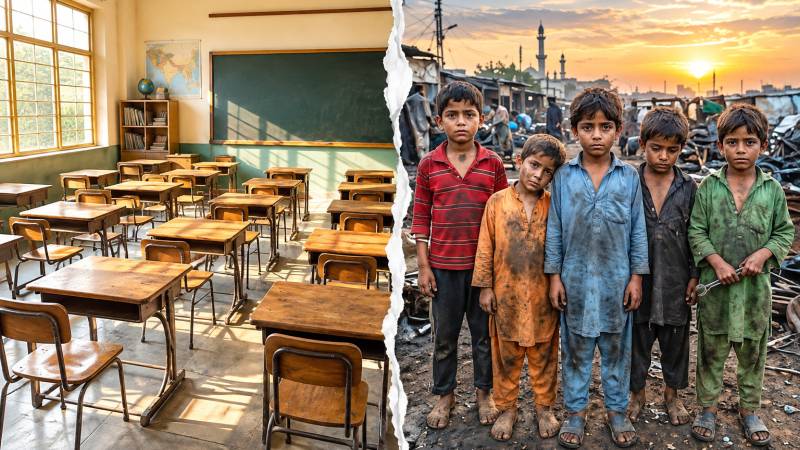
When a child misses school, the loss is often regarded as missed education. However, the real damage extends far beyond the individual classroom. Education is the primary engine of upward mobility, and when it grinds to a halt, the consequences ripple outward in a devastating compounding effect. Pakistan has one of the largest out-of-school child populations in the world. According to the National Commission on the Rights of Child (NCRC), an estimated 25.1 million children aged 5–16 in Pakistan are out of school. Behind this figure is a significant economic cost: every year of education forgone represents skills that are not acquired, productivity that is not developed, and earning potential that may never be fully realised.
Education is often framed as a basic social service, but from an economic perspective, it represents a foundational investment in human capital. From early childhood through higher learning, formal instruction cultivates essential competencies: ranging from basic literacy and numeracy to advanced critical thinking. As individuals acquire these capabilities, their personal economic potential expands significantly, granting them entry into higher-paying, specialized roles within an increasingly complex and technology-driven labour market.
When a child receives little or no education, that critical investment in human capital is either severely depleted or lost entirely. For an individual, the consequences of never attending school may not seem significant. A child may enter the labour market early, help with household work, or remain dependent on informal employment. In the short term, this may provide a household with an additional source of labour or income. Without the foundational human capital acquired through education, an individual faces compounding structural barriers that progressively narrow their trajectory over a lifetime.
When millions of children remain outside the education system, the loss extends far beyond missed classrooms—it translates into forgone skills, lower lifetime earnings, weaker productivity and lost economic potential for the country.
Without basic literacy or numerical skills, it becomes difficult to acquire high-paying jobs, which harms an individual’s income in the long run. This creates a gap between the economic potential of a young person and the opportunities available to them. When this happens to millions of children simultaneously, the individual loss becomes a national economic problem. This also has an intergenerational effect. As household incomes drop, impoverished families are compelled to pull their own children out of school to cover basic survival needs, turning localised poverty into a permanent cycle.
Economic growth does not depend only on how many people are in the workforce; rather, it depends on the productivity of those individuals as well. A worker who has received adequate education can potentially operate machinery, use technology, manage accounts, interpret information, communicate effectively, and acquire new skills. A worker without foundational education faces greater barriers to many of these activities. This amplifies the stakes dramatically for Pakistan as it attempts to expand beyond low-productivity employment. The World Bank has warned that Pakistan’s low human-capital outcomes limit its growth prospects and that a healthier, better-educated, and more skilled population would be more productive and able to earn more if the economy creates sufficient jobs.
This also has negative repercussions for the government, as a large population with limited education and low earning potential can contribute to lower tax revenues, greater demand for social protection, and lower productivity across the economy. At the same time, the limited skills of a large section of the workforce can intensify unemployment and underemployment pressures. Pakistan currently has a very young population, which presents an opportunity for economic growth if this population is adequately educated and integrated into the labour market. However, as this population ages, the economic consequences of inadequate education could become more pronounced. A workforce with lower lifetime earnings and limited savings or access to formal social protection may place a greater burden on the state as the proportion of dependants increases. In this sense, failing to educate children today could create fiscal and economic pressures for the government decades into the future.
Ultimately, Pakistan’s out-of-school children represent more than a social problem. They represent lost economic potential as well. If millions remain without the skills required for productive employment, the country risks lower incomes, weaker tax revenues, and a greater burden on the government in the future. Educating children today is therefore not only a social investment. It is an investment in Pakistan’s long-term economic growth.