

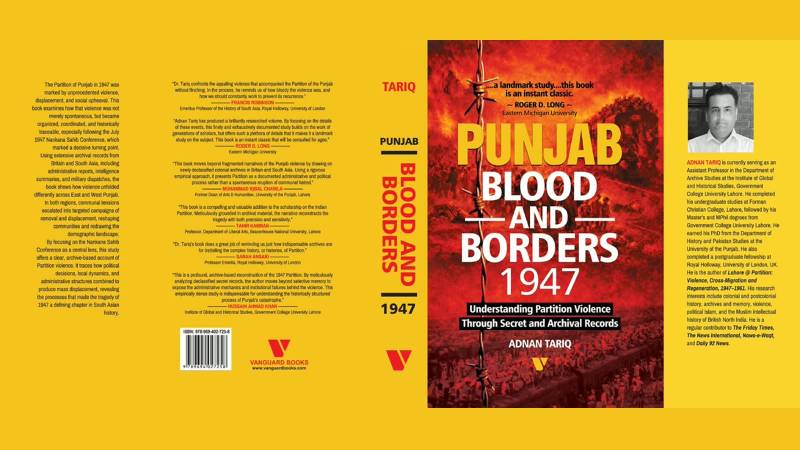
The history of Partition has been written and rewritten from almost every possible angle: the politics of the Muslim League and Congress, the decisions of the British, the creation of Pakistan and India, refugee journeys, oral memories, gendered violence, literature, and the remaking of cities. Yet Punjab remains a particularly difficult case because its Partition cannot be reduced to a single moment or a single explanation. The violence did not simply begin when the new states came into existence. It developed over months, involved different political and social actors, destroyed property as well as lives, and eventually transformed the demographic character of the province.
It is this complicated history that Adnan Tariq examines in Punjab, Blood and Borders: Understanding Partition Violence Through Secret and Archival Records. Tariq, a faculty member in the Department of Archive Studies at Government College University Lahore, approaches the subject primarily through the archival record. His concern is not merely to retell the familiar story of killings and migration but to ask how violence developed into a process through which people were gradually made to leave places where their families had lived for generations.
This emphasis on the archive gives the book its distinctive character. Tariq's research began with his work in the India Office Records in London, where he encountered a substantial body of official material relating to Punjab in 1947. Military reports, police intelligence, governors' correspondence, and administrative records form an important part of the evidence on which the book rests. Such material has long been used by historians of Partition, but Tariq's attempt to bring different categories of confidential and administrative records together allows him to reconstruct the crisis from the perspective of institutions that were witnessing it as it unfolded.
This does not mean that the official archive should be treated as an objective record of truth. Government files have their own assumptions, prejudices, and silences. An intelligence report is not necessarily an accurate description of what actually happened on the ground, and an administrator's account may tell us as much about the concerns of the administration as about the event itself. The value of these documents lies partly in their contemporaneity. They reveal what officials knew, what they believed was happening, what they expected to happen next, and, perhaps most importantly, where their attempts to maintain order failed.
Tariq's first major intervention is therefore chronological. He asks the reader to look at Partition violence before August 1947. The attacks on Hindus and Sikhs in Hazara and the Potohar region are particularly important in this regard. They demonstrate that large-scale communal violence and displacement were already occurring before the boundary between India and Pakistan had been announced. This complicates the familiar chronology in which independence comes first and mass violence follows.
The border did not merely separate two political territories; it separated communities that had previously lived alongside one another
The significance of this earlier violence is not that it provides a simple explanation for everything that happened later. Such an argument would reduce the history to an endless cycle of revenge. The situation was more complicated. Political mobilisation, local rivalries, rumours, economic interests, fears about the future, and the actions of armed groups all interacted. But violence in one region could profoundly alter perceptions elsewhere. Reports of killings and expulsions became part of the political language of fear and retaliation.
This is particularly important because Partition violence has sometimes been presented as though communities suddenly turned against one another after the announcement of independence. Tariq's evidence suggests a longer process. By early 1947, many people were already thinking about whether they would be able to remain in areas where their community might become a minority. The uncertainty surrounding the future of Punjab had itself become a source of insecurity.
The episode of Katra Jaimal Singh in Amritsar is one of the book's most striking examples. On the 9th of March 1947, the commercial area was attacked and burned. Contemporary civil and military reports discussed by Tariq describe destruction on a very large scale, with estimates reaching thousands of shops, a substantial proportion of them Muslim-owned. The importance of the episode lies not simply in the destruction itself but in the economic geography of the city.
Amritsar was a Sikh-majority city, yet Muslims had a significant presence in its commercial life. Lahore presents an interesting contrast. It was a Muslim-majority city, but some of its most important commercial areas, particularly Shah Alami, had strong Hindu and Sikh commercial communities. The destruction of Katra Jaimal Singh therefore represented more than an episode of communal violence. It damaged the economic foundations of a particular community within the city.
This is where Tariq makes one of his most persuasive arguments. Forced migration does not necessarily begin with an order saying that a population must leave. It can begin with the destruction of the conditions that make staying possible. A shopkeeper whose business has been burned, whose goods have disappeared, and whose commercial network has been destroyed may have little reason to remain, even if nobody has formally expelled him. Violence against property can consequently become a mechanism of demographic change.
This emphasis on property is one of the strengths of the book. Partition was not only about people being killed or driven from their homes. It was also about shops, houses, agricultural land, factories, and commercial networks being abandoned, seized, or redistributed. The connection between violence and property has also been explored by other scholars of Partition, including work on looting and the economic motivations behind communal violence.
Tariq's contribution is to place this question within a broader narrative of forced migration. The book gives particular importance to the Sikh gathering at Nankana Sahib on the 27th of July 1947. By this stage, Partition had become an imminent political reality, but the precise boundary remained unknown. Sikh political leaders faced a difficult territorial problem. Sikh populations were dispersed across Punjab, while many important religious sites and agricultural interests lay in areas whose eventual political future was uncertain.
The Nankana Sahib meeting was not simply a religious gathering. Contemporary documentation describes it as a major political meeting connected with Sikh boundary claims, with plans for a large mobilisation and the participation of prominent Sikh leaders. Tariq sees the event as significant because it reflects the transformation of Sikh anxiety about Partition into increasingly territorial political mobilisation.
The argument is strongest when the conference is treated as a turning point in political thinking rather than as a single command that mechanically produced everything that followed. The violence that developed after August 1947 cannot be explained by one meeting. There were multiple Sikh organisations, different local interests, changing military circumstances, and rapidly shifting political conditions. Nevertheless, Nankana Sahib demonstrates how, by late July, the question of population and territory had become inseparable from the question of Punjab's future.
This leads Tariq into one of the more difficult parts of his argument: the role of the Sikh princely states. Patiala, Nabha, Jind, and other princely territories were not ordinary districts of British Punjab. Their rulers retained considerable authority and possessed administrative and military resources of their own. Their position during the crisis therefore mattered.
The role of the Sikh princes in the violence of 1947 has already been examined by historians, most notably Ian Copland, whose work explored the relationship between Sikh political mobilisation, the princely states, and the massacres in East Punjab. Tariq builds on this broader scholarship by treating the princely states as part of a fragmented political landscape in which authority was divided among British provincial officials, rulers of princely states, political organisations, local administrations, and armed groups.
This is one of the book's most useful ways of thinking about Partition. The problem was not simply that the state disappeared. In many places, the state remained physically present. Police continued to report incidents. Administrators continued to issue instructions. Military units remained available. Intelligence continued to function. Yet the capacity of these institutions to act collectively and effectively was breaking down. The result was a fragmentation of authority. Different institutions could receive the same information and yet respond differently. Political organisations could mobilise outside the direct control of provincial governments. Princely rulers could pursue their own interests. Refugee movements could overwhelm administrative arrangements. The distinction between official authority and political power consequently became increasingly blurred.
This perspective also helps explain Tariq's central idea: forced migration was a process.
The conventional narrative often reduces the chronology to a simple sequence: Partition was announced, violence erupted, and people fled. Tariq suggests a more complicated sequence. Political uncertainty generated fear; fear made people vulnerable to mobilisation; violence destroyed security; property was attacked; families fled; refugee movements became targets; abandoned property was occupied; and the possibility of return gradually disappeared.
Not every locality experienced this process in exactly the same way. Some areas remained relatively peaceful while others experienced extreme violence. Indeed, recent research on Nankana Sahib itself has stressed that parts of the region avoided the levels of communal violence seen elsewhere, reminding us that Punjab cannot be treated as a single undifferentiated zone of catastrophe. This variation is important and suggests that local leadership and administrative choices could sometimes make a difference.
Yet the broader demographic transformation is undeniable. By the end of 1947, the population geography of Punjab had been radically altered. What had once been mixed towns and villages were increasingly divided into Muslim-majority West Punjab and Hindu-Sikh-majority East Punjab. The border did not merely separate two political territories; it separated communities that had previously lived alongside one another.
Tariq's discussion of Delhi extends this argument beyond Punjab itself. Delhi's violence cannot easily be separated from the refugee crisis emerging from Punjab. Thousands of refugees arrived from West Punjab, carrying memories of violence and dispossession. At the same time, Delhi's Muslim population faced growing insecurity. The violence that intensified in the city during September 1947 therefore needs to be understood within a much wider geography of displacement.
The question of political organisation in Delhi is particularly sensitive and requires careful treatment. Claims concerning the involvement of the RSS and other organisations cannot simply be accepted as explanations without examining police reports, intelligence records, and contemporary administrative evidence. Here again, the value of Tariq's archival approach is that it provides the basis for testing such claims rather than relying solely on later political narratives.
One of the broader implications of the book is that the word “riot” may sometimes be inadequate to describe what happened in Punjab. A riot suggests a sudden outbreak of violence between groups that then subsides. The violence of 1947 often had much longer consequences. A burned market could destroy a community's economic presence. An abandoned village could be permanently resettled. An attack on a refugee convoy could turn temporary flight into permanent displacement.
This is why the book's use of the concept of forced migration is significant. It brings Punjab into conversation with a wider international literature on population displacement, ethnic cleansing, and the relationship between violence and territorial state-making. Historians have debated whether Partition should be understood through concepts such as ethnic cleansing or genocide, and there is no complete consensus on which framework best captures the events of 1947. Ian Talbot, for example, has stressed the distinctive characteristics of Partition violence and the combination of political, communal, and opportunistic motives behind it.
Tariq's approach is most productive when it avoids forcing Punjab into a ready-made international category. The comparison with other cases of mass displacement can be useful, but Punjab had its own political and social circumstances. The better question is not whether Punjab was “the same as” another case, but whether similar mechanisms—territorial anxiety, property destruction, political mobilisation, administrative failure, and population removal—can be identified across different historical situations.
The book is not without limitations. Its emphasis on major episodes sometimes leaves the reader wanting a more systematic comparison of different districts and towns. Why did some areas experience extreme violence while others remained comparatively peaceful? Why did some local administrations retain greater control? How did the composition and behaviour of the police affect the outcome? These questions could provide the basis for further research.
The real achievement of Tariq's book is therefore not that it provides the final word on Partition violence. It does something more useful: it complicates the questions with which we approach 1947. Instead of asking only who killed whom, it asks how violence changed the economic and social conditions of entire communities. Instead of seeing refugees merely as the consequence of Partition, it asks how people were made into refugees. Instead of treating the border as the beginning of displacement, it examines the violence and insecurity that made the border meaningful on the ground.
Punjab was not transformed simply by the drawing of a line on a map. It was transformed through the interaction of violence, political mobilisation, property, administrative failure, and population movement. That is the central insight of Punjab, Blood and Borders. Its secret files do not offer one uncontested story of 1947, but they reveal a Punjab in which the future was being violently negotiated before the border had even been drawn. For anyone interested in understanding Partition beyond the familiar political narrative, this is the book's lasting value. It brings the archive back into the centre of the story and reminds us that behind every statistic of migration was a house, a shop, a village, a neighbourhood, and a decision—often made under extreme pressure—about whether it was still possible to stay.