

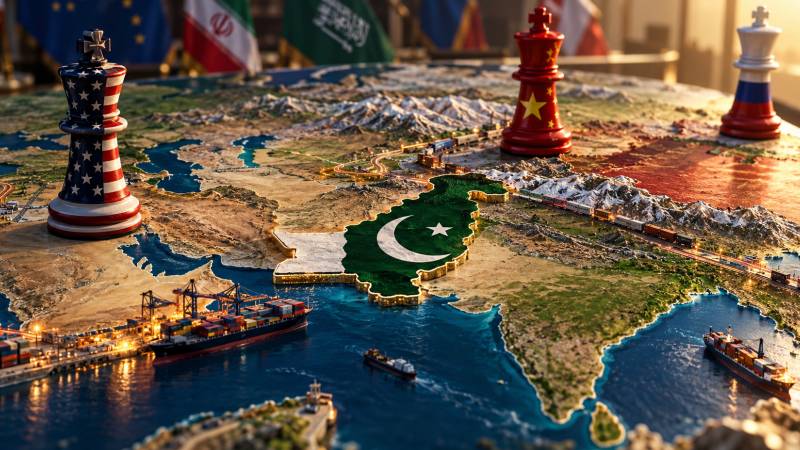
The ongoing geopolitical landscape and the scholarly debate over the emerging global order is not simply confined to whether the old order will survive. The more important question, in my view, is what kind of order will replace it, and where will Pakistan stand in it? Michael Beckley and Hal Brands, in their Foreign Affairs article “Heartland vs. Rimland,” revive the ideas of Mackinder and Spykman to explain the growing competition between a China led continental grouping and the United States maritime coalition. They also highlight the importance of hinge states, countries whose strategic choices can influence the balance between competing blocs.
I find this argument particularly relevant to Pakistan. Interestingly, the authors do not place Pakistan in the same category as India and Saudi Arabia, which they identify as strategically important but structurally uncommitted hinge states. Instead, Pakistan may seem to appear among the countries associated with the broader Heartland grouping. This should encourage Pakistan to undertake a serious critical self-appraisal rather than assume that geography alone will give it strategic importance.
I believe it appropriate to refer to Lord Palmerston’s timeless saying: “We have no eternal allies, and we have no perpetual enemies. Our interests are eternal and it is our duty to follow.” Hence, for Pakistan, national interest must remain the guiding axiom of foreign policy. Foreign relations, be it with China, the United States, Gulf states or Russia, should be analyzed through the prism of their contributions to Pakistan’s long-term security, economic advancement and strategic autonomy.
However, pursuing national interest requires an honest critical self-appraisal as outlined by Jared Diamond in his book, Upheaval: How Nations Cope with Crisis and Change. A nation should first know its weaker points to be able to adapt. Pakistan must ask itself hard questions: Is our economy viable in the long run? Are we secure enough with our resources? Can our institutions act fast at a time of crisis?
The response of Pakistan should be more than the mere mobilization of resources. It should be a readiness plan combined with economic stability, flexibility in action, and unity of the nation.
In this regard, Iranian stance provides something very crucial. Narges Bajoghli and Vali Nasr in their Foreign affairs article, describe how Iran's conflict experience led to the emergence of a stronger state that changed the way its leadership evaluates the Israeli incursion and its weaknesses, hence reevaluating its security policy. Regardless of what opinion one has regarding Iran's overall military performance, the prime takeaway, in my opinion, is the need to ensure that the attack leads to institutional learning instead of being simply used for political applause.
Moreover, the critical analysis of Iran in the ongoing war against the USA indicates, military capability alone could not sustain prolong conflicts. A country’s success at the strategic level overwhelmingly depends upon the support of the whole nation. The people can remain in conflict if they believe the government can protect their life. Thus, the possibility to supply their food, fuel, medicine, electricity, and other relevant stuff for a long time can also be considered one of vital national capacities. Iran has been able to ensure all these facilities so far.
This lesson is of major importance for Pakistan because India is its strategic archrival. Pakistan cannot cautiously assume that the outcome of the conflict of 2025 would prevent a war. As Robert Jervis comments, future conflicts will be interpreted according to the memory of previous ones. The response of Pakistan should be more than the mere mobilization of resources. It should be a readiness plan combined with economic stability, flexibility in action, and unity of the nation. We need to examine past wars to learn from them: what strategies succeeded, what our weak points were and what would have happened if the conflicts had endured for days.
The hinge-state concept becomes relevant here as well. As the rimland Staes are looking to consolidate themselves and are showing less enthusiastic interest in developing the underdeveloped states. The opportunity for Pakistan may lie in being economically and diplomatically relevant to many powers. Its geographical position, ports, CPEC, access to the Arabian Sea, position close to Central Asia and the Middle East suggests possibilities, but geography must be backed by economic strength, institutional capability and national resilience to turn into strategic power.
The critical issue is not about the classification of Pakistan as either the Heartland or the Rimland. The pivotal issue here is whether Pakistan can create enough economic power, national strength, and strategic independence to guarantee that no matter which shape the future world takes, its interests cannot be disregarded. Pakistan must take a leaf from Iran's example, apply Diamond's self-reflection in its case, heed Jervis's warning concerning the durability of strategic memories, and follow Palmerston's axiom regarding the national interest.