

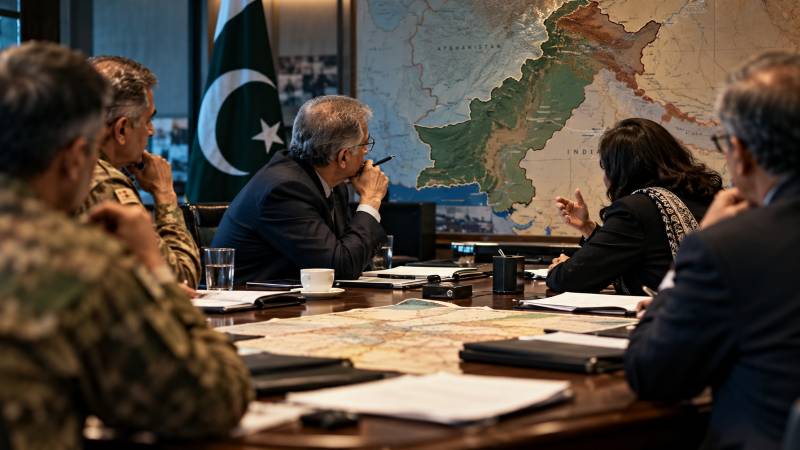
I have spent most of my working life arguing cases, and if the Bar has taught me one thing, it is to be wary when everyone in chambers agrees. Agreement feels like strength. More often, it means nobody has bothered to argue the other side. The seniors I learned from would hand the file to a junior and say, “Go and break it. Better you do it tonight than the judge does it tomorrow.” My question is whether, when Pakistan decides something that matters about India, Afghanistan or Washington, there is anyone in the room whose actual job is to say, “Wait, what if we have this wrong?” I don't think there are enough such people. I also think fixing it is less dramatic than it sounds. Other countries worked this out long ago, usually after getting burnt.
The Americans put civilians at the heart of it. Most CIA analysts come out of universities, not barracks. The Pentagon kept a civilian economist, Andrew Marshall, in charge of its long-range assessments for over forty years. In 2002, the State Department’s small intelligence bureau doubted that Saddam was rebuilding a nuclear programme. It was overruled, and it turned out to be right. Israel’s story is the one I find most telling. After 1973, the Agranat Commission concluded that military intelligence had dominated national assessments so completely that one comfortable belief went unchallenged until the tanks crossed the canal. Israel added a devil’s advocate cell, strengthened the Foreign Ministry’s research unit and later built a National Security Council. Since October 2023, it has been having the same painful argument all over again. India handed its Kargil inquiry to a civilian strategist, K. Subrahmanyam. China’s civilian security ministry maintains its own institute of area specialists. Russia is the cautionary tale: in 2022, Moscow had experts on Ukraine, but nobody was brave enough to tell the Kremlin that the Ukrainians would fight.
None of these countries told its generals to stop thinking. They just made sure the generals were not the only ones doing it. So what about us? I want to be fair. Our armed forces are the most organised institution we have. Their officers go through Kakul, Quetta and the National Defence University. Many have studied abroad, and in May 2025, they held their nerve in a way most of us were proud of. When civilian governments left gaps, and they left many, the army filled them. That is history, not flattery. But being good at something is not the same as hearing every view on it. Our assessments are written, by and large, by men who entered the same academy as teenagers, rose through the same ranks and attended the same courses. That makes for a superb fighting force. It does not make for many dissenting footnotes.
Look at the plumbing. The ISI, which assesses our external threats, still has no founding statute of its own. The first National Security Policy, in January 2022, was drafted under a civilian adviser. A few months later, the post was vacant, and since April 2025, responsibility for the role has rested with the serving Director General of the ISI. With India talking of war, I understand why. But as a lasting arrangement, this means that the person who judges the threat is also the person who advises on what to do about it, however able he may be. Somewhere in that merger, the second opinion gets lost.
We have paid for this before. In August 2021, a good part of our establishment, politicians included, greeted the Taliban’s return to Kabul as a strategic gain. Few would say so now. I am not interested in blaming. I only wonder whether one dissenting paper, put on the table at the right moment, might have cooled the celebration. That brings me to an idea I keep turning over. For decades, we have inducted army officers into the civil and foreign services and given them civilian grades. Why not do the reverse and give civilian experts military rank?
I see the attraction. Ours is a hierarchy, and a Grade 19 civilian among brigadiers will be listened to with courtesy and then ignored. Rank gets you a chair and gets your objection minuted. But I also see the trap. A commissioned officer obeys orders, and his promotion is decided by the very people he is supposed to contradict. Whatever an institution gives, it can take away, and everyone in the room knows it. The Americans tried embedding social scientists inside combat brigades from 2007 to 2014 under something called the Human Terrain System. Placed within the chain of command, they were seen by their own professional association as serving the operation rather than informing it, and the association condemned the scheme.
Compare R. V. Jones. In 1940, he was a 28-year-old civilian physicist, junior to every air marshal at the Air Ministry, who was convinced that the Luftwaffe was navigating by radio beams. Senior people thought he was wrong. Churchill heard him out, sent up an aircraft that same night, and the beams were there. Jones had no rank. What he had was the Prime Minister’s ear. And there is my own profession. America’s military lawyers wear full uniform, yet since 2004, the law has forbidden any Pentagon official from interfering with their independent advice to commanders. They have the rank and a statute to stop it from being turned against them.
Beyond rank, there are a few practical steps. A small National Assessments Staff, half civilian and half military, could produce one honest net assessment a year, with disagreements recorded. A civilian deputy and staff for the National Security Adviser could be appointed when circumstances allow. Above all, we should go and find our own. Pakistanis who have studied international relations, economics, history and technology at the world’s best universities are scattered across foreign faculties, think tanks and international institutions. The State Bank and the Finance Ministry have brought such people home for years. The ISI’s analytical wings and GHQ’s strategic directorates could do the same, with proper vetting, and recruit people who speak Dari, Pashto, Persian, Mandarin and Hindi. Our officers, for their part, should attend civilian universities to earn proper degrees, not just complete short courses.
Being a lawyer, I would also write these provisions into an Act of Parliament. A statute would protect the analyst from being sidelined and protect the institution from the old accusation that it works in the dark. None of this is aimed at our soldiers. Every serious army has already done this to itself and is stronger for it. Back to chambers, then. Every good brief needs someone whose job is to tear it apart before the other side does. Pakistan deserves one too.