

Indeed, it was an unusual confession that governance system has collapsed, however, the people in power don’t have a slightest idea of how ordinary citizens are suffering at the hands of bureaucrats and politicians, particularly in rural areas, where they tightly hold the fort of that collapsed system. Issues of the rural population generally remain far away from the spotlight of mainstream media, causing them to fall through the cracks.
No wonder, the commoners feel helpless and frustrated whenever they need to approach Deputy Commissioner (DC), Senior Police Superintend (SSP) or any other high officials for resolution of any genuine grievance, because often they snub them without properly listening to their story, behaving as if they are the masters rather than public servants. Moreover, hardly any effective mechanism exists to hold these bureaucrats accountable for their day to day working as to why they put certain matters in pending for years and years, what is their decision-making process, how is efficiency and effectiveness of their leadership measured, most importantly, no seems to look at their vastly accumulated assets beyond their known source of income.
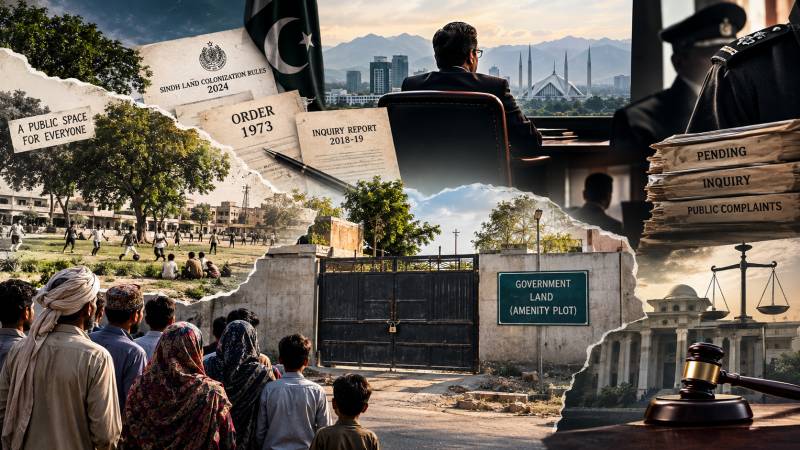
To understand the sheer scale of the crisis, one only needs to look at small town in district Dadu, where a single arbitrary administrative blunder shattered the lives of ordinary citizens. Recently the Deputy Commissioner Dadu Murtaza Shah, on the basis of contrived justification, has approved a construction of a high boundary wall around the Government owned plot situated in the heart of Johi town measuring twelve thousand square feet, opposite Mukhtiarkar office. Following the approval, overnight approximately Rs.5 million rupees were in unusual haste out of the MPA’s funds.
On the face of it, nothing seems wrong with the decision; however, delving deeper reveals how it the way for the land grabber, who had long been using various tactics to seize the property, to take over the precious amenity land. Once a high wall was built, the DC handed over the keys, giving the encroachers exclusive access directly from their adjacent home to the plot while completely shutting out the general public. For decades, this same plot served as an open public space for political, literary, cultural, and social gatherings, as well as sports (waali ball), children’s recreation, and the town’s only taxi stand. In short, it was an amenity plot that served multiple public purposes.
While reviewing the available official records concerning this case, it revealed that the same encroachers had claimed in 1973 that the land belonged to them. Then Deputy Commissioner Dadu had himself visited the site and held the public hearing. After two detailed inquiries into the case, the DC rejected the private claim over the plot as bogus, cancelled the relevant revenue entries and ordered that the plot shall remain vacant.
In the wake of former Prime Minister Benazir Bhutto’s assassination, widespread riots ensued across Sindh, during which revenue records were reportedly set on fire. Operating on the assumption that official record for this specific plot had been destroyed in the unrest, the same encroachers falsely claimed the ownership of the land in 2018 and attempted to construct illegal infrastructure.
Again, the matter was brought to cognizance of DC Dadu, who had directed concerned Assistant Commissioner (AC) to conduct a fresh inquiry into it. In the light of the inquiry report, while rejecting the fake claim the DC maintained his predecessor’s order of 1973 whereby ongoing construction work was halted. Moreover, the inquiry pointed out that the same encroachers have already illegally constructed fours shops and one small petrol pump unit on the plot, that need to be removed. Ironically, nearly eight years have passed since then but no action has been taken against the highlighted illegally construction. On the contrary, the current DC has further gladly strengthened their hands to construct a boundary wall for them, indirectly handing over the possession the plot to them.
With construction of high boundary walls the entire community’s access to the plot has not only been blocked but neighbors’ life has been made extremely difficult as children have been deprived of their playground and the taxi drivers forced out. Sadly, neighbors from nearby who used to sit at the plot to breath in a fresh air in the open space during power cuts, that are frequent and long in rural areas, can no longer do so. Moreover, adjacent the streets have narrowed whereby vehicles access to neighborhood has become impossible, Dr Sikander Jamali feel forced to shift his four decades old clinic to somewhere else in the town. because patients experience unusal hassle in reaching at the clinic due to this unplanned, illegal and inconsiderate construction. Apparently, their long-term scheme is to build shopping centre. To achieve this, they are deploying tactics designed primarily to cut off the public interaction with the plot. Otherwise, the Rs. 5 million spent from public exchequer could have been used to convert this land into a multi-purpose public park - something that is desperately lacking in rural areas.
As far as the Sindh Land Colonization Rules, 2024 are concerned, they protect land reserved or used for amenity purposes. Such land cannot lawfully be diverted or its legal character altered through an administrative decision or under any pretext. In addition, public property must remain open to all for public use. As per the Orders of two previous DCs issued in 1973 and reiterated in 2018-9 the plot should remain open for general public use Therefore, the current Deputy Commissioner has no independent authority to change the character of an amenity plot and do a favor out of the way, directly or indirectly, to his “own people” under any contrived justification in violation of his predecessors’ orders and laws.
Concerned by the situation, some citizens led by Prof. Dr Nadeem first approached MPA Johi and then DC Dadu but in vain. Both fobbed them off that they would look into it. Eventually, these citizens have had to take the matter to the District Criminal Justice Coordination Committee Dadu to look into the matter, restore the plot to its original public amenity status in accordance with the 1973 order. The District and Session Judge Dadu has sought a report from the DC Dadu to explain his position, but the report is still awaited after a month period has passed. Besides that, the citizens have approached the Sindh Information Commission, Government of Sindh to obtain all relevant certified copies of the record under the Right to Information Act; however, the DC has not yet responded to multiple letters issued by the Commission.
Given such state of affairs, do the people at the helm of affairs in Islamabad realize how much the governance system has deteriorated? In this situation, who will safeguard the public interest when public officeholders have carte blanche and remain above the accountability?