

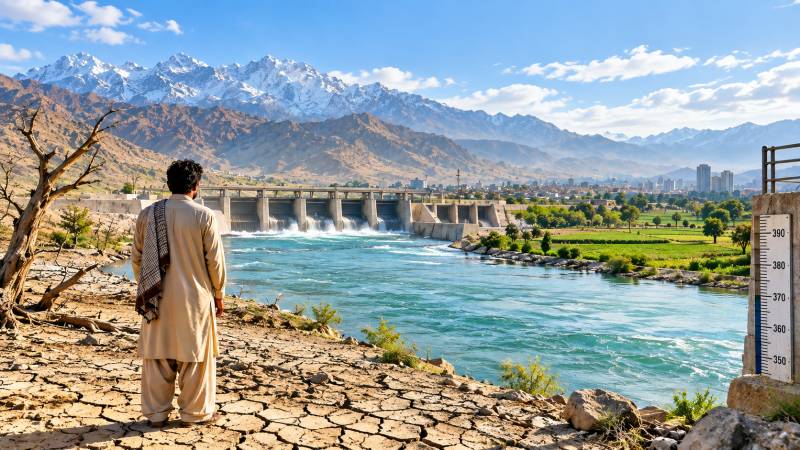
Pakistan's climate and water challenges are often discussed as if they were primarily problems of nature: too little water, too much water, changing rainfall, melting glaciers, floods, droughts and rising temperatures. They are certainly environmental and climatic challenges. But increasingly, they are also governance challenges. The question is not simply whether Pakistan has enough water, whether rainfall will increase or decline, or whether temperatures will continue to rise. The deeper question is whether the institutions responsible for managing these risks have the authority, information, technical capacity, accountability and public support required to respond effectively. This is where the debate on governance reform intersects directly with the debate on water security and climate resilience.
A recent discussion on governance reform rightly points to the distance between citizens and the institutions that make decisions affecting their lives. It argues that decentralization is meaningful only when functions, authority and resources move together, and that government becomes more accountable when it becomes more accessible. A separate analysis highlights: climate variability, changing rainfall patterns, pressure on the Indus Basin, inadequate storage, glacial change and the growing vulnerability of agriculture and cities. Taken together, these arguments point towards a larger conclusion: Pakistan's climate resilience will depend not only on infrastructure and finance, but on whether its governance system has the capacity to use both effectively. The most important governance reform may therefore be less about creating new institutions and more about strengthening the institutions Pakistan already has—by giving them the right skills, data, technology, resources, accountability mechanisms and incentives to perform. In other words, demand-driven capacity building should become a central pillar of Pakistan's climate and water strategy.
Pakistan's vulnerability to climate change is no longer a future scenario. It is a development reality. The 2022 floods provided a devastating demonstration of this vulnerability. More than 33 million people were affected, more than 1,700 people lost their lives and the Post-Disaster Needs Assessment estimated damages of more than US$14.9 billion and economic losses of approximately US$15.2 billion. Recovery and reconstruction needs were estimated at at least US$16.3 billion, excluding additional investments required for longer-term climate adaptation. The effects extended far beyond the immediate loss of homes and infrastructure. Agriculture, livestock, transport, housing, health, education and livelihoods were all affected. Millions of people were pushed into or deeper into poverty. Pakistan's exposure is also reflected in international climate indicators. The latest ND-GAIN Country Index places Pakistan at 147th out of 185 countries, with relatively high vulnerability and low readiness. Its 2024 readiness score was 0.310, while its governance readiness component was particularly weak. The index also identifies water, food, agriculture and disaster preparedness as significant areas of vulnerability. These indicators should not be read simply as rankings. Their greater significance is what they tell us about the relationship between vulnerability and institutional readiness. A country can experience a climate shock because of geography and weather. But the scale of the resulting human and economic damage is influenced by governance: whether warnings reach communities, whether drainage systems are maintained, whether water is allocated transparently, whether agricultural practices reflect water availability, whether local governments have the resources to respond, whether public institutions coordinate, and whether citizens know where responsibility lies. Climate resilience therefore begins before a flood, drought or heat wave occurs. It begins with institutions.
Pakistan’s climate and water challenges are fundamentally governance challenges; building resilience requires more than infrastructure and technical expertise—it requires demand-driven capacity, accountable institutions and informed communities.
Pakistan's water challenge is frequently described in terms of scarcity. That description is incomplete. Pakistan has substantial water resources, but the country faces increasing pressure from population growth, agricultural demand, groundwater depletion, inefficient irrigation, pollution, climate variability and competing demands among provinces, cities, industries, ecosystems and agriculture. The Indus River System is the country's dominant surface-water system and the foundation of its irrigation economy. The system supports agriculture, domestic needs, ecosystems, industry and hydropower. The Indus Basin Irrigation System covers approximately 150,000 square kilometres, equivalent to about 83 percent of Pakistan's cultivated land. This makes one principle particularly important: Pakistan must learn to respect the river as a system, rather than treating water simply as a commodity to be divided. Respecting the river means understanding its ecological, hydrological, agricultural and social functions. It means managing the entire river basin rather than focusing only on individual canals, barrages, reservoirs or provincial allocations. It also means recognizing that a river does not operate according to administrative boundaries. The Indus originates beyond Pakistan's borders and its tributaries flow across a complex Trans boundary basin.
Within Pakistan, its waters are shared among provinces through the Water Apportionment Accord of 1991. The Indus River System Authority, established under the IRSA Act of 1992, has an important role in regulating and monitoring the distribution of Indus River waters among the provinces. IRSA therefore sits at the heart of one of Pakistan's most sensitive governance systems. Its role is not simply technical. It is institutional, constitutional and political. The Authority needs reliable hydrological information, accurate measurements, credible forecasting, transparent procedures and the technical capacity to explain water availability and allocation decisions. Where information is weak or contested, mistrust can quickly become a governance problem. Pakistan has already recognized this challenge.
The development of the Water Accord Apportionment Tool, supported by the Government of Australia and Australia's CSIRO in collaboration with Pakistani institutions, demonstrated the value of combining international technical expertise with domestic institutional knowledge. More recently, investments in telemetry have sought to replace manual processes with real-time information on water flows and gate positions. These initiatives point to an important lesson: technical capacity is not an optional addition to governance. It is part of governance itself. An institution cannot be expected to make credible decisions about water allocation without credible information. Strengthening IRSA means strengthening trust. Water disputes in Pakistan are often framed as political disputes between provinces. But beneath many disagreements is a question of trust. Do provinces trust the data? Do farmers trust the allocations? Do water managers have access to timely information? Can the public understand how water availability was calculated? Can parliamentarians scrutinize the system? Can researchers independently analyses the information? Can citizens see whether commitments are being implemented? These are governance questions. Strengthening IRSA should therefore not be understood merely as strengthening an individual organization. It should mean strengthening the wider water-information and accountability ecosystem around it.
Investment in hydrology, remote sensing, telemetry, data management, modelling, climate forecasting, groundwater monitoring and technical analysis is essential for Pakistan's water security. But investment in technology and technical expertise alone will not resolve the country's water challenges. There is another, less visible capacity gap: the ability to translate complex technical information into information that decision-makers, parliamentarians, farmers, journalists and ordinary citizens can understand and use. Water governance can quickly become inaccessible when discussions are dominated by technical terms, complex hydrological calculations, satellite imagery, flow measurements, modelling assumptions and statistical projections. The result can be a simple disconnect between those who generate evidence and those who have to make decisions based on it. This is where advocacy and community engagement become critical. Know Your Audience: the same evidence should not necessarily be communicated in the same way to an irrigation engineer, a parliamentarian, a farmer, a journalist or a community member.
A hydrologist may need a detailed water-balance model. A parliamentarian may need a two-page evidence brief explaining what the numbers mean for different provinces, agriculture and public expenditure. A farmer may need to know how water availability will affect the next cropping season and whether changing irrigation practices can reduce costs. A journalist may need a clear explanation of the difference between measured data, a modelled estimate and a climate projection. A community may simply need to know: Is there a water risk? When could it occur? How will it affect us? What can we do? Who is responsible for responding? This is not about simplifying the science to the point of losing accuracy. It is about translating evidence without distorting it. From "How much water?" to "What does this mean?" Water debates can become particularly difficult when technical estimates are presented as political facts. For example, discussions about river flows, water availability, groundwater depletion, canal allocations or climate projections can involve complex calculations and different assumptions. Furthermore the institutional arrangements through which technical evidence can be independently scrutinised without undermining the authority of the statutory.
in short, Pakistan’s climate and water challenges are fundamentally governance challenges. Building resilience requires more than infrastructure and technical expertise; it requires demand-driven capacity, accountable institutions and informed communities. The Indus River System must be managed through credible data, stronger technical capacity and transparent institutions such as IRSA. With agriculture consuming about 95% of freshwater withdrawals, crop choices and efficient irrigation are critical. Parliament must strengthen oversight, while media, civil society and communities can translate complex water and climate evidence into understandable, actionable information through a “Know Your Audience” approach. By strengthening existing institutions, advocacy, accountability and responsiveness, Pakistan can turn knowledge into action and build lasting climate resilience.