

President Donald Trump came remarkably close on Sunday to ordering US strikes against Yemen's Houthis. According to The New York Times, military commanders had approved target lists and bombs were being loaded onto American warplanes when Trump changed his mind. For now, there will be no US strikes. The decision followed another appeal from Crown Prince Mohammed bin Salman, who had asked Trump to help stop the rapidly advancing Houthis. Trump initially instructed the Pentagon to prepare for strikes, only to reverse himself days later. Washington will continue intelligence and other assistance, but Saudi Arabia remains largely on its own in fighting the most powerful surviving Iranian proxy. This is an extraordinary outcome of a war that began with US-Israeli attacks on Iran on February 28. Saudi Arabia did not start it, opposed its expansion and exercised strategic patience to keep itself and the GCC outside it. Seven months later, Israel is largely watching, America has stepped back, and Saudi Arabia is fighting the Houthis.
The irony goes further. Washington and the Houthis are in direct communication. Senior Houthi official Mohammed al-Bukhaiti has confirmed that his movement assured the Trump administration that it would not attack American vessels. The Houthis, however, explicitly excluded what he called the “Saudi enemy” from that assurance. This follows the Oman-mediated understanding under which the Houthis stopped attacking American ships and the United States ended its bombing campaign against them. Washington thus has an arrangement protecting its own vessels, while Saudi ships, territory and infrastructure remain legitimate Houthi targets.
Mohammed bin Salman had spent months trying to avoid precisely this situation. Saudi Arabia had wound down its earlier Yemen intervention, restored relations with Iran and concentrated national energies on Vision 2030. Even after the Iran war began, Riyadh resisted being dragged into it and sought to prevent the GCC from becoming another theatre of confrontation. That restraint eventually reached its limits. The Saudi-Houthi truce unravelled in July after Saudi-backed forces struck Sanaa airport to prevent an Iranian aircraft from landing, saying it was carrying weapons for the Houthis. Fighting subsequently intensified, and Houthi forces expanded along Yemen's Red Sea coast towards the strategically vital Bab al-Mandab.
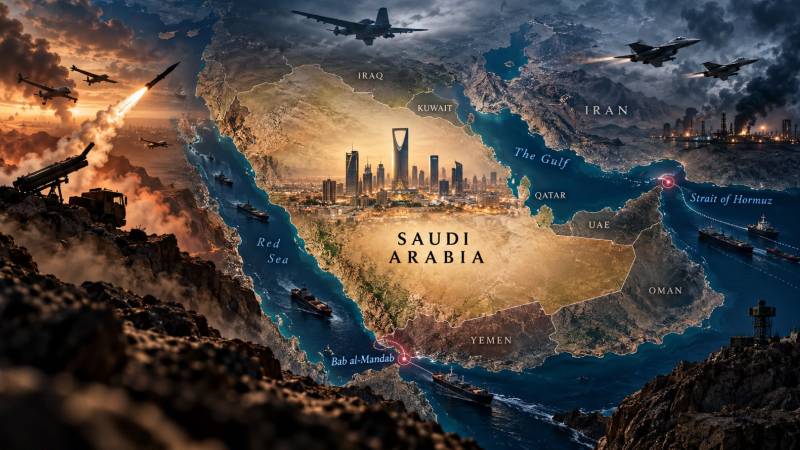
The war has now reached Saudi territory again. Missiles and drones have targeted Riyadh, Saudi energy installations and other strategic sites. Pakistan strongly condemned even a Houthi drone attack targeting Makkah on September 16, describing it as a violation of Saudi sovereignty and an affront to Muslims worldwide. The consequences extend far beyond Yemen. Iran has already severely constrained shipping through the Strait of Hormuz. The Houthis can now exert pressure around Bab al-Mandab, the second maritime gateway connecting Gulf and Asian commerce with the Red Sea and Suez.
The figures are alarming. Before the February war, around 125 large commercial vessels crossed Hormuz daily. Only 17 commodity vessels crossed during the latest weekend. Traffic through Bab al-Mandab has also fallen, while no visible Saudi oil loadings from Yanbu were recorded after September 16. Pressure is therefore mounting simultaneously around both sides of the Arabian Peninsula. The economic burden does not fall equally. Saudi Arabia and the Gulf suffer first. China and other Asian economies follow, along with poorer energy-importing countries across Africa and the Global South. Higher oil prices, insurance premiums, freight costs and disrupted supply chains transmit the consequences far beyond the Middle East. Only months ago, the Gulf was the brightest spot in the Muslim and Arab world. Saudi Vision 2030 was transforming the Kingdom, while the UAE, Qatar and their neighbours were attracting unprecedented investment, tourism, technology and global business. All of this depended upon the peace and stability that the Gulf states had painstakingly tried to create.
Iran's proxy strategy directly threatens this progress. Tehran may deny controlling every Houthi decision, but its military and political support for the movement is well established. Pressure through Hormuz from the east and through an armed ally around Bab al-Mandab from the west gives Iran asymmetric leverage even while it remains under severe military and economic pressure itself. But Iran and its proxies constitute only one part of the emerging regional problem. Israel's expanding military reach has generated a parallel concern across the Arab and Muslim world. Since October 2023, Israeli military operations have extended across Gaza, Lebanon, Syria and eventually Iran itself, reinforcing perceptions of an increasingly unconstrained regional power willing to use force far beyond its borders.
Iran and Israel are bitter adversaries, not partners. Yet their respective strategies can produce outcomes that reinforce each other. Iranian proxies destabilise Arab states and provide Israel with security justifications for wider military action. Israeli expansion and military operations, in turn, enable Tehran and its allies to present themselves as the resistance to Israel and sustain their influence across the Arab world.
The principal losers from this cycle are the Arab states seeking stability and development. Muslims fight Muslims, regional economies suffer, and the space for both Iranian proxy influence and Israeli military expansion grows. Neither serves the Saudi vision of a Middle East increasingly defined by development rather than permanent conflict. This is the wider context in which the Makkah Joint Defence Agreement between Saudi Arabia, Pakistan and Türkiye has suddenly become so important. Its immediate relevance is the threat posed by Iran and its proxies. Over the longer term, it also provides an indigenous deterrent against any regional power seeking to impose its will through military superiority.
The pact should remain defensive. Its purpose is not to enlarge the Yemen war but to deter its enlargement. Türkiye has already indicated that it is prepared to meet Saudi military requirements under the agreement, while Pakistan has repeatedly reaffirmed its commitment to Saudi sovereignty and security. The Houthis clearly recognise this new reality. Al-Bukhaiti has publicly warned Pakistan and Türkiye against joining Saudi Arabia militarily. Iran- and Houthi-aligned social media accounts have simultaneously speculated about activation of the Makkah agreement, while some pro-Israel accounts have conspicuously celebrated Saudi difficulties.
Pakistan and Türkiye should resist attempts to provoke them into an unnecessary expansion of the Yemen war. But they should equally leave no doubt that sustained attacks threatening Saudi territorial integrity, strategic infrastructure or the Holy Cities cannot continue indefinitely without consequences. Pakistan faces the more delicate diplomatic task because it has retained unusually close channels with Tehran. Field Marshal Asim Munir has repeatedly engaged the Iranian leadership, while Interior Minister Mohsin Naqvi has again visited Tehran. Such contacts can serve a useful purpose, particularly if Islamabad is communicating messages on behalf of Saudi Arabia and other concerned powers.
The greatest danger is not only another military escalation, but the loss of a historic opportunity for the Middle East to move from conflict and proxy warfare towards development, stability and cooperation.
Indeed, Pakistan has already conveyed a Saudi warning to Tehran to rein in the Houthis. This diplomatic channel should continue, preferably increasingly through discreet backchannel engagement. Repeated highly visible visits to Tehran while an Iranian-backed movement attacks Saudi Arabia can otherwise create avoidable misperceptions among Saudi and wider Gulf audiences. There are also limits to mediation. Pakistan cannot indefinitely occupy equal political distance between an Iranian-backed force attacking Saudi Arabia and a treaty ally whose security it has formally undertaken to defend. Continued Houthi escalation may eventually force choices that Islamabad has so far successfully avoided. Tehran should understand this before that threshold is reached.
Washington faces an even greater credibility problem. Saudi Arabia, Qatar and the UAE have invested enormous economic and political capital in their American relationship. Their security partnerships with Washington extend back decades. Yet America now has an understanding protecting its own ships from Houthi attacks while Saudi Arabia remains exposed. This feeds a perception already consolidating in parts of the Saudi, Arab and Muslim discourse: Trump can act decisively when he chooses, but his commitments are not always followed by sufficient action when America's regional allies face the consequences. His administration celebrates strategic successes elsewhere, while Saudi Arabia today confronts both Iranian pressure and Houthi attacks without the level of American military support it expected. That perception is dangerous for American interests. The Gulf states have made massive investment commitments to the United States and remain indispensable partners in energy, security and regional diplomacy. They are also part of the broader Arab and Muslim effort to achieve a viable Palestinian settlement and create a more stable Middle East.
Trump has shown elsewhere in the region that he can act independently of Israel when American interests require it. His willingness to restrain Prime Minister Benjamin Netanyahu over Lebanon and Syria and to manage Israeli-Turkish tensions has been positively noticed across the Arab and Muslim world. Continuing that approach would strengthen rather than weaken American influence.
Washington must therefore demonstrate resolve in both directions. Iran and its proxies cannot be permitted to threaten America's Gulf partners with impunity. Israel should equally understand that American support does not provide unlimited freedom for military expansion at the expense of regional stability. Nor does military resolve against the Houthis necessarily mean another endless American war. The United States possesses the intelligence, surveillance and precision-strike capabilities to target missile, drone, command and weapons infrastructure without assuming responsibility for Yemen or becoming permanently involved in its civil war.
The same principle applies to Iran. Diplomacy remains necessary, but diplomacy unsupported by credible deterrence eventually loses effectiveness. Repeated threats followed by postponement encourage adversaries to test how far American restraint can be pushed. A limited and decisive demonstration of force is also different from the prolonged interventions opposed by Trump's MAGA constituency. The objective should be to impose sufficient costs to restore deterrence and then return to diplomacy, rather than begin another Iraq or Afghanistan.
The stakes now extend far beyond another Saudi-Houthi confrontation. The post-February war has exposed a larger contest over the future regional order. Iran seeks to retain influence through proxies and asymmetric pressure. Israel has emerged with unprecedented freedom to project military power. America remains the strongest external power but risks losing credibility among the very Arab states most committed to partnership with it.
Against this stands a different regional vision represented most visibly by Saudi Arabia: economic transformation, connectivity, investment and gradual movement away from the ideological and military conflicts that have devastated the Middle East for decades. Vision 2030 is not merely a Saudi economic programme in this context; its success demonstrates what the region can become when development replaces perpetual confrontation.
The Makkah agreement strengthens that alternative by adding collective deterrence to Saudi economic power. Pakistan and Türkiye bring military depth and political weight, while Saudi Arabia provides the economic and diplomatic centre. Its success should be measured not by whether its members enter the present war, but by whether their combined strength ultimately prevents larger ones.
Saudi Arabia has already demonstrated remarkable strategic patience. That patience should not be mistaken for an unlimited willingness to absorb attacks. Iran must restrain the Houthis, Israel must recognise the limits of military expansion, and Washington must restore confidence that its longstanding partnerships in the Gulf carry obligations as well as benefits. Otherwise, the Middle East will continue moving in precisely the direction Saudi Arabia spent years trying to escape: from development back to conflict, from regional reconciliation back to proxy warfare, and from economic transformation back to insecurity. The greatest casualty would not merely be Saudi Arabia. It would be the possibility of a more peaceful and prosperous Middle East that had finally begun to appear within reach.