

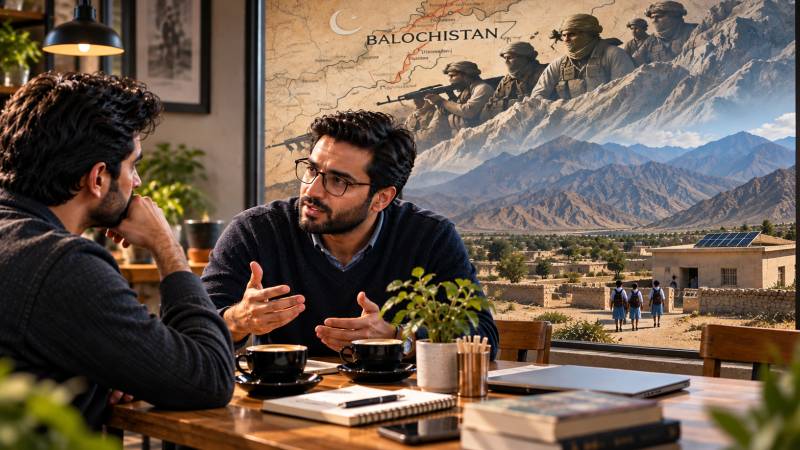
The man across the table had never been to Balochistan. This did not prevent him from explaining it to me. He did it kindly, the way people correct your pronunciation of your own name, certain they are helping. We were in a café in Gulberg, Lahore, with exposed brick and a menu that traced its coffee to a farm in Yirgacheffe. Call the two men Hamza and Ali. The names are invented; the arguments are not. They read the news and followed the columns. When I mentioned where I was from, neither asked which part.
Hamza began with the sardars. “They keep their own people uneducated on purpose,” he said, stirring his coffee without looking at it. “It suits them.” I said tribal power was real, but a poor master key for a province this large and varied. Hamza nodded. “Sure, but the old structures are still there underneath. That’s the real issue
Ali moved to foreign funding. I said that even where outside interference could be demonstrated, it did not automatically explain away disappearances, political exclusion or disputes over resources. He agreed easily, then returned to the part about outside actors making everything worse. There was room for every correction, provided it changed nothing. That was what bothered me. Not because everything they said was false. Tribal power is real. Security shapes life in Balochistan. Claims of outside involvement have long been part of the argument. The problem was the size of the explanations. Each was broad enough to survive whatever came next. A grievance could be reduced to tribal manipulation; a protest to foreign influence; resistance to development to backwardness. Once an explanation can account for everything, it no longer has much reason to ask questions.
Then came development. Hamza said people opposed projects and later complained that nothing was built. Ali spoke about Gwadar, CPEC and what the port was supposed to mean for the region. I had stopped correcting individual claims. I was beginning to notice the structure of the conversation instead. My presence seemed useful because I came from Balochistan. What I actually knew became less useful whenever it complicated the Balochistan already on the table. Quetta came up. Gwadar came up. Sui came up. The names moved around easily, as if familiarity with a map were the same thing as familiarity with a place. It is possible to know every district and remain incurious about everyone living inside it. Neither man asked which part of the province had formed my childhood.
Perhaps this is part of why Balochistan becomes so easy to discuss and so difficult to know: in the national conversation, it arrives already translated into a small vocabulary — insurgency, sardars, minerals, security, development.
I come from a village in Pishin. I know that place intimately. I do not know Turbat, Gwadar or Awaran in the same way, and pretending otherwise would reproduce the mistake irritating me across the table. My experience gives me somewhere to begin speaking about Balochistan, not somewhere to finish. That was the uncertainty I wanted in the conversation: not ignorance, but the possibility that an answer might change the next question.
Hamza and Ali were not rude. Their courtesy made the exchange harder to interrupt. An insult would have given me something clean to object to. Instead, I was answering explanations delivered in reasonable tones by men who had read enough to recognise the province and not enough to doubt their recognition of it. It would be satisfying to leave them there as the villains of the story: two men in a comfortable Lahore café mistaking familiarity with national headlines for knowledge. It would also be dishonest. By then I had started doing my own version of the same thing. I had arrived expecting them not to understand Balochistan. Every familiar argument confirmed me. I was no longer listening to discover what they thought; I was listening for the next thing they would get wrong. Their certainty had irritated me into a certainty of my own.
Perhaps this is part of why Balochistan becomes so easy to discuss and so difficult to know. In the national conversation it arrives already translated into a small vocabulary: insurgency, sardars, minerals, security, development. These are real subjects. They are also efficient ones. They make an enormous and internally varied province manageable in a television segment, a policy panel or a café conversation.
At home, those subjects coexist with concerns too ordinary to travel as well. Water pressure. Board exam results. Whether the phone signal reaches the house. A cousin’s illness. A wedding date. A failed transformer. Whether a child who finishes school will find work nearby or have to leave. These are not minor subjects beside the political ones. They are where politics eventually arrives. Water, electricity, roads, schools and jobs are questions about public money, administrative attention and who gets to expect ordinary things to work.
While Hamza talked about development, I thought about the girls’ primary school in my village. Our community had helped install solar panels there. The questions were not grand. Would the batteries survive the winter? Who would repair them if they failed? What would replacement cost?
It was a small story. That was precisely why it belonged in the conversation. It involved actual people, a real school and problems too specific to disappear inside a slogan. It would not have settled every argument. It might simply have made the discussion narrower, and therefore more honest. I had already decided the story would not interest either man. That was my assumption, not theirs, and by keeping it to myself I made sure it could never be tested. They had spent the evening explaining Balochistan. I had a story about a school there. I didn’t mention it.