

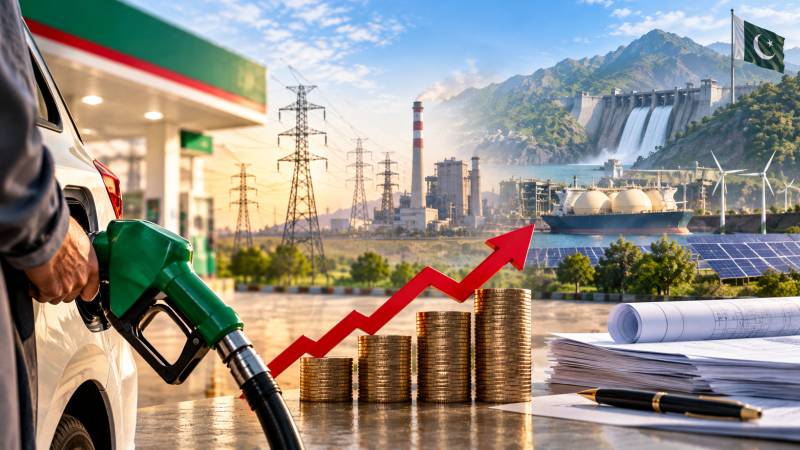
Almost nobody has named the culprit, though everyone in Pakistan knows the victim: the household paying Rs 114 in levy on every litre of petrol. Nearly a year ago—long before the war between Iran and the United States ignited—Hafiz Naeem ur Rehman, Ameer of Jamaat-e-Islami Pakistan, sat across from me with his core team. Their questions were heavy and urgent: How do we fix the crushing circular debt? How do we secure our water and energy future? How do we reinstate the Indus Waters Treaty?
My answer was simple: produce a series of rigorous White Papers on Pakistan’s most critical threats—energy, water, and climate security. I may not be a political scientist, but I know what institutional memory is worth. In a functioning democracy, a genuine opposition doesn't just shout—it exposes failure with undeniable evidence. It dissects the systemic rot, lays bare the ruling regime’s incompetence, and then does the hardest work of all: it delivers real solutions. They nodded, and I have been waiting a year for the first page.
The frustrating part is that JI already owns the machinery. Its Institute of Policy Studies in Islamabad was vibrant under Professor Khurshid Ahmad, a place where research made ministers uncomfortable. Somewhere along the way it became a think tank like most others in Pakistan, a tank only in the sense that it holds the founding vision while the money drains out, with no quality reports to show for it. Meanwhile JI spent months pressing the government to waive the petroleum levy, Rs 114 a litre on petrol and Rs 100 on diesel, arguing, correctly, that 260 million Pakistanis are being crushed by inflation, unemployment and unaffordable fuel and food. But a waiver won at the negotiating table, without ever naming what forced the levy into existence, is a request for mercy. It is not reform. The levy did not fall from the sky. It is a fiscal patch stretched over a hole our own planners dug. Let me show you the scene of the crime.
In 2013, PML-N inherited a power-sector circular debt of about Rs 480 billion and cleared it in 47 days, a genuinely competent start. Then came the decisions that mattered. As CPEC opened, Chinese officials urged Pakistan to build on its own strengths in hydropower, solar and wind. Pakistan's planners declined and committed the country to LNG-fired plants and imported coal, paid for in dollars and exposed to every global price shock.
Left on the shelf were Diamer Bhasha (4,500 MW), Dasu (4,320 MW) and Bunji (7,100 MW), a single project that could generate more electricity annually than all the imported-fuel plants combined. Also ignored was a cheap fix: retrofitting ageing gas-fired plants in Faisalabad, Shahdara and Muzaffargarh, doubling efficiency from 25% to 50% for around $500 million, as India did with 17,500 MW. Pakistan built new sites instead, at an estimated $52 billion in avoidable cost. Thar coal, which Shenhua offered to develop in 2004 at 5.6 cents per unit, collapsed over a 0.3-cent tariff dispute. Pakistanis now pay 12 to 17 cents.
The bill arrived as circular debt: Rs 2.31 trillion in power and Rs 2.084 trillion in gas by the close of FY2023, the latter driven by LNG contracts and two floating terminals built to feed plants that never needed to exist. This is what marched Islamabad to Washington's door. The IMF did not create our dependency. Its conditions, the levy included, are the terms of a rescue, not the cause of the drowning.
Pakistan needed rigorous white papers that could expose the decisions behind circular debt, imported fuel dependence and costly contracts not another cycle of press conferences and political slogans.
Now to the part that should keep JI's leadership awake. Beneath Sindh and Balochistan, in the Sembar and Ranikot formations, lies shale I have studied for over a decade. American geologists who reviewed our data told me, almost in disbelief, that in places our rock rivals Argentina's Vaca Muerta, the formation that turned Argentina from a gas importer into an exporter.
In 2016, a credible investor offered to develop our shale gas at a guaranteed $9 per MMBtu: domestic gas, no ships, no dollar drain. The offer was not accepted. We turned to imported LNG and paid more than $25 at the crisis peak. Our mills lost their edge to Bangladesh and Vietnam, and children in Larkana and Khuzdar studied by candlelight. What Pakistan needed was about eight pages: a framework on acreage, royalties, permitting and dispute resolution, the modest document that brought Chevron, Shell and TotalEnergies to Argentina. And in all this time, I cannot recall Jamaat-e-Islami raising shale gas once. Not in a white paper, not in a Senate speech, not in a single sustained campaign.
I say this with the severity it deserves. JI presents itself as the party of the common man and has spoken for years, rightly, about fuel, electricity and the factory worker. Yet on the one subject where all three converge, a resource under our own soil that could lower fuel prices, power tariffs and the import bill together, it has never led. It has never even asked the question. A party that claims to fight poverty while ignoring the largest untapped answer to it has confused the theatre of concern with the work of it.
JI must also ask itself a harder question: why is Gen Z and youth not joining its ranks? Perhaps because young Pakistanis can read the network diagram. They look at JI's server and see it hosted in the same data centre where the government operates. Its marches, however loud, seem to exist to release the pressure of the public, a safety valve that lets off steam so the boiler never bursts and never asks why the pressure keeps building. The youth know it. A generation raised online can smell a scripted performance from a mile away, and it will not be moved by a manoeuvre any more than by a hashtag.
It would be comfortable to make JI the lone villain, but it is an illustration of a disease that runs through the whole political class. Not PML-N, not PPP, not PTI, not JI has made a habit of publishing white papers grounded in verifiable data on the power sector, the gas sector, or the debt structures strangling the country. A white paper takes months of technical work and offers no viral moment. A fiery press conference takes an afternoon and leads the evening bulletin. Pakistani politics has chosen the afternoon every time.
Here is the inconvenient truth. None of this is fixed in stone. The power-purchase agreements with the IPPs, the LNG contract with Qatar, and the terminal contracts are commercial agreements, not scripture. Men negotiated them and men can renegotiate them. Pakistan has walked back agreements before when it chose to. It has never chosen to here. So the snake is not hiding in Washington, New Delhi or in Tel Aviv. It is coiled in the Planning Commission and in the ministries that signed these deals, extended them, and defended them long after the cost was obvious. Who are they? That is exactly the question a white paper, not a press conference, is built to answer.
JI considers itself the truest follower of Islam, and the Quran places Al-Haqq, the Truth, at the summit of reality, rooted in divine revelation. Truth is not a tone. It is a name spoken plainly. Yet JI has never bluntly put the question to Ahsan Iqbal, the Planning Minister and the government's main negotiator: Sir, you are the architect of the imported coal-fired plants that built this debt trap, and you hailed them as a game changer. Was it a game, and who did it change? Ask it, Jamaat, with figures attached. Gen Z will lean in the moment a party calls a spade a spade.
This is the real dilemma of Pakistan's political system. We say governance has collapsed because governments are careless, and they are. But it has also collapsed on the opposition benches, where parties that believe in the street and not the library have never produced the reports that would force a government to answer. A ruling party that is never audited grows reckless, and an opposition that never writes anything down grows comfortable. Both survive, and the public pays. A crowd holding an angry slogan is a nuisance a government can outlast. A crowd holding an audited, costed document is a danger it cannot ignore. I offered that choice to the Ameer a year ago, and I offer it again to every party. Until someone takes it, we will keep negotiating over the size of the tax while the debt that produced it compounds, unnamed and unaccountable.