

Any proposal for a Karachi province must begin by taking the people of Sindh into confidence. Karachi has deep historical, cultural and economic ties with the rest of the province. A proposal to change its administrative status must explain, patiently and concretely, how people on both sides would benefit and how their rights would be protected. In the present coalition setting, an initiative of this importance cannot realistically advance without taking coalition partners and other stakeholders into confidence. The PPP, other parliamentary parties and representatives of the affected communities should be invited to negotiate a settlement. Broad political agreement should precede the constitutional process. Article 239 of the Constitution of Pakistan requires two-thirds of the total membership of both the National Assembly and Senate and, where Sindh’s boundaries are altered, the same majority in the Sindh Assembly before presidential assent. There is therefore no workable route that bypasses Sindh’s elected representatives.
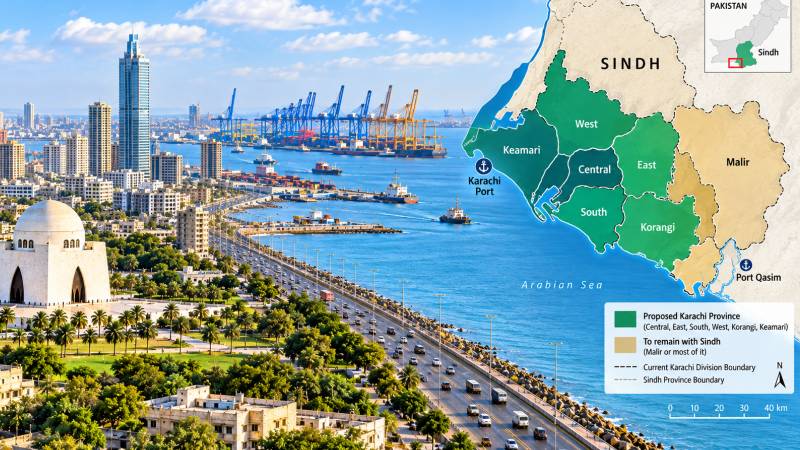
The message to the PPP and the people it represents should be reassuring: Karachi is yours too. Your homes, businesses and connection with the city would remain secure. Under the arrangement proposed here, Sindh would retain its coastline outside the proposed Karachi province, including Port Qasim and the adjoining industrial areas in Malir. Sindh would continue to have a major maritime and industrial base, with considerable room for development.
My suggestion is to discuss a Karachi province comprising Central, East, South, West, Korangi and Keamari districts, while Malir, or most of it, remains with Sindh. According to the Area and Maps information published by the Commissioner Karachi’s office, Malir covers 2,160 of Karachi Division’s 3,527 square kilometres—about 61 per cent of its area. The precise boundary, including the airport area, should be settled after consultation with residents and examination of transport links, settlements and essential services.
The economic reassurance is substantial. In its official port profile, the Port Qasim Authority reports 18 berths, annual handling capacity of 89 million tonnes and an industrial zone covering 15,474 acres. Karachi Port at Keamari would lie within the proposed Karachi province, while Port Qasim would remain within Sindh. Both are major gateways: the Ministry of Finance’s Pakistan Economic Survey 2025–26, in its chapter on Transport and Communications, records cargo of approximately 42.03 million tonnes at Karachi Port and 36.42 million tonnes at Port Qasim during July 2025–March 2026. These figures establish the scale of activity at both ports, without making unsupported claims about their relative efficiency.
Both ports should continue under federal administration. Their location within a province would not automatically make federal customs receipts provincial revenue. The settlement would have to identify the revenues available to each province, alongside the benefits of industry, employment and commerce. Sindh’s financial viability must be demonstrated through figures that all parties can examine. Why consider this arrangement? Karachi’s residents need dependable water, functioning sewers, clean streets, usable roads and public transport. Housing, pollution, public safety, schools and hospitals require sustained attention. The city needs an administration that can be held directly responsible when services fail, together with empowered local governments capable of doing the daily work.
Karachi’s residents need an administration answerable for their city, while deprived communities across Sindh need a government that gives them sustained attention.
Interior Sindh needs equally determined attention. In deprived communities, safe drinking water, sanitation, accessible healthcare, functioning schools and secure livelihoods remain pressing concerns. Flood damage adds to these burdens. These are questions of everyday dignity for families who cannot afford to wait indefinitely for development to reach them.
A Sindh government principally based in Hyderabad could devote more time to these communities. Karachi’s recurring emergencies place heavy demands on the provincial leadership. With a separate administration responsible for the metropolis, Sindh’s Chief Minister, ministers and senior officers could concentrate more closely on its smaller cities, towns and villages. That opportunity should be supported by regular district visits, public hearings and published progress on development schemes. Moving offices would serve little purpose if official habits remained unchanged.
The understanding between the two provinces should rest on a simple principle: “Karachi sab ka.” People from Sindh should remain free to live, own property and conduct lawful business in Karachi, and Karachi’s residents should enjoy the same freedom in Sindh. Articles 15, 18 and 23 of the Constitution protect movement and residence, lawful business and property rights respectively, subject to their constitutional qualifications. Existing homes, businesses and investments must be protected throughout the transition. Sindh should be able to establish a Sindh House in Karachi for its visiting Chief Minister, Governor and officials, with a liaison office for official work. Suitable land could be allotted at the applicable government rate through a transparent agreement. Sindh could also establish accommodation and other facilities in the portion of Malir remaining within its jurisdiction. Hyderabad would nevertheless be the seat of its principal institutions.
The move could take place gradually. Karachi’s Chief Minister, Governor and ministers could initially use rented offices and residences, while its secretariat and High Court used existing premises under the agreed transition arrangements. Sindh’s institutions would move to Hyderabad as accommodation became available. The Sindh High Court’s published court information confirms that a Circuit Court already operates in Hyderabad; its judicial strength, sittings, staff and facilities should be increased, through the competent authorities, pending establishment of the principal High Court there.
The Federal Government should undertake construction of Sindh’s assembly building, secretariat, High Court premises, Governor’s House and Chief Minister’s offices and residence in Hyderabad. Sindh and Karachi should contribute equally to the agreed cost, through legally authorised arrangements for deductions from their respective NFC shares. The schedule should protect essential public services. The Federation should separately bear the salaries of additional officers and employees required for the transition for one year. Federal supervision should carry firm completion dates, transparent procurement and public reporting of expenditure. Rural Sindh should also receive an explicit assurance that its existing share in federal civil-service recruitment will be protected through the necessary legal arrangements. Any redistribution must account fairly for Hyderabad and Sukkur, rather than treating the entire existing urban-Sindh allocation as Karachi’s entitlement.
I would propose a further safeguard to ensure that rural opportunities reach their intended beneficiaries. Candidates claiming the rural Sindh quota should establish genuine rural residence and show verified education in rural Sindh through Intermediate or its equivalent. Students studying elsewhere on verified scholarships should be exempt from this educational-location requirement. After Intermediate, university, professional and specialised education anywhere in Pakistan or abroad should not affect eligibility. This proposed reform would need clear definitions, fair verification and a right of appeal.
A committee chaired by a federal minister, comprising parliamentarians and senior officials from the Federation and Sindh, with representation from Karachi and other affected areas, should prepare the negotiated package. Its work should cover boundaries, assets, liabilities, employees, pensions, representation and finances. It should examine whether Malir’s airport area and other strategically important locations belong within Karachi or Sindh, guided by residents’ interests and practical access. Water, drainage, transport, policing and access to both ports would require binding arrangements between the provinces. Judicial matters must remain with the competent constitutional authorities. These details deserve discussion before political positions harden. The PPP and other parties should have a full opportunity to shape the proposal and secure protections for the people they represent. Karachi’s residents need an administration answerable for their city, while deprived communities across Sindh need a government that gives them sustained attention. An agreement that serves both purposes, preserves Sindh’s economic strength and keeps Karachi open to everyone is worth negotiating.