

While universities are mushrooming across Pakistan, turning higher education into an industry by making degree acquisition increasingly easier, the quality of research remains far from satisfactory. In the field of English Studies, this research deficit has been particularly acute due to the scarcity of impactful critical scholarship produced by indigenous researchers. Although this gap has begun to narrow in recent years through valuable contributions in the areas of feminism and the theorisation of Pakistani Anglophone literature, the area of critical theory remained conspicuously barren. Indigenous scholarship was virtually absent from the monographs used for the teaching and learning of literary theory, despite the centrality of critical theory to contemporary literary research.
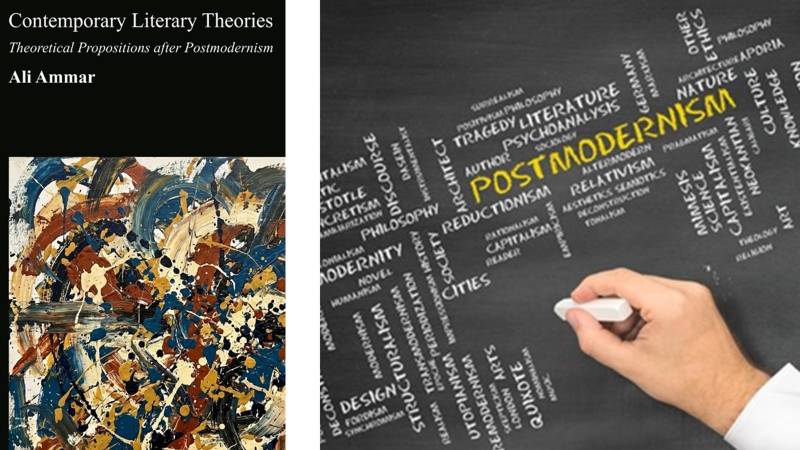
Ali Ammar, who earned his PhD from Air University, Islamabad, and possesses extensive teaching experience across various institutions of higher education, has accomplished a remarkable feat by authoring a book on contemporary critical theory that surpasses many existing works in both scope and style. Contemporary Literary Theories: Theoretical Propositions after Postmodernism, published by Cambridge Scholars Publishing, Newcastle upon Tyne, UK, is a refreshing and significant addition to the growing body of reference works on literary and critical theory.
Unlike conventional textbooks that trace the evolution of literary theory from New Criticism to Ecocriticism in a predictable and often formulaic manner, Ammar's work offers fresh perspectives on theoretical approaches that are particularly relevant to the contemporary intellectual climate. It engages with an era that has grown increasingly sceptical of postmodernism's rejection of grand narratives, its questioning of the authenticity of literary works through irony and pastiche, its privileging of subjective experience over objective reality, and its tendency to trivialise emotions and human values.
Ali Ammar engages with an era that has grown increasingly sceptical of postmodernism's rejection of grand narratives and its tendency to trivialise emotions and human values
In response to these developments, Ammar introduces readers to a range of emerging theoretical paradigms, including metamodernism, performatism, renewalism, remodernism, digimodernism, altermodernism, cosmomodernism, post-postmodernism, hypermodernism, Irmtraud Huber's concepts of reconstructive fantasies and present-tense narration, as well as globalism and planetarism. He presents these approaches as productive theoretical frameworks that contemporary scholars can employ in their literary research. Collectively, these theories reflect Ammar's conviction that researchers should be encouraged to engage with intellectual paradigms that speak directly to the complexities of the present rather than remain confined to the theoretical labyrinths of the twentieth century, which were largely shaped by thinkers from the Western hemisphere.
Another notable strength of this book lies in Ammar's lucid and engaging style of exposition. He explains each theoretical approach not only through its application to literary texts but also by drawing examples from diverse forms of cultural production, including music, Hollywood films, independent cinema, and popular web-streaming platforms such as Netflix and Prime Video. This interdisciplinary approach enhances the accessibility of the book, enabling young researchers to grasp complex theoretical concepts through cultural texts with which they are already familiar.
The idea of writing a book on contemporary literary theory in the wake of the decline—or, as some would argue, the demise—of postmodernism appears to have taken shape when Ali Ammar published his research article, "Labeling Contemporary Literary Theory: Attitudes of Depressiveness and Happiness" in the December 2017 issue of the Journal of Social Sciences (Government College University, Faisalabad). In that article, he introduces and lucidly explains several of the theoretical approaches that are examined in much greater depth in the present volume. The book may therefore be seen as the culmination of an intellectual journey that began several years earlier.
Indeed, one of the hallmarks of a serious researcher is the ability to remain committed to a line of intellectual inquiry rather than abandoning it with the passage of time. Instead, such scholars continue to refine, expand, and deepen their ideas, enabling them to make substantive scholarly interventions that shape future research. Ammar's command of the diverse theoretical paradigms discussed in this book, together with the clarity and coherence of his exposition, reflects the intellectual maturity and scholarly rigour that characterise his work as a literary researcher.
Ali Ammar's work heralds a new chapter in English Studies in Pakistan. For decades, English departments across the country's institutions remained overwhelmingly dominated by Anglo-American literary and critical texts. Beginning in the early 2000s, however, these departments gradually embraced the shift from the study of English literature to literatures in English and increasingly incorporated twentieth-century critical theories into their curricula. Today, even that theoretical framework appears insufficient to address the rapidly changing intellectual and cultural realities of the twenty-first century. In this context, Contemporary Literary Theories: Theoretical Propositions after Postmodernism emerges as a timely, relevant, and much-needed contribution by a scholar whose work deserves serious attention from students and researchers alike.