


Before proceeding further on our current river water disputes with India, there should be no doubt in any Indian mind that any diversion of rivers that are allocated to Pakistan under the Indus Water Treaty (IWT) of 1960 is an act of war and, as enunciated by the Pakistani government many times, it will be treated and responded to as such. The people of Pakistan do not fear war or death. When the choice is between dying of thirst and fighting, our option is foretold, and we have the means to implement our option. In the meantime, the world too remains on edge.

In recent days, Indian rhetoric and actions have been picking up pace with conflicting statements. While the RSS ideologues are hinting at peace overtures, the Indian army chief said something about geography and history. As for Pakistan, and even peaceniks like this author, we neither have any trust in the intentions of the former nor in the abilities of the latter. Rhetoric often gets the better of our eastern neighbours; hence, we don't give credence to any verbal assurances or threats. The taste of the pudding is in the eating. Try diverting the rivers and watch how geography and history are altered. India has taken the first steps in this direction. As pointed out by water expert Arshad Abbasi in a recent article, India not only is holding the IWT in abeyance, she has commenced construction of a 23-km-long tunnel that will divert the waters of the River Chandra, a tributary of the Chenab, to a tributary of the River Beas. India has experience building tunnels in the area, as it built a road tunnel named Atal, after Atal Bihari Bajpai, the ex-PM of India. The 9-km-long tunnel, the longest single-tube tunnel in the world above 10,000 feet, connects the Chenab and Beas Valleys. Now, the water from the former will flow to the latter, in utter violation of the IWT.
The total annual discharge of the Indus River Basin averages about 137 to 146 Million Acre-Feet (MAF). Under the 1960 IWT, Pakistan receives approximately 84% of this, equivalent to about 142 MAF, while India receives the remaining 16%. India is determined to change this equation.
The IWT was brokered and approved by the World Bank, and recently backed as validated by the Permanent Court of Arbitration at The Hague. International treaties are sacrosanct as long as signatories adhere to them. When a stronger party feels that it has the muscle to enforce it, as the US frequently does, the weaker party cannot unilaterally abrogate it. However, in the reverse case, if the stronger party feels that it can ignore a treaty it has signed with a weaker nation, the treaty remains in abeyance. When India declared the IWT to be in abeyance and no longer effective, she was in fact declaring that she is powerful enough not to be obliged to Pakistan or any international organisation. Therefore, for Pakistan, the test is simple! Can it let India get away with this breach of the water treaty without reprisals? The RSS breed understands only power, as it is immune to peaceful overtures. Hopefully, not only shall the custodians of Pakistan respond to this aggression, but they will also do so to create deterrence for the future.
When the choice is between dying of thirst and fighting, our option is foretold – and we have the means to implement our option
This author is no expert on water issues. Syed Jamaat Ali Shah remained Pakistan’s Indus Water Commissioner in the first decade of this century but was removed for reported negligence, but this author has no knowledge of whether these allegations were technical, ethical, or political. However, there are several knowledgeable experts on water issues who agree that Pakistan has woefully lagged in constructing dams and water storage facilities. The River Indus has several feasible dam sites in Gilgit-Baltistan itself, including Shyok, where the Shyok River merges with the Indus about 100 km upstream of Skardu; Katzarah, where the Shigar River joins the Indus at Skardu; and Bunji, a little downstream of Jaglot on the Indus. Pakistan has a water storage capacity of 90 days, or perhaps of 30 days only, both figures being given by the Planning Commission. This is against the regional figure of 120 days and the world standard of 300 days. Even with the completion of the Bhasha, Mohmand, and Dasu dams, the storage will increase to 45 days. If a political consensus for the Kalabagh Dam is achieved in the future, it will add 8 MAF, or about 7 days of storage capacity. As against this, the Aswan Dam in Egypt has a storage of 1,000 days, the Colorado in the US and the Murray-Darling in Australia have 900 days each, the Orange River in South Africa has 500 days, and India has 320 days. The neglect in creating water storage facilities is criminal, as it mortgages the future of our children and grandchildren.
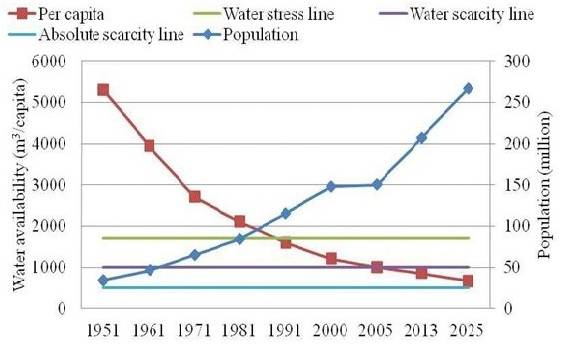
According to the Pakistan Council of Research in Water Resources (PCRWR), as against the per capita requirement of 1700 m3 of water, Pakistan fell below this figure in 1990, to less than 1000 m3 in 2005, and below 500 m3 in 2025, which is the ‘absolute water scarcity’ stage. The corresponding PCRWR graph placed below shows a direct relationship between population rise and water scarcity. Additionally, drinking water in Pakistan is unsafe, with only 18% of samples found fit.
In the case of Islamabad-Rawalpindi, the Dotara Dam upstream of the Khanpur Dam on the Haro River, the Shahdara Dam on a water stream near Saidpur model village, and the Dadocha Dam on the Ling stream, a tributary of the Soan River, should have been built a long time ago, but our lack of efficiency is punishing the people. Dadocha, near Rawat, is a case that proves the point of difficulties in execution arising due to delays. The dam, projected to provide 25 MGD of water to Rawalpindi, was planned in 2001 but was delayed. Later, the land for its water storage was acquired by the DHA and the case went under litigation. Now the dam is under construction with a completion date of 2029; a tragic delay of two decades from the original plan. Dotara will have a live storage of 0.1 MAF and supply 72 million gallons (MG), whereas Shahdara will provide 10 MG of much-needed water per day to the twin cities.
Pakistan has been slow in creating water storages—in fact, painfully slow as compared to India, with whom we are in contention for the water distribution of the Indus basin rivers. It’s true that there are some genuine provincial issues that need to be resolved, especially the ones raised by Sindh. The intrusion of seawater in the Indus delta, in the districts of Thatta, Sajawal, and Badin, is of serious concern to farmers and fishermen. The province needs an annual discharge of 8.5 to 15 MAF, or 1.0 MAF per month, below the Kotri barrage. Sindh and KP also have reservations against the Kalabagh Dam, one of the largest possible dams over the Indus and also the easiest to build. Looking at the gorge above this dam site, it is clear that nature created it for us to store water here. Until 1977, when the then-government had commenced work, the dam was not politicised as it subsequently came to be. Now, no government finds the political will to create a consensus on its construction.
However, there are other sites for major and minor dams that are non-controversial but have not been taken up. Three are mentioned above. There are others like the Kurram-Tangi Dam in North Waziristan, the Nai Gaj Dam in Dadu, the Naulong Dam in Jhal Magsi, and the Soan River Dam in Potohar (first identified in 1955), which seem to have taken forever and have either yet to start or have been under construction for a long time. This is criminal neglect. There are several sites for small dams in KP, GB, and Balochistan which must be built as a top priority.
Pakistan’s share of rivers under the IWT have their sources in India and are vulnerable to Indian actions. The most vulnerable of the Pakistan-allocated rivers originating from India is the Chenab. India has already built or is building a number of hydroelectric projects on this river, including Baglihar (900 MW), Salal Dam (690 MW), and Dulhasti-I (390 MW), which are operational, and Sawalkote (1,856 MW), Ratle (850 MW), Kiru (624 MW), Kwar (540 MW), and Dulhasti Stage-II (258 MW), which are under construction. India is authorised under the Indus Water Treaty to store up to 1.2 MAF of river discharge water in projects along the Chenab against a total annual discharge of 30-33 MAF. Existing Indian-built, run-of-the-river hydroelectric dams in the basin have a combined active (live) storage capacity of roughly 0.26 MAF, still short of its allocation by a large margin. India has launched the Rs 2,600 crore Chenab projects amid the Indus treaty freeze with Pakistan.
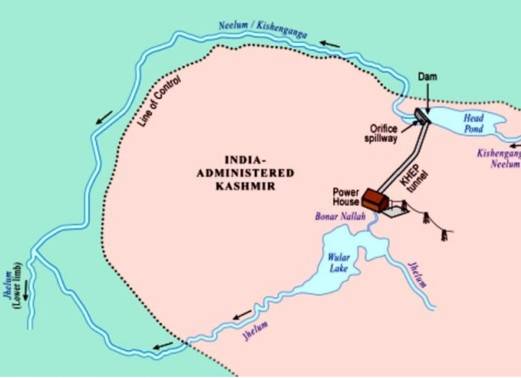
The largest river diversion project in Kashmir is the 100-km-long diversion of the Kishenganga-Neelum River from the Gurez Valley, where a pondage dam has been built, to Wular Lake on the Jhelum River, where the powerhouse exists. Many misleading projections have been fed to the media in Pakistan about this project. However, as the Neelum River is a tributary of the Jhelum, Pakistan is not deprived of any water. Inter-tributary diversions are permitted under the IWT. This project is similar to the Neelum-Jhelum Hydropower Project, where the water of the Neelum is diverted to the River Jhelum. The only breach of the treaty would occur if it becomes technically and politically feasible for India to divert the waters of the River Chandra, a tributary of the Chenab, to the Beas. The capacity of this diversion is 1.9 MAF of water, a large number, which should be countered by international arbitration, or through force, whatever it may lead to.
The water crisis is a question of life and death for the country. Pakistan needs to protect the IWT and seriously undertake the construction of large and small dams to enhance water storage.