

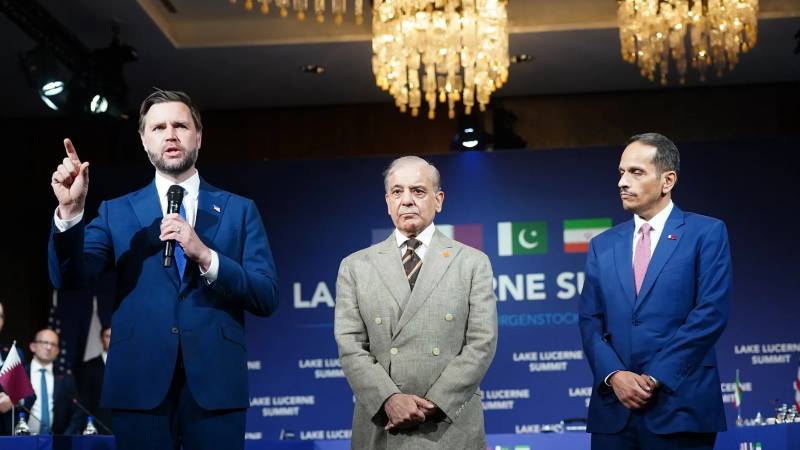
The first session of high-level talks under the Islamabad Memorandum of Understanding (MoU), concluded in Bürgenstock, Switzerland, represents a significant step forward in structured diplomacy between the Islamic Republic of Iran and the United States of America, with the Islamic Republic of Pakistan and the State of Qatar playing a central and increasingly influential facilitation role.
Far from being a conventional round of negotiations, the Lake Lucerne Summit is best understood as the emergence of a new diplomatic framework—one in which Pakistan, in particular, has positioned itself as a pivotal bridge between competing regional and global interests. The outcome reflects not only progress between Washington and Tehran, but also the growing capacity of Pakistan to shape high-stakes diplomatic outcomes beyond its immediate region.
At the core of the summit’s achievement is the establishment of a structured, multi-layered negotiation architecture. This includes a High-Level Committee tasked with political oversight, supported by technical working groups focused on nuclear issues, sanctions, compliance mechanisms, and implementation. Together, these bodies are designed to ensure continuity, accountability, and steady progress towards a final agreement.
What distinguishes this process from previous diplomatic efforts is the degree of institutionalisation. Rather than relying on intermittent political engagement, the framework creates sustained channels of dialogue and coordination. This shift is widely seen as essential for managing one of the world’s most complex and long-standing geopolitical disputes.
A particularly important development is the establishment of direct communication channels between the parties. These are intended to reduce misunderstandings, prevent escalation, and strengthen crisis management—especially in sensitive areas such as maritime security in the Strait of Hormuz. Alongside this, a Lebanon de-confliction cell has been created to help stabilise one of the region’s most volatile conflict theatres.
Rather than remaining on the periphery of major geopolitical negotiations, Islamabad has positioned itself at the centre of a process that could shape regional stability for years to come
Pakistan’s role in shaping and enabling these mechanisms has been widely noted within diplomatic circles. As a co-facilitator alongside Qatar, Islamabad has not only provided diplomatic support but has also helped design the procedural backbone of the negotiations. This includes contributing to the structure of oversight mechanisms, communication channels, and implementation frameworks that now define the process.
Iranian Foreign Minister Abbas Araghchi credited the mediation efforts of Pakistan and Qatar as instrumental in achieving the breakthrough in Switzerland, underscoring Pakistan’s growing profile as a credible intermediary capable of engaging both Western and regional actors simultaneously.
Beyond procedural contributions, Pakistan’s involvement is increasingly being viewed as strategically significant. Its participation reflects a broader diplomatic evolution in which mid-power states are playing a more active role in conflict mediation and global problem-solving. For Islamabad, the summit reinforces its position as a facilitator of dialogue in situations where traditional diplomatic channels have struggled to deliver sustained results.
For the United States, engagement in this Pakistan-facilitated framework signals an acknowledgment of the value of trusted intermediaries in navigating complex regional disputes. For Iran, Pakistan’s proximity, historical ties, and diplomatic credibility in the broader Muslim world provide reassurance that negotiations are being conducted within a balanced and regionally informed context.
The summit’s 60-day roadmap towards a comprehensive agreement further highlights the importance of sustained facilitation. Pakistan’s role is expected to be critical not only in convening continued dialogue but also in ensuring that technical negotiations remain aligned with political objectives. This includes supporting continuity between working groups and maintaining momentum across parallel tracks of discussion.
In parallel, the creation of structured mechanisms for sanctions discussions, potential economic adjustments, and regional security coordination reflects a broader attempt to link diplomacy with tangible outcomes. If successfully implemented, these steps could open pathways towards reduced tensions, improved economic conditions, and enhanced regional stability.
Pakistan’s diplomatic contribution is also evident in the establishment of the Lebanon de-confliction mechanism. By helping facilitate coordination among multiple stakeholders, Islamabad has helped introduce a practical tool for reducing conflict intensity and improving compliance with existing understandings. This approach aligns with Pakistan’s broader emphasis on de-escalation and multilateral engagement.
Equally important is the mechanism for maritime communication in the Strait of Hormuz. Here again, Pakistan’s role in supporting the creation of real-time communication channels reflects an effort to reduce the risk of miscalculation in one of the world’s most strategically sensitive waterways. The institutionalisation of such channels underscores a shift towards preventive diplomacy rather than reactive crisis management.
While the full outcomes of the Lake Lucerne Summit will depend on implementation over the coming weeks, the initial framework reflects a notable achievement in diplomatic design. It establishes not only a pathway for United States–Iran engagement but also a model in which Pakistan and Qatar serve as key facilitators of structured, sustained dialogue.
For Pakistan in particular, the summit represents an expansion of its diplomatic footprint and a reinforcement of its role as a constructive actor in global affairs. Rather than remaining on the periphery of major geopolitical negotiations, Islamabad has positioned itself at the centre of a process that could shape regional stability for years to come.
As the 60-day negotiation window progresses, the effectiveness of this framework will be tested. Yet the Lake Lucerne Summit has already achieved a significant milestone: it has demonstrated that with structured mediation and credible facilitation, even deeply entrenched geopolitical disputes can be brought into a managed and forward-moving diplomatic process.