

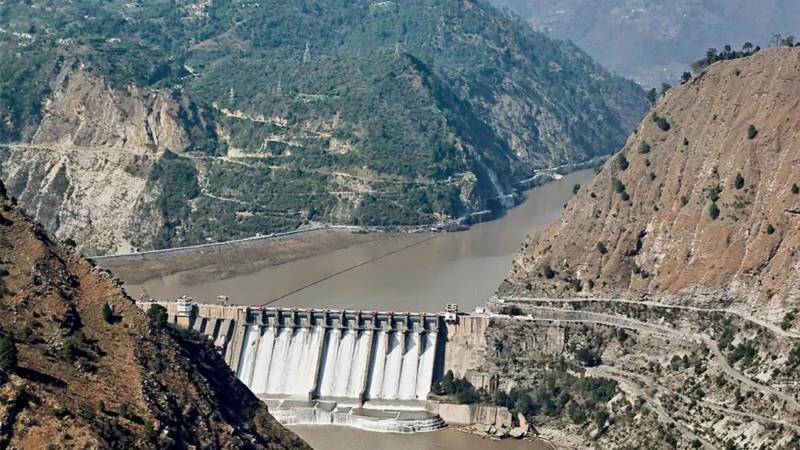
In 1960, when Eugene Black and the World Bank brokered the Indus Waters Treaty, they did not simply settle a dispute between two new states. They built — with the money of seven nations — the physical infrastructure that made the settlement real. That distinction matters enormously today, as India signals its intent to alter water flows on the western rivers in the aftermath of the treaty's announced suspension.
A Treaty Built on Foreign Treasuries, Not Just Foreign Goodwill
The numbers are not in dispute. The Indus Basin Development Fund mobilised USD 566 million from an international coalition: the United States contributed USD 247 million, Germany USD 126 million as an outright grant, the World Bank a USD 80 million loan, Canada USD 22.1 million, the United Kingdom USD 20.86 million, Australia USD 6.97 million, New Zealand USD 1 million, and India itself, USD 62.06 million.
This was not foreign aid in the loose, rhetorical sense people often use that term. It was public money, taxpayer revenue, appropriated by elected legislatures in Washington, Bonn, Ottawa, London, Canberra, and Wellington, committed to a specific, engineered outcome: making the 1960 water allocation physically operable.
The World Bank did not hand Pakistan a cheque. It supervised the design and execution of two storage dams, six major barrages, and eight inter-river link canals, including the Qadirabad–Balloki Link Canal, completed in 1967, which carries surplus Chenab water to the Ravi, and the Trimmu–Sidhnai Link Canal, completed around 1966, which performs the same function between the Chenab and the Ravi at Sidhnai. These were not incidental public works. They were the load-bearing structure of the treaty itself — the physical mechanism by which Pakistan's loss of the eastern rivers was compensated by guaranteed, engineered access to the western ones.
Why This Changes the Legal Conversation
Treaties are often discussed as if they are purely matters of state-to-state consent, revocable whenever a signatory's strategic patience runs out. The Indus Waters Treaty does not fit that model cleanly, because the treaty and the infrastructure are not separable. The link canals, barrages, and dams were built to a specific flow design — a design predicated on the western rivers continuing to deliver water to Pakistan in the quantities and timing the treaty specified. Donor nations did not fund “a treaty”. They funded concrete, steel, and earthworks engineered around a permanent hydraulic order. That has three consequences worth stating plainly:
First, there is no exit clause, and everyone has always known it. The treaty contains no provision allowing either party to unilaterally suspend or terminate it. Whatever India's stated position since April 2025, an “abeyance” or “suspension” announced by one party does not, on its own, alter a binding bilateral instrument governed by international law and guaranteed by the World Bank's continuing role under Article IX.
Any Indian infrastructure project that would alter the design flow into those canals does not merely breach a bilateral treaty; it degrades public assets that the citizens of the United States, Germany, Canada, the United Kingdom, Australia, and New Zealand financed for an express and recorded purpose
Second, the donor contributions function as more than historical trivia; they are evidence. In any dispute forum available under the treaty's own Annex G, or before the Permanent Court of Arbitration or the International Court of Justice, India's own USD 62.06 million payment into the fund is not a footnote. It is the record of India's contemporaneous, financial acceptance of the very allocation regime it now wishes to revisit.
A state does not pay into a fund built to operationalise an allocation it considers illegitimate. Sixty-five years of accepting the benefits of that allocation, having drawn fully on the eastern rivers awarded to it, while now claiming the right to also encroach on the western rivers awarded to Pakistan, is not a position international law treats kindly.
Third, and most importantly: altering the flow design of works built with multinational public money is not purely an India–Pakistan matter. The Qadirabad–Balloki and Trimmu–Sidhnai link canals exist because seven national treasuries, including India's own, paid to make a specific water-sharing arithmetic physically real.
Any Indian infrastructure project that would alter the design flow into those canals does not merely breach a bilateral treaty; it degrades public assets that the citizens of the United States, Germany, Canada, the United Kingdom, Australia, and New Zealand financed for an express and recorded purpose. Those nations, and arguably their taxpaying publics, retain a legitimate interest in whether the infrastructure they funded continues to function as designed. A grant given for a stated purpose does not become a blank cheque the moment the recipient regime changes its mind decades later.
The Legal Architecture Behind the Rhetoric
It is one thing to say the donor nations have a moral stake in this dispute. It is another to show that international law gives that stake teeth. It does, on at least four grounds.
The donor nations are not bystanders — they are treaty parties. This is the detail that gets lost in most commentary on the Indus Waters Treaty. The donor nations did not simply write cheques to a Pakistani development project. On the same day, the Indus Waters Treaty was signed in Karachi, 19 September 1960. Australia, Canada, Germany, New Zealand, Pakistan, the United Kingdom, the United States, and the World Bank signed a separate, legally binding instrument: the Indus Basin Development Fund Agreement, registered with the United Nations as Treaty Series No. 6371.
That agreement explicitly recites the Indus Waters Treaty as its operative premise and was built to fund the precise works — the storage dams, barrages, and link canals, including the Chenab-to-Ravi transfers at Qadirabad–Balloki and Trimmu–Sidhnai — that make the 1960 allocation physically real. Under the basic rule of treaty law known as pacta tertiis nec nocent nec prosunt (a treaty neither harms nor benefits those who are not party to it, codified in Article 34 of the Vienna Convention on the Law of Treaties), the donor governments cannot be bound by obligations under the Indus Waters Treaty itself.
Any reduction in western river flows is not a diplomatic inconvenience; it is a direct threat to the food and water security of 220 million people
But the inverse point is what matters here: India and Pakistan are equally incapable of unilaterally rewriting the Indus Basin Development Fund Agreement, a separate, UN-registered treaty to which six other sovereign governments are actual signatories — not third parties, not donors in the colloquial sense, but co-equal parties to a binding instrument built around a specific, designed water-flow regime.
International courts have already rejected unilateral redesign of shared-water infrastructure built under a treaty. The closest real precedent is the International Court of Justice's 1997 judgment in Gabčíkovo–Nagymaros (Hungary v. Slovakia), arising from a 1977 Hungarian–Czechoslovak treaty to jointly build dams and locks on the Danube.
When Hungary tried to suspend and abandon its treaty obligations, and Czechoslovakia responded by unilaterally diverting the Danube into a “provisional solution” it built and operated on its own territory, the Court found fault on both sides: Hungary was not entitled to walk away from a treaty tied to joint infrastructure investment, and Czechoslovakia was not entitled to unilaterally divert the shared river without the other party's consent, even though the bypass works sat entirely within its own borders.
The treaty, the Court held, survived both parties' attempts to act outside it. The parallel to the Indus system is direct: a state cannot unilaterally suspend a water treaty built on jointly or internationally financed infrastructure, and it cannot unilaterally redesign the flow of a shared river even on works built within its own territory, when those works exist to implement an internationally financed allocation.
The Indus Waters Treaty itself contains no exit ramp, and its own arbitration tribunal has said so. Article XII of the treaty states that it remains in force until terminated by a duly ratified treaty agreed by both governments, not by unilateral suspension. Article IX establishes a layered dispute mechanism: the Permanent Indus Commission first, then a Neutral Expert or a Court of Arbitration under Annexures F and G.
In the Kishenganga and Ratle proceedings, the Court of Arbitration constituted under this mechanism held that India's act of ratifying the treaty itself constituted binding consent to that compulsory dispute-resolution machinery consent that cannot be retracted by simply declining to participate. India has separately tried the treaty's own legitimate amendment route, invoking Article XII(3) in 2023 to propose modifications; Pakistan declined. That sequence matters: it shows the treaty's amendment clause exists and has been used, and that the lawful path to change the allocation runs through negotiation and mutual ratification, not suspension.
The donor record itself functions as estoppel. India's own USD 62.06 million contribution to the fund paid under Article V of the treaty, it now wishes to step back from is not incidental. In international law, a state that has accepted the benefits of a regime, paid into the instrument that built it, and relied on it for sixty-five years is in a poor position to later claim that the regime was never binding on its conduct. Whatever forum eventually hears this dispute, the Permanent Indus Commission, a Court of Arbitration under Annexure G, or international diplomacy outside any formal tribunal, that financial record will be cited, because it goes directly to the question of consent.
The Stakes Are Not Abstract
This is not a quarrel over symbolism. The Indus Basin Project transformed Pakistan's agricultural land from 11.7 million hectares in 1947 to 27.3 million hectares by 2007, a 133% increase driven almost entirely by this irrigation infrastructure. It turned a food-importing nation into a net exporter of wheat, rice, and cotton. Tarbela Dam alone has generated, by 2025 assessments, over USD 460 billion in cumulative economic value. Today, roughly 78% of Pakistan's hydroelectricity and 95% of its water storage trace directly to that original commitment. Any reduction in western river flows is not a diplomatic inconvenience; it is a direct threat to the food and water security of 220 million people, built on infrastructure that the international community financed precisely to prevent that threat from ever materialising.
The Argument, Stated Plainly
India is entitled to every drop the treaty allocates to it. It is not entitled to more. And it is not entitled, on its own authority, to alter the engineered flow of water into works the Qadirabad–Balloki Link Canal, the Trimmu–Sidhnai Link Canal, and the broader Indus Basin system that were not built with Pakistani money alone, or even primarily with Pakistani money.
They were built with money appropriated by the legislatures of the United States, Germany, Canada, the United Kingdom, Australia, New Zealand, the World Bank, and India itself, for the specific and recorded purpose of making the 1960 allocation permanent and operable. Before any single drop above the treaty's allocation is diverted from the Chenab, the Jhelum, or the Indus, that question deserves an answer not just in New Delhi and Islamabad, but in every capital whose taxpayers paid to build the system that question would undo.