

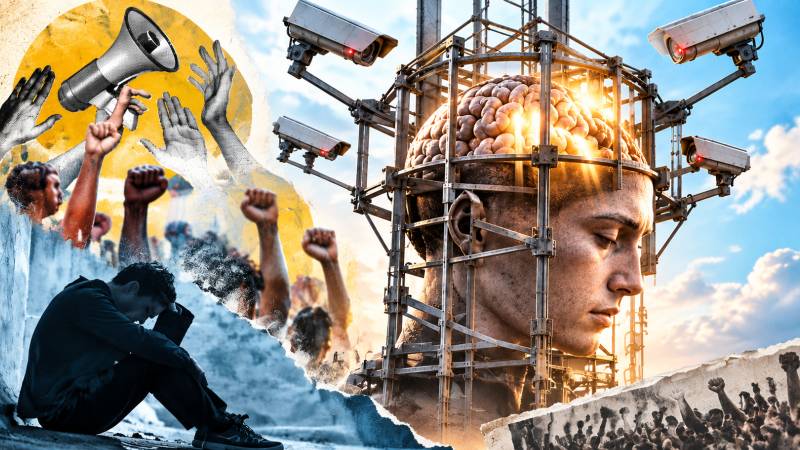
In one of television's bleakest philosophical monologues, the detective Rust Cohle calls human consciousness a tragic misstep in evolution; a self-awareness so acute, it leaves us estranged from the world, aware of our own mortality in a way no other animal has to be. Dostoevsky got there more than a century earlier. In Notes from Underground, his narrator confesses that to be overly conscious is an illness, a real and thorough one; a condition that isolates the reflective mind while the unthinking move through life wrapped in easy self-satisfaction. Both writers treated acute awareness as a private torment. What's changed is that the diagnosis has left the realm of psychological despair and become a matter of statecraft. An active conscience used to be an interior burden. Now it's a political liability.
Call it what it is: the "hard state" is consolidating, in democracies and hybrid regimes alike, riding a wave of populist nationalism and a demand for conformity that would have looked crude a generation ago. The old autocracies wanted silence, you kept your head down and your mouth shut. The hard state wants something closer to what Dostoevsky's narrator feared: it wants to cure the friction of an inner life that keeps examining the machinery of power.
The bargain on offer is a simple one. Surrender the exhausting work of thinking for yourself, and get back the comfort of belonging to something bigger. In place of hard ethical questions, the movement hands you certainties, an enemy, a grievance, a flag to stand behind. The uncritical partisan thrives here, protected from ever having to sit with moral discomfort. The person who won't do that who keeps mourning suffering on the "wrong" side of a border, who keeps picking apart the official story, isn't just annoying to this system. They're treated as a threat to it.
The hard state wants something closer to what Dostoevsky’s narrator feared: it wants to cure the friction of an inner life that keeps examining the machinery of power.
Technology has made the enforcement side of this much easier than it used to be. Dissent used to require showing up somewhere — a square, a printing press, a protest. It was visible, and visibility was the cost of it. A biometric registry, a facial-recognition feed, a cybercrime law broad enough to cover an unflattering tweet, these don't wait for you to show up anywhere. None of these systems were necessarily built as instruments of thought-policing, but a system that already knows who you are and can flag your online speech doesn't need to invent new tools to become one. A person becomes a data point, and the data point is either compliant or suspect.
For anyone who actually stops to think, ordinary life starts to feel like walking through a minefield of small, deliberate self-censorships, what to post, what to say in a lecture hall, which sentence to cut before hitting send. The exhaustion that independent writers and academics describe in shrinking civic spaces isn't a personal failure of resilience. It's the intended output of a system engineered to make moral clarity expensive.
South Asia carries a particular version of this. Institutions built in the colonial period, now wired into the newer apparatus of surveillance and data collection, have left less and less room for genuine intellectual independence. Pluralism gets rebranded as subversion. Teaching contested history becomes an act you have to justify. A conscience that won't fall in line gets filed under foreign interference. Cohle's answer, in the end, was to suggest humanity simply stop reproducing and walk quietly into extinction. That passive despair is exactly what the hard state is counting on, a public too tired to keep arguing with it.
If heightened consciousness really is an illness, it might be the only one left worth keeping. The loneliness Dostoevsky wrote about isn't a symptom of losing. It's the friction of a mind that refuses to be smoothed down to fit. Staying awake, holding onto your own read of events, refusing the manufactured outrage, keeping your empathy switched on when cruelty is what gets rewarded isn't just a personality trait anymore. It's one of the few forms of resistance still available to an ordinary person.