

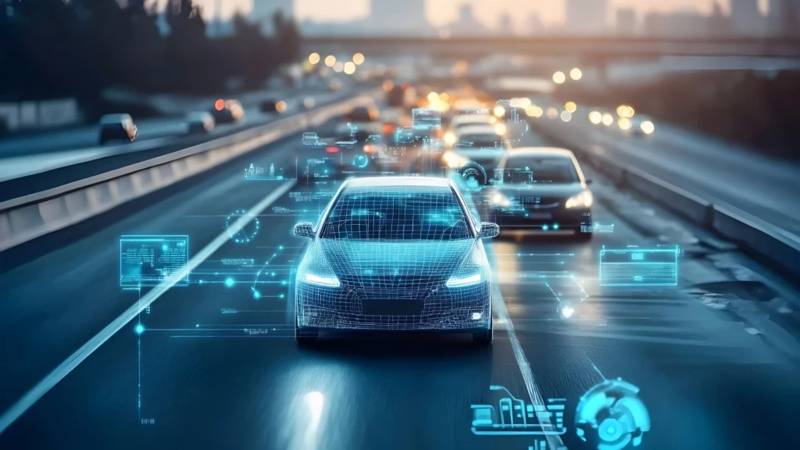
Artificial intelligence (AI) has spread rapidly during the past decade and now encompasses our lives in so many ways. Just about everyone who studies or writes or gives presentations relies on AI to some extent. Even writing a document in Word or creating a slide deck in PowerPoint is facilitated by AI.
So is the driving of cars. Most modern cars are equipped with computers and use AI to assist drivers. The list of functions enabled by AI includes forward collision warning, automatic emergency braking, obstacle-aware acceleration, lane/safety assistance, cruise control that adjusts automatically to the speed of the car ahead of yours, cabin driver monitoring, parking camera visualisation, adaptive headlights, traction and safety control, battery management in electric vehicles, automotive braking, and climate control, to list a few of the tasks that depend on AI.
Full Self-Driving (FSD) is the latest evolution in the world of digital technologies. It is mostly found in electric vehicles (EVs), particularly those made by Tesla. I was first introduced to the concept of EVs in the early 1980s, soon after I started working as an economist at the Electric Power Research Institute (EPRI).
At that point, EVs were just a concept. The issue of interest for electric utilities was whether or not consumers would be interested in driving EVs. A few market research studies had yielded mixed results. Potential drivers were concerned whether the short range that was likely to be associated with the batteries available at that time would be worth acquiring. A few said they might want to buy them as a third car for grocery shopping. They would be more of a novelty than anything else.
But, as I discovered when I began researching the topic, as far back as 1960, Professor Ted Levitt had published a paper in the Harvard Business Review which included a discussion of EVs. It was entitled Marketing Myopia. It began with these prophetic words:
“Every major industry was once a growth industry. But some that are now riding a wave of growth enthusiasm are very much in the shadow of decline. Others that are thought of as seasoned growth industries have stopped growing. In every case, the reason growth is threatened, slowed, or stopped is not because the market is saturated. It is because there has been a failure of management.”
The driver must pay attention to the road and be ready to take over at all times – failure to follow these instructions could cause damage, serious injury, or death
He mentioned that the oil industry, which took its growth as guaranteed, would likely face competition in a few decades. He said competition might come from EVs, which would displace gasoline and diesel cars.
Of course, it took several decades before the first EVs appeared. They were golf carts. EVs designed for routine transportation first appeared in the 2000s. The emergence of EVs was sparked by stricter environmental regulations in the 1990s and revolutionised by lithium-ion battery technology in the 2000s.
Growth began to accelerate in the 2010s when many models began to appear. Several of my friends began driving EVs. Most of them were engineers. I talked with them and learned that electric motors were not only more reliable and powerful than gasoline cars but also required much less maintenance. I also learned that because they used a phenomenon called regenerative braking, drivers did not have to use the brake pedal as much as with a gasoline car, again requiring less maintenance. They were quieter than gasoline-powered cars. They also had faster acceleration. And, of course, EVs did not generate pollution unlike gasoline cars. They were more climate-friendly. All of that appealed to me, as it did to millions of Americans.
In 2019, I took the plunge and replaced my gasoline-powered car with an EV made by Tesla. It was a compact sedan. I would charge it mostly at home during the off-peak hours of a three-period time-of-use rate for electricity. Occasionally, on long trips, I would charge at a Supercharger. The prices were a bit higher, but the rate of charging was much faster as well. The savings in driving costs of the EV versus a gasoline car were significant. Maintenance costs were much lower. And the car drove faster and made far less noise. There were no tailpipe emissions of odiferous carbon. All of what I had been told came true, and I wrote it up here.
EV sales were progressing in the US partly due to a federal income tax credit, which lowered their capital cost. However, it became clear in 2024 that it was going to expire when a new administration that was big on promoting the consumption and production of fossil fuels, and that did not believe in climate change—much less in the role that carbon emissions played in changing the climate—would take over.
So, in November 2024, I decided to replace my EV with a newer model. The new car had all the charms of the previous model, but it was also quieter on the road since it had double-pane windows and it had a much better suspension. But what intrigued me the most was the ability to put it in full self-driving (FSD) mode. It was enabled by a new computer (Level 4) and advanced firmware to go with it.
When Full Self-Driving is engaged, the Model 3 attempts to take the car to a driver-specified destination by following curves in the road, stopping at and negotiating intersections, making left and right turns, navigating roundabouts, and entering/exiting highways.
It is not the same as autonomous driving, in which the car does not even require a driver. Currently, that feature is only offered in certain taxis. Waymo is the leading brand, and their taxis are quite visible in San Francisco.
Tesla’s FSD must be “Supervised” by the driver. It uses inputs from cameras mounted at the front, rear, left, and right of the Model 3 to build a model of the area surrounding the Model 3. The AI computer installed in the Model 3 is designed to use this input, rapidly process neural networks, and make decisions to guide the driver to their chosen destination.
However, it comes with several warnings. Tesla cautions that driver intervention may be required in certain situations, such as on narrow roads with oncoming cars, in construction zones, or while going through complex intersections. The driver must pay attention to the road and be ready to take over at all times. Remain attentive, be mindful of road conditions and surrounding traffic, pay attention to pedestrians and bicycles, and always be prepared to take immediate action (especially around blind corners, crossing intersections, and in narrow driving situations). Failure to follow these instructions could cause damage, serious injury, or death.
When I got the new Model 3, I was offered three months of free FSD, but I was not mentally ready to use it. The warnings cited above freaked me out. I kept worrying it would crash into a wall or another car. However, as the months passed, I noticed many of my friends and relatives were activating the FSD mode in their cars. Many were saying it drove better than they did. They also said it took the stress out of long drives.
One drove 380 miles from Los Angeles to San Francisco in FSD mode. He said he arrived fresh at a wedding reception that evening. A few others would describe their experience in glowing terms.
So, finally, I bit the bullet and activated the FSD feature in my car about ten days ago. I did some city driving and then some freeway driving. I was required to be “attentive” and keep looking at the road but did not need to place my hands on the steering wheel.
At first, it scared the daylights out of me. It felt strange to be sitting in the driver’s seat and just watching the car drive itself, with my hands not on the steering wheel. In the city, I saw some pedestrians and joggers staring at me because my hands were not on the wheel. But the car stopped at every stop sign and waited a tad longer than I would have waited if I were driving. It felt safe. It stopped at every red light. It gave the turn signal in advance of making all its turns. And it changed lanes safely.
It gave me five options for “speed.” On the first day, I chose “chill”, the second slowest option. That’s what I experienced a few months ago when I carpooled with three friends in another friend’s Tesla Model Y. It was very slow for me, so on the second day, I chose the “standard” option. On the third day, I chose the “hurry” option, which is a tad higher than standard.
Now, eleven days later, I can say it has been quite an amazing experience. FSD functions very well 90–95% of the time. It is almost like Aladdin's Magic Lamp on wheels. The key word is almost, since there are cases where I must “take over” the driving function, either by touching the brake pedal or putting my hands on the steering wheel.
Most of these issues happen in the parking lot. Sometimes it will be parked in a space that is reserved for handicapped drivers. Sometimes it will be quite far from where I need to go. Sometimes it will park at a much higher speed than me. Twice it has ignored the arrow on the road in a parking lot and driven in the wrong direction. A couple of times it got lost in the parking lot and was unable to exit. And it seems unable to park in my garage. Most of the time it just stops on the driveway.
On a city road, occasionally it will drive in the fast lane even though it must make a right turn in just half a mile. At other times, it will switch from the fast lane on the freeway to the slow lane way too soon since it does not need to exit for another five miles.
But there have also been two scary incidents. Once it almost hit another car at a busy roundabout. I turned off the FSD mode and drove manually. Another time, while in a line of cars waiting for the light to turn green, it almost rear-ended the car ahead of me. Once again, I turned off the FSD mode.
I have shared my FSD experience with a dozen friends who have been using the same AI-enabled feature. Several of them have learned to live with the limitations of AI and think it still makes sense to use the FSD mode. Some use it for all their driving needs, except for parking. Others just use it for freeway driving. One said to me that it takes a year to get used to it.
I have shared my experience with Tesla to see if it was consistent with their expectations or unusual. If it was the latter, then there might be something wrong with the cameras in my car.
At the Tesla service centre, I spoke with three different staff members. Each of them listened carefully to my issues and said there was nothing unusual about my experience. The software is being continuously updated to improve the experience. But I remain concerned. Maybe my car’s cameras are not functioning well. So, I am going to have them checked out.
This has been a very interesting case study with AI. The pros are staggering, but the cons need some work. It is nowhere near perfection. Sometimes human intelligence is superior to artificial intelligence.