

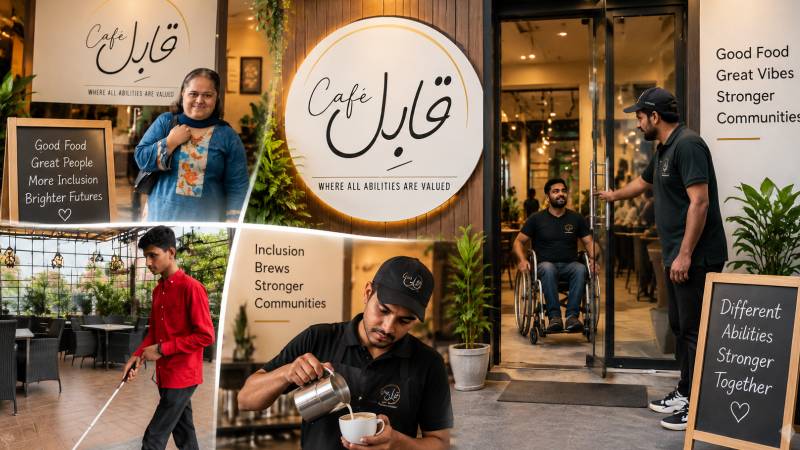
Café Qabil in Lahore stands out as an inspiring model of disability inclusion within Pakistan’s hospitality sector. Describing itself as an accessible space designed to foster dignity, independence, and active participation, the café operates as a social enterprise, under the Specialist Welfare Organization, tied directly to disability training and employment. In a 2026 study published in the Academic Journal of Social Sciences, researchers Dr. Hassaan, Warda Gul, and M. A. Farooq highlight Café Qabil as a hospitality-based enterprise that combines daily restaurant operations with structured skill development. By moving away from traditional charity-based welfare and toward a capability-based framework, the café offers individuals with disabilities a pathway toward meaningful employment and self-sufficiency. Hospitality is an ideal sector for this model because restaurants depend heavily on clear communication, teamwork, and service quality. Through practical training in food service, customer relations, time management, and workplace ethics, Café Qabil equips its staff with real-world skills.
A site visit reveals that physical accessibility has already been thoughtfully integrated into the café’s design. Features include an entrance ramp, wide and unobstructed internal pathways, tactile floor guidance for visually impaired guests, accessible counter heights, and dedicated accessible restrooms. Seating mixes cozy booths with open tables, while lighting is kept bright enough to clearly view faces and hands without being harsh. Background music is intentionally maintained at a moderate level (adjusted readily upon request). These spatial choices demonstrate that physical accessibility is firmly built into the café’s foundation. However, a crucial question remains: does general disability inclusion automatically guarantee effective communication accessibility for Deaf and hard-of-hearing customers? While a Deaf customer can navigate a well-designed physical space with ease, they may still encounter subtle barriers when reading a menu, modifying an order, asking questions, interacting with staff, or receiving critical safety alerts.
Inclusion in customer service requires recognizing that Deaf and hard-of-hearing individuals communicate in diverse ways. Some rely on Pakistan Sign Language (PSL), while others use lip-reading, speech, hearing aids, written notes, or a mix of these methods. A truly inclusive environment must offer multiple, intuitive modes of interaction to ensure an independent customer experience for everyone.
By integrating visual menus, flexible communication methods, and disability-focused training, Café Qabil demonstrates how hospitality can become a pathway for social inclusion.
Observations of Café Qabil’s daily operations reveal several strengths that naturally support Deaf and hard-of-hearing guests, even if those features were not explicitly designed for auditory accessibility. The menu is highly visual, featuring photos, clear product descriptions, prices, and size options. This layout allows guests to make decisions independently without relying on verbal explanations. The service flow also eliminates common noise-related friction points. Customers are greeted and seated by staff, and orders are taken directly at the table using a standard notepad. When ready, food and drinks are brought directly to the table, sparing customers from having to listen for their name or order number to be called out over a counter.
When spoken interaction is challenging, staff adapt flexibly. Employees report that Deaf customers frequently type orders on their smartphones or exchange written notes using the café’s notepad. The calm ambient environment, supported by moderate noise levels and clear lighting, further assists guests who rely on hearing devices, or lip-reading. Café Qabil’s internal training model extends directly to Deaf inclusion. Deaf trainees receive hands-on barista training accompanied by sign language interpreters in a dedicated training space, reflecting the café's mission to foster workplace confidence and independence. Despite these valuable practices, there is a clear distinction between informal accommodations and systematically designed communication accessibility.
Currently, written interaction relies entirely on an ordinary paper notepad or a customer's personal smartphone. While functional, this setup depends heavily on staff responsiveness and individual improvisation rather than a standardized system. No dedicated digital ordering platforms, QR-code customization menus, or customer-facing tablets are currently in place. Visual navigation and accessibility cues are also minimal. There is an absence of designated accessibility icons, or clear visual wayfinding to facilities like the restrooms.
The most critical gap lies in emergency communication. The café lacks a visual alarm system, such as flashing emergency lights. In the event of an urgent safety warning that relies solely on auditory cues, a Deaf customer could easily miss information that hearing customers receive instantly. As the academic research on inclusive workplaces emphasizes, true inclusion must function as an everyday operational practice rather than just a stated brand value. Applied to customer service, inclusion requires dedicated communication infrastructure rather than reliance on informal goodwill.
Strengthening Café Qabil’s communication accessibility does not require overhauling its existing operations; rather, it involves formalizing and expanding them through a few key updates. Introducing digital or QR-based ordering, through a mobile QR code or table tablet, would allow customers to independently browse, customize, and submit orders without ever needing spoken communication. Written interaction could also be formalized by placing clearly marked writing boards or digital tablets at tables, accompanied by signs stating “Type or write to communicate with staff,” making communication options immediately visible and easier to use. Clear visual wayfinding and signage would create a more welcoming and navigable environment for all guests. Most importantly, installing flashing light indicators synchronized with the café’s fire and emergency alarm system would address a critical safety gap that staff improvisation cannot reliably resolve. Together, these improvements would build on Café Qabil’s existing inclusive practices while allowing Deaf and hard-of-hearing customers to navigate the café and communicate with greater independence and confidence.
Café Qabil provides a compelling, real-world example of how disability inclusion can be embedded into Pakistan’s hospitality industry. Its model successfully bridges commercial operations with social impact, helping shift public perception from welfare-based charity to active capability. While physical accessibility is well-established at the café, communication accessibility remains largely informal. By adopting targeted enhancements Café Qabil can set a gold standard for sensory inclusion across the region that others would be inspired to follow.