

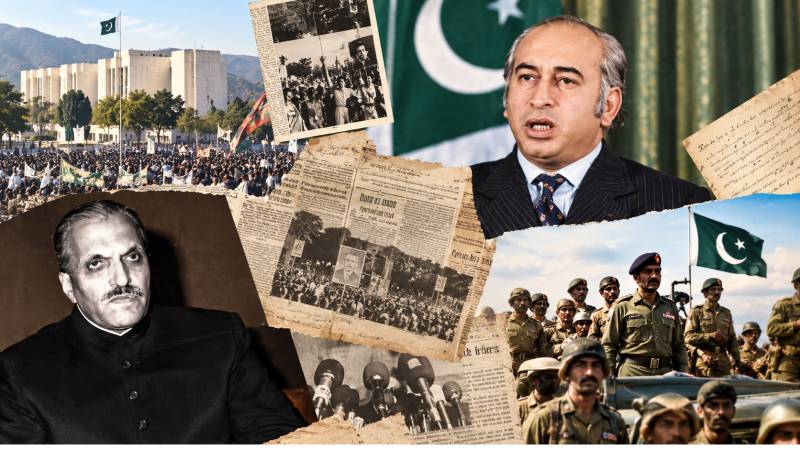
The Pakistan Peoples Party’s struggle against the working classes and progressive nationalist forces, accompanied by its shift to the Right, increasingly transformed the façade of democracy into an authoritarian regime; though its appeasement of the Right seemed to know no bounds, its growing isolation from its roots of support made it vulnerable to the petty bourgeoisie, the Establishment, and imperialist forces unhappy with its foreign and internal policies. At the same time, the era of nationalization was coming to a close, neoliberalism had already taken flight from Chile in 1975, and a new mantra was being propagated by international financial institutions; yet the Pakistan Peoples Party was unable to completely suppress and crush the working classes and the masses in pursuit of neoliberal initiatives, as doing so was beyond its capacity. Therefore, the regime reached a point where high despotic power met low infrastructural power—it had reached the structural limits of its coercive capacity, resulting in an incapacitated authoritarianism marked by social entropy and rendered redundant to the ruling elites. The military was waiting in the wings to complete the unfinished agenda.
The nationalization of agro-based medium-sized enterprises—cotton ginning, rice husking, and flour milling units—on July 17, 1976, bringing around 2,400 units under state control, was considered the last nail in the coffin, as business and trading classes became determined to oust Z. A. Bhutto by financing and strengthening the furious petty bourgeoisie, organized under the Nizam-i-Mustafa movement, which began on March 7, 1977, to demand the implementation of Sharia laws. The nine opposition parties from the Right and Left, including progressive nationalists, also united under the Pakistan National Alliance (PNA), and as protests and agitation expanded, creating a political vacuum and unleashing anarchy, the military intervened on July 5, 1977, deposing the regime and seizing power.
After assuming power, General Zia-ul-Haq imposed Martial Law and, as Martial Law Administrator, presented his intervention as necessary, claiming as a ‘soldier of Islam’ that his sole aim was to hold free and fair elections in October and transfer power within 90 days—a promise unfulfilled until his death 11 years later. He placed the 1973 Constitution in abeyance, dissolved the National and Provincial Assemblies, and dismissed the cabinet. Meanwhile, Zia incorporated the Right and extended an olive branch to Pashtun and, to some extent, Baloch leadership while taking relief measures. Gen. Zia visited Wali Khan and his Baloch comrades, Nawab Khair Bakhsh Marri, Sardar Attaullah Mengal, and Mir Ghaus Bakhsh Bizenjo, as a goodwill gesture to neutralize opposition. Imprisoned leaders were released, Wali Khan was shifted to CMH Rawalpindi for treatment, and the Hyderabad Conspiracy Case ended when the tribunal was wound up in 1978.
The Pakistan Peoples Party’s shift to the Right transformed the façade of democracy into an authoritarian regime, ultimately reaching the structural limits of its coercive capacity.
With labor and peasant leaders put behind bars, a sigh of relief for the Islamists and nationalists alike, the shift in the atmosphere put an end to, and to some extent reversed, the process of nationalization and land reforms through executive orders and court rulings. It was in these circumstances that Dr. Feroz Ahmed sharply criticized the NAP leadership for its alliance with the Right through the PNA, political neutrality towards the military dictatorship, and acceptance of amnesty, arguing that these actions made progressive nationalists useful to the Right and the military. In the larger context, it was an ideological and political capitulation of progressive nationalism in the service of the Right and the Establishment. By and large, General Zia initially took advantage of the neutrality of nationalist forces. After the NAP was banned, Pashtun and Baloch nationalists had already formed the National Democratic Party (NDP), headed by Sardar Sherbaz Mazari, with Begum Nasim Wali Khan playing a leading role in the NWFP. The NDP had been at the forefront of the opposition to the Bhutto regime.
Not only did Pashtun nationalists initially maintain political neutrality, but sections of Sindhi nationalism also refrained from mobilizing against Zia, enabling the regime to court elements of the mainstream nationalist leadership. Sindhi nationalist forces, particularly the Jeay Sindh Tahreek led by G. M. Sayed, had opposed Bhutto, supported the PNA movement, and subsequently accommodated Zia’s regime. However, this stance should not be conflated with ordinary Sindhis, many of whom were deeply shocked by the military takeover and, especially after Bhutto’s execution on April 4, 1979, became increasingly alienated from the regime. Sayed’s opposition to Bhutto and distance from the anti-Zia movement created political space for the regime in Sindh, while the weakening and repression of the PPP created expectations that Sindhi nationalism would expand. Yet the narrow organizational and social base of the Jeay Sindh movement limited its ability to capitalize on this political vacuum.
The Afghan Revolution of April 1978, followed by civil war and Soviet military intervention in December 1979, created further space for the military regime in Pakistan. Western powers and the Gulf countries, particularly Saudi Arabia, sought to contain Soviet influence by turning the Afghan conflict into a wider Cold War battleground, while the United States and Saudi Arabia, through Pakistan, developed political, economic, and military support for the Afghan resistance and Pakistan. This provided much-needed oxygen to the military regime. Initially, Pashtun nationalists opposed the Saur Revolution because of its revolutionary character and leadership, until the Soviet Union invaded and installed Babrak Karmal in Kabul after killing Hafizullah Amin. The rest is history.
This international support further emboldened the Zia regime to curtail democratic rights at home. Political repression intensified as the press came under stringent censorship and dissent was brutally suppressed, with arrests, detention, flogging, and other punishments becoming common tools of political control against political workers, journalists, human-rights activists, and other opponents. Thus, the Afghan conflict not only strengthened Pakistan’s strategic importance to Western and Gulf powers but also gave the military regime greater political and material space to consolidate authoritarian rule. Political resistance took organized form with the Movement for the Restoration of Democracy (MRD), formed in 1981 to unite opposition forces against military dictatorship. The MRD witnessed a particularly strong and sustained struggle in Sindh, especially during the mass agitation of 1983, but its radical energy was ultimately sublimated, producing an asymmetrical outcome. The military regime subsequently moved toward general elections, which were held on a non-party basis in 1985.
Before the general election, the regime consolidated its power through tactics designed to counter democratic forces. It portrayed parliamentary democracy as Western and unsuitable for the country and replaced it with an Islamic Shura model, establishing the Federal Advisory Council of ulema, technocrats, professionals, and other influential ‘non-political’ figures. The Majlis-e-Shura was began functioning in January 1982. The regime had already started building an alternative political structure through local governance, holding the first local bodies elections in September 1979. In this way, it sought to accumulate the raw material needed to counter organized political parties. Though the non-party system was openly opposed by mainstream opposition and nationalist parties, many nevertheless participated in one way or another, producing formidable consequences for the democratic process in the years that followed.
The capitulation of progressive nationalist forces in Pakistan was neither accidental nor isolated; rather, it was symptomatic of a broader anti-grand-narrative pivot, signaling the drift of progressive elements toward postmodern ideology, which was then sweeping through academia, media, and journalism internationally. Rejecting ‘Grand Narratives/Metanarratives,’ postmodernism’s skepticism toward ‘global progress,’ ‘humanity,’ and ‘objective truth’ was reflected in its rejection of a unified struggle against oppression, presenting social conflicts instead as fragmented and unrelated to a system as a whole. Nationalists consequently preferred ‘the endorsement of localized identity over global solidarity,’ while Jean-François Lyotard’s formulation of ‘incredulity towards metanarratives’ provided an ideological framework through which nationalists could challenge universal ideologies.
Born initially in France among disgruntled former revolutionary intellectuals after the failed revolution of 1968, postmodernism became an ideology of middle-class former radical students and progressive nationalist intelligentsia who increasingly assumed ‘managerial positions,’ distancing themselves from the working class as they supervised labour and controlled workers from their offices. It argued that society had entered a postmodern or post-industrial phase requiring new philosophies, politics, and ways of understanding society; therefore, it spread through educational institutions and political parties and, during the 1980s, gained currency among the Left, progressive nationalists, and literary organizations. It was this erosion of ideological anchors—the universality of solidarity, opposition to oppression, and resistance to imperialism—that shaped progressive nationalist parties’ decisions to forge alliances with their historical rivals. This was not merely a calculated strategy but a symptom of broader ideological disorientation, demonstrating conceptual disarray and a growing departure from principled politics in the decades that followed.