

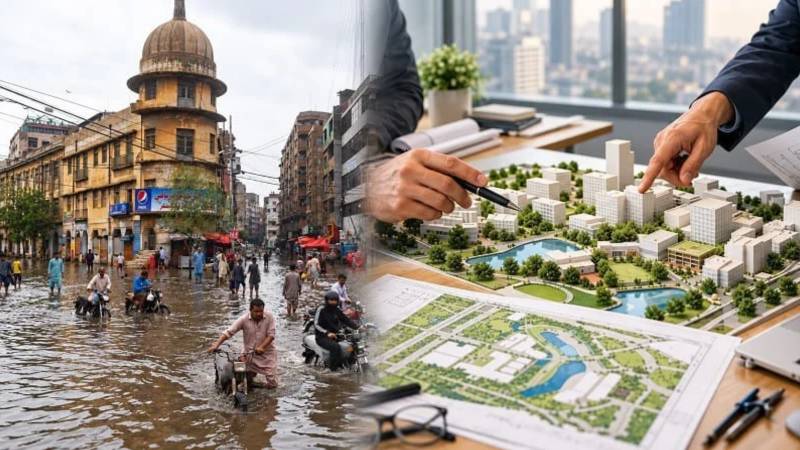
Karachi is facing a host of climate related problems such as extreme heat, deadly heatwaves, urban flooding, heavy rainfall, water scarcity, coastal threat, loss of green cover, and weak urban infrastructure. The following are not individual problems. They are linked, side effects of planning, development, governance and service of the city. To address them, it is not enough to put together a document that lists the climate risks and suggests interventions. An integrated climate resilient urban planning is still lacking in Karachi that links land use, infrastructure, water management, public health, emergency response and institutional accountability. The Karachi Climate Action Plan (K-CAP) is a crucial intervention in this direction, but has its technical shortcomings, its legal form and its institutional ownership and incorporation into long-term spatial planning, fundamental questions that must be raised about its effectiveness of bringing about meaningful change.
The beauty of K-CAP is that it acknowledges several key issues that are challenging Karachi's climate. It covers urban heat, urban flooding, water stress and water availability, coastal vulnerability, green infrastructure, buildings, energy, and other climate related issues of climate mitigation and adaptation. But it is not possible to judge the depth of a climate action plan by the number of issues it includes. The challenge is whether all identified risks are transformed into measurable targets, intervention in space, technical standards, institutional responsibilities, specific budgets, time limits and monitoring mechanisms. K-CAP does offer a strategic framework, though key aspects of a more detailed and action-oriented city climate-resilience plan are yet to be fully realized.
Need for a working Cooling Action Plan for Karachi
One of the most imminent climate risks in Karachi is the extreme heat. K-CAP suggests actions like urban greening, shade, drinking water supply, and energy-efficient cooling, heat-resistant buildings etc. These measures are required but do not form a Heat Action Plan. A successful heat strategy should set clear thresholds for triggering emergency responses, link weather warnings to public health services, prepare hospitals and ambulances, organize cooling centers, have drinking water supplies available for emergencies and have guidance on how to operate in the event of extended power outages. It needs to also take into consideration the vulnerabilities of outdoor workers, women, children, older people, people with disabilities and those living in informal settlements.
The plan should establish areas of highest heat exposure, target groups and agencies to reach exposed communities. It should establish heat-health surveillance, monitor heat-related illnesses and fatalities and have clear communication, emergency mobilization, and post event assessment procedures. The existing Heatwave Management Plan 2017 of Karachi is relevant to the context of the city and could be a starting point, but a linkage between K-CAP and the existing Heatwave Management Plan should be established. Tree planting and cool roofs are tools that will help climate change mitigation but are not a replacement for a working system that will keep people safe during extreme heat events.
Urban Flooding requires Engineering Solutions!
Urban flooding is a key climate risk to which K-CAP responds with measures concerning drainage, natural water storage, green infrastructure and natural restoration of rivers. But what Karachi needs is more than a mere pledge of 'flood resilient'. It demands an integrated Stormwater and Urban Flood Management Plan that is based on catchment-level hydrological and hydraulic modelling. This should include an evaluation of the drainage network capacity, culverts, outfalls, pumping needs, natural drainage and the relationship between rain, tide, and coastal water levels. It should apply climate adjusted rainfall estimates to assess the capacity of the existing infrastructure for accommodating extreme precipitation for the future. Flood-routing models should provide information on the location of water accumulation, roads that will be impassable, critical facilities that are exposed and the locations of detention and/or retention facilities.
The strategy should also include taking measures to stop encroachments on natural drainage routes, using sewage as a fertilizer for the soil, maintaining waterways and cleaning up contamination during flood. If these technical evaluations, delegated tasks and invested infrastructure projects are not in place, then the strategic targets for flood-resilience may be hard to break down into tangible results. Water shortage is an integral part of Karachi's climate vulnerability. Households are also under stress with the increase in water demand during periods of extreme heat, and during drought conditions, population growth and reliance on water from tankers. Flooding poses another threat, although of a different nature, to polluting water sources and harming infrastructure.
K-CAP therefore needs to be connected to a comprehensive Climate-Resilient Water Security Strategy. This should focus on water availability under future climate scenarios, demand projections, distribution loss, extraction of groundwater, non-revenue water, pumping-station reliability and energy dependence and the resilience of bulk-water infrastructure. It should also put in place measures for emergency water supply in case of a heat wave or a flood, especially in areas lacking adequate services.
The issues of water supply, drainage, sewerage, and storm water management should not be considered as distinct technical problems. They are interdependent in an urban system and their demands on public health, household security and city operations need to be considered in a climate-resilient planning process.
Land Use and Urban Design: The Missing Link in Heat Resilience
Land use and heat are one of the most significant climate-related aspects of urban planning. Simply planting trees is not enough to guard Karachi from extreme temperatures as the loss of open spaces, rising built-up densities, blockage of nature's drainage channels and reduction of urban ventilation are also affecting the city. Land-use planning needs to be a tool for climate adaptation. This involves heat-risk zoning, development density controls, building setbacks, protection of sea-breeze and ventilation corridors, minimum open space requirements, tree canopy standards and restrictions on development within environmentally sensitive areas. The code shall include passive cooling, shades, reflective roofs, permeable surfaces and climate-appropriate design.
Wetlands and natural drainage, parks and other places that cool, capture rainwater or lessen flood exposure should be safeguarded by the same spatial planning framework. K-CAP identifies a few interventions that could be relevant; however, Karachi requires a clear Climate-Sensitive Land Use and Urban Design Framework, which will help to ensure the objective is achieved as a development control. If the city's land use continues to raise the very threats the climate action plan is tackling, it will have no impact.
The Legal & Institutional Question: Who is authorized to put K-CAP into practice? The technical deficiencies of the K-CAP system is not the only issue. Its institutional and legal status is also crucial. Government of Sindh has set up a provincial climate-governance system with the Directorate General of Climate Change under the climate change department of the province. It is tasked with coordinating climate actions and incorporating climate factors into the development planning of provinces. The Sindh Climate Change Policy 2022 is an important component within this framework. This brings up a basic issue, what is the mandate, what the powers of the Karachi Metropolitan Corporation (KMC) are to adopt a climate action plan that runs across multiple provincial and municipal areas?
But it would be wrong to say that KMC is not empowered to do anything for the climate. Under the law and in accordance with the division of responsibilities, municipal activities like local infrastructure, environmental upgrading, urban greening and other development activities can have a direct contribution to climate adaptation. K-CAP stands for provisions of Sindh Local Government Act 2013 regarding development plans and works and suggests the formation of a Directorate of Environment and Climate Change in KMC.
A city cannot, however, make claims about the authority of the KMC over provincial departments, disaster-management institutions, health services, water agencies or development authorities without the explicit authorization of such powers from said institutions. Nor does the preparation of K-CAP itself give them such powers. While the proposed directorate and climate-governance proposals must be separated from those institutions that already exist and are legally empowered.
There needs to be an honest tracking program that is available to the public that not only tells people it has cost them money or planted enough trees, but whether it has decreased heat exposure, reduced flood risks, created more reliable water supply and improved protection for vulnerable communities.
The question is thus not if KMC can help with climate action, but how there is a clear legal and institutional mechanism to coordinate, finance and implement the plan at the relevant agencies. If the Government of Sindh and Directorate General of Climate Change is not formally engaged, recommendations from K-CAP have an inherent risk of being strategically ignored or acted upon by different agencies on their own mandate and decisions.
Mayoral Endorsement Is Not Council Adoption
The other distinction is the endorsement of K-CAP. The plan includes a meeting at the KMC office in September 2024, the Mayor's endorsement of the plan and proposed governance structure. K-CAP was later rolled out to the public in 2025. The Mayor's endorsement cannot be identified as adoption by the KMC City Council, however. These are institutional discriminatory acts. A Mayor's endorsement does not automatically mean that the Council adopted the plan by resolution, nor does it mean that all the proposed institutional arrangements have legal effect.
From the publicly accessible information examined in connection with this assessment, no formal resolution from the City Council to adopt K-CAP has been found. This is not an indication of absence of internal proceedings, but rather it is a reference to the fact that the relevant resolution, minutes and/or notification have not been created in accordance with the public record available.
This is important because the plan should support the development of the municipality, budgeting, and institutional duties, and should have a clear approval process. The status needs to be recorded in the appropriate Council proceedings and where necessary, formal provincial notification or inter-agency agreements. Otherwise, there is ambiguity regarding institutional ownership, implementation responsibilities, and relationship with existing laws and policies.
Integration with the Greater Karachi Regional Plan 2047
The integration of K-CAP with Greater Karachi Regional Plan (GKRP) 2047 is far more significant in terms of long-term development of the city. In terms of conceptual understanding the importance of climate resilience, infrastructure, water management, environmental management and urban development as planning issues, K-CAP and Greater Karachi regional Plan 2047 are in sync. Greater Karachi regional Plan 2047 (GKRP 2047) also identifies climate change, resilience and adaptability as part of its planning process. But conceptual alignment does not equal formal integration.
The key is whether the climate-risk assessments, targets and adaptation measures put forth by K-CAP will influence the spatial development of Karachi. Will heat-risk maps affect building codes and building density? Will the flood risk assessments be the place where buildings are limited? Will the natural drainage corridors and coastal vulnerability be considered as information for land-use zoning? Will water security agenda impact on investment in infrastructure? Will green and blue infrastructure enter in the regional development framework, or will it still be isolated projects?
In this context, K-CAP's strategic appraisal identified the opportunity to enhance climate governance and take measurable climate goals into account in regional planning through the implementation of Greater Karachi regional Plan 2047 (GKRP 2047). The next step is to formalize a plan for integrating K-CAP into GKRP to determine what will be incorporated into the regional plan, how these will be implemented in spatial regulation and infrastructure priorities, and who will be responsible for implementation. If this does not happen, then Karachi may end up with parallel planning documents, discussing the same issues but without a common agenda and sense of priorities or responsibilities or tools of implementation.
The regional plan's legal status is also a significant factor. Greater Karachi regional Plan 2047 (GKRP 2047) is in a process of preparation and approval; as such, its proposed status as a statutory and administrative document should be defined. Climate measures will not be enforceable simply by being included in the proposed planning measure. Their legal impact will rely upon the relevant approval process, the relevant law and any required notification and development-control instruments.
Karachi doesn't have to have another stand-alone climate document. It requires a system to link up the existing plans and institutions. K-CAP should be the city level strategic climate mitigation and adaptation policy in line with the Sindh Climate Change Policy and provincial climate-governance structure. Its priorities need to be embedded in Greater Karachi regional Plan 2047 (GKRP 2047), sectoral infrastructure plans, municipal development programmes and emergency-response arrangements.
That involves clearly establishing the division of responsibilities, a legally binding coordination process, budget allocation, measurable results, coordination timelines and monitoring by the public. The mapping of climate risks should be part of spatial planning at District, Town, Union Council and neighbourhood level using GIS. Planning for infrastructure projects needs to consider future climate risks, and land use planning needs to consider how it will impact heat exposure, flooding, water security and environmental resilience.
There needs to be an honest tracking program that is available to the public that not only tells people it has cost them money or planted enough trees, but whether it has decreased heat exposure, reduced flood risks, created more reliable water supply and improved protection from vulnerable communities. The experience of planning in Karachi shows that making plans is just one aspect of urban governance. Turning them into decisions, projects and accountable institutions that can be implemented is the more difficult task.
What really matters about K-CAP, and how it will define itself, is whether it will shift the planning, development and governance of Karachi; rather than merely expanding its coverage of climate change. A plan without a defined authority, resources and mechanisms to implement, is not a complete planning instrument. There are five basic questions that Karachi requires a framework to address: Where is the risk? Who is vulnerable? Who did the responsibility lie? What is the evidence of legal standing and resources that back the intervention? And what will be the measure of its results?
These questions have not yet been addressed, and K-CAP will, therefore, not be a complete system of climate-resilient urban planning until they are answered. There should be a clear legal and institutional and spatial linkage of K-CAP with Greater Karachi regional plan 2047 (GKRP 2047) and Sindh climate policy, with a priority. This is not just another climate plan for Karachi. It requires cooperation amongst the plans it has, it requires institutions to be firmly empowered, and it requires commitments that become manifest improvements in the daily lives of its citizens.