

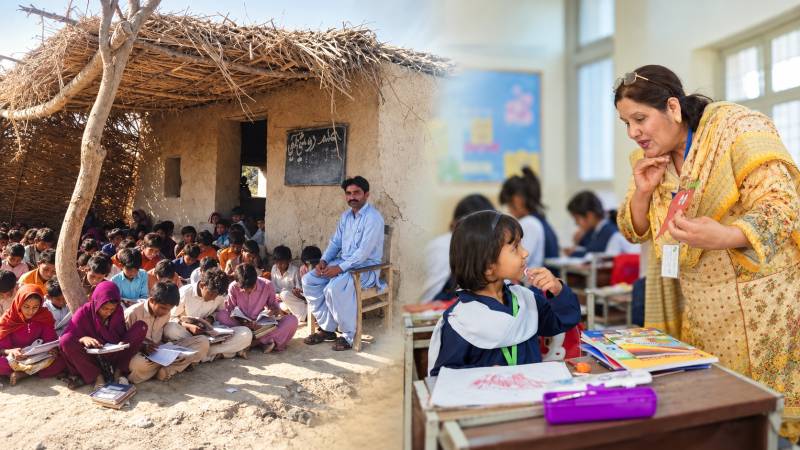
Pakistan cannot build an educated, capable society while treating teachers as second-choice professionals. To grasp the true weight of education, we must reflect on the words of the Prophet Muhammad (PBUH) when he declared, "I have been sent as a teacher." This reminds us that teaching is not just a simple career path. In the Islamic tradition, it is far more than a routine administrative job; it is the sacred work of the prophets themselves. It carries forward that early, timeless message whispered in the quietness of Hira: "Read! And your Lord is the Most Generous, Who taught by the pen, taught man that which he knew not" (Surah Al-Alaq 96:3–5). Knowledge sits at the very core of human growth, and teachers are the dedicated guides who carry that light far beyond the classroom walls. As Hazrat Ali (RA) once expressed with profound humility: "He who has taught me even a single word has made me his servant."
Yet the reverence accorded to teaching in our religious and cultural tradition stands in stark contrast to the status teachers receive in Pakistan today. In policy speeches and ceremonial conferences, we routinely proclaim education as the sovereign remedy for national development, poverty alleviation, and civic stability. But the individuals expected to deliver that societal transformation are left financially starved, administratively commandeered and culturally undervalued. This disregard for teachers is part of a wider educational crisis. Pakistan’s educational emergency can no longer be softened by euphemism. The latest estimates from UNICEF and the Pakistan Institute of Education reveal that over 25.1 million children aged five to 16 remain out of school, leaving our homeland with the second highest out-of-school population globally. Public investment reflects an even grimmer picture: national expenditure on education has plummeted to a heartbreaking 0.8 percent of GDP, a mere fraction of the benchmark endorsed under the Education 2030 Framework. The fallout from this fiscal neglect is etched into the tragic landscape of everyday schooling, where millions of children sit in classrooms stripped of clean drinking water, electricity, functional sanitation, or basic books.
At the centre of this educational crisis stands the Pakistani educator. A teacher cannot indefinitely subsidise systemic dysfunction through personal endurance and quiet tears. A classroom cannot transform into a sanctuary of critical thinking and ethical curiosity when the person standing before it is crushed by economic vulnerability and bureaucratic conscription. Public-school teachers have long been utilised as a low-cost, replaceable administrative workforce. Whenever the state requires hands for national census drives, contentious election polling, demographic surveys, or door-to-door polio vaccination campaigns, it reaches mercilessly into the classroom. Every week an educator spends canvassing streets or filling government rosters is a week of stolen future for dozens of impoverished children.
In the low-cost private sector, the indignity shifts from bureaucratic distraction to sheer economic exploitation. Many university-educated young women and men labour long hours for wages that fall well below the statutory minimum, devoid of contracts, healthcare, maternity protection, or professional dignity. We demand that they nurture confident, forward-looking citizens, yet we deny them the basic economic security required to hold their heads high.
The deepest fracture, however, is neither infrastructural nor financial. It is cultural. Over decades of changing social priorities, we have quietly normalised an insidious premise: teaching is what one does when every other door has slammed shut. In drawing-room discussions, matchmaking circles, and family councils, medicine, engineering, civil services, and corporate management are elevated as the only legitimate benchmarks of ambition. Teaching, by contrast, is patronisingly dismissed as an uninspired backup plan which is respectable, perhaps, for domestic convenience, but rarely a dream for exceptional minds. This hierarchy of prestige is a tragedy for our national soul. If our most articulate, innovative, and driven university graduates are systematically discouraged from entering the classroom, we construct an unresolvable contradiction at the root of our state. We would never counsel a surgeon that operating on human hearts is a pursuit for those who failed elsewhere; we would never cross a bridge designed by an engineer who took the job only by default. Yet, when it comes to the moral compass and psychological formation of our precious children, the future of our nation, we settle for whoever had nowhere else to turn.
It is time to dismantle the toxic fiction that teaching is where people end up when they have nowhere left to turn, and instead build a country where standing before a classroom is once again recognised as one of the highest and most consequential forms of service.
The consequences of this mistake do not make immediate headlines, making them even more devastating. When a bridge fails, it collapses in seconds; when a physician errs, a life is lost in the afternoon. But when an under-resourced, exhausted teacher enters a classroom, the consequences can unfold slowly across generations. It manifests years later in decayed institutions, an erosion of critical thought, civic intolerance, economic stagnation, and an electorate vulnerable to demagogues. The teacher’s impact is cumulative and deeply spiritual; an inspired educator reaches hundreds of young souls, each of whom influences countless others.
The contrast with societies that treat education as national defence is illuminating. In Finland, primary school teaching is one of the most prestigious, competitive professions in the republic, drawing from the top tier of graduates and granting teachers clinical autonomy and the standing of trusted public intellectuals. In Japan, the honorific Sensei remains a hallmark of profound societal deference. In Singapore and South Korea, competitive salaries and rigorous training ensure that teaching attracts elite talent. The lesson is clear: teacher quality will never become a reality until teaching itself is treated as an elite profession in our own land. Respect cannot remain an empty slogan; it must be built into our institutions with unwavering commitment. A teacher must earn a living wage that shields them from financial distress, along with dedicated preparation time, instructional autonomy, and protection from state-mandated non-teaching duties so their singular loyalty remains with their students.
If Pakistan is to salvage its human capital and honour its constitutional promises under Article 25-A, we must embrace a cohesive set of vital solutions. To rebuild our nation, we must restructure public compensation and working conditions to reflect professional parity while strictly enforcing minimum wage laws and employment safeguards in the private sector to end the quiet exploitation of teachers. Furthermore, we must protect instructional sanctity by declaring teaching time administratively invincible, utilising dedicated civil cadres or technology for state surveys rather than disrupting the academic calendar. Alongside this, we must overhaul teacher induction and pedagogy by transforming degree mills into rigorous training institutes that couple meritocratic recruitment with continuous professional development. Finally, we must spark a profound societal reset through universities, media and families to deconstruct the stigma surrounding the profession, ensuring that when a gifted young graduate wishes to teach, our response is never one of doubt, but rather a proud embrace of their noble calling.
Pakistan cannot bridge an out-of-school crisis of 25.1 million children simply by constructing boundary walls and inaugurating empty brick buildings. It cannot nurture an innovative economy through archaic rote-learning delivered by demoralised instructors. The teacher is not a second-choice worker; the teacher is where every noble vocation begins. Every surgeon, engineer, judge, civil servant, and artist sat first at the feet of an elementary teacher. Before a nation can build sound hospitals, honest institutions, or thriving industries, someone must first shape the hearts and minds of those who will run them.
Restoring the teacher’s honour is not a sentimental gesture, nor is it an act of charity. It is the single most vital investment in the intellectual survival and moral architecture of Pakistan. It is time to dismantle the toxic fiction that teaching is where people end up when they have nowhere left to turn, and instead build a country, where standing before a classroom is once again recognised as one of the highest and most consequential forms of service.