

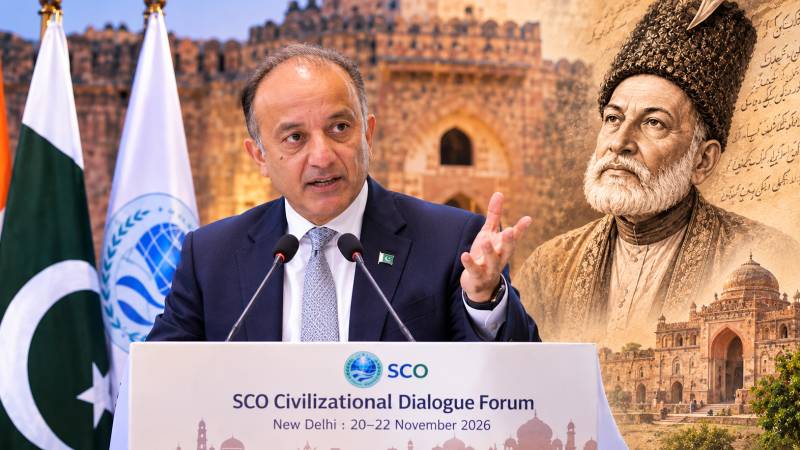
On the evening of 20 November 2026, Prime Minister Narendra Modi opened the first Shanghai Cooperation Organisation (SCO) Civilizational Dialogue Forum at Purana Qila, the sixteenth-century fort on the western bank of the Yamuna. The next day, a Pakistani minister rose to speak and began by explaining why he would not use English. It felt strange, said Musadik Masood Malik, Pakistan's Federal Minister for Climate Change and Environmental Coordination, to sit a few miles from Ghalib's grave and address the gathering in English. So he would speak to them in Urdu, the voice of his heart.
It was a graceful opening to a visit few expected to go smoothly. Malik was the first Pakistani federal minister to set foot in India since Bilawal Bhutto Zardari travelled to Goa for an SCO foreign ministers' meeting in May 2023, and the first since the military clashes of May 2025. The relationship he walked into is the coldest in a generation. After the Pahalgam attack of 22 April 2025, in which 26 people were killed, India placed the Indus Waters Treaty in abeyance. Two weeks later the two armies fought a four-day conflict, from 7 to 10 May. Since then there has been no structured dialogue, and contact has been confined largely to multilateral meetings.
The forum itself was India's initiative. Modi proposed a dedicated platform for civilizational dialogue at the SCO summit in Tianjin in 2025, and the grouping endorsed the idea in its Bishkek Declaration. New Delhi then invited all members, observers and dialogue partners. Pakistan's invitation originally went to Aurangzeb Khan Khichi, the Federal Minister for National Heritage and Culture. Islamabad sent Malik instead. That choice was deliberate. Malik is one of the government's most fluent spokesmen, a familiar face on television talk shows, and a technocrat equally at home in English and Urdu. He is also the minister who has carried Pakistan's case on the Indus Waters Treaty to the United Nations and to international water conferences, where he has accused India of weaponizing water.
That role made him a lightning rod. In the summer of 2026, at a joint press conference with Information Minister Attaullah Tarar, Malik warned that Pakistan would "cut off those hands" that tried to take its share of the Indus waters. Indian outlets ran the clip under headlines calling it a threat, and it spread widely on social media. When his visit was announced, sections of Indian social media resurrected the remark, presenting him as the man who had threatened India and was now arriving on Indian soil. The aim was plain: to put the guest on the defensive before he had said a word.
Official Delhi was not much warmer. Days before the forum, Culture Minister Gajendra Singh Shekhawat told reporters that Pakistan's civilizational evolution was "not different from us", rejected Pakistan's claim to the heritage of the Indus Valley Civilization, and observed that it was less than 80 years since Pakistan separated. Opposition parties, meanwhile, attacked the government for inviting Pakistan at all. Leaders of the Congress, the Samajwadi Party and the NCP (SP) called the invitation inconsistent and hypocritical; the government replied that invitations had gone to all SCO members under established multilateral practice.
A Pakistani minister, in other words, was walking into a room where the host's culture minister had already questioned his country's past, the host's opposition had questioned his presence, and a section of the host's media had already written his headline. Malik's address, delivered on 21 November, was built around a single idea: that diversity enriches a civilization rather than dilutes it. He began with Ghalib. The poet, he noted, regarded himself as a master of Persian, yet the world remembers him for his Urdu. Delhi, Lucknow and Lahore were all cradles of poetry, literature and culture, he said, but Ghalib's manner of expression was something else entirely. The point was not literary trivia. It was a way of saying that one shared tradition can hold many voices without any of them losing its character.
He then turned to the city around him. Delhi, he said, was not diminished by the arrival of outside civilizations or by people coming from beyond. Through them it expanded, flourished and grew stronger. The venue sharpened the line. Malik reminded the audience that Purana Qila's foundations were laid by the Mughal emperor Humayun, and that its story also belongs to Humayun's rival, the Afghan ruler Sher Shah Suri. He called the fort a complete historical account. The Archaeological Survey of India had laid out its finds for the delegates: painted grey ware, Mauryan-period terracotta figurines, a Rajput-era image of Vaikuntha Vishnu and an inscription referring to Indraprastha. The site has been excavated in 2013-14, 2017-18 and 2022-23, with a fourth round planned. Layer sits upon layer, Hindu, Buddhist and Muslim, each built on the one before.
In a political climate in which India's ruling party and its ideological allies often cast Muslim rulers simply as invaders, the remark carried an unmistakable message. Yet Malik never named the BJP, the RSS or anyone else. He praised Delhi. It is hard for a host to object when a guest compliments the capital's openness, even when the compliment contains an argument.
Iqbal came next. Since Ghalib had been mentioned, Malik said, Iqbal naturally came to mind, and he recalled the poet's imaginary journey to paradise. He used it to describe two ways of seeing: how we see ourselves, and how we appear through someone else's eyes. "Today," he told the delegates, "we are looking at ourselves through the lens of all of you." He added a small lesson in etymology. In the Greek, dia means through and logos means meaning, so a dialogue is a free flow of meaning between civilisations. Later, to reporters, he compressed the idea further: "Singularity only requires a monologue. Dialogue is about diversity."
The speech had a second strand, closer to his portfolio. Malik argued that climate change poses a far greater threat to civilization and its heritage than the rivalries between nations, and that countries should stop seeing one another as enemies when a larger danger threatens them all. For one of the world's most climate-exposed countries, this is not rhetoric; it is the daily business of his ministry. He also staked Pakistan's own claim. Pakistan, he said, is the custodian of three important periods of civilization, with historical ties running north to Bukhara and Samarkand and cultural ties running west to Persia and Arabia. It was a quiet answer to Shekhawat's dismissal of Pakistan's heritage, made without once mentioning him.
Malik refused to turn a multilateral cultural forum into a bilateral confrontation. Instead, he called for evidence, transparent investigations and recognition of the human cost of terrorism on both sides, denying his questioners the easy narrative they appeared to be seeking.
The speech was the easy part. The harder test came outside the hall. Indian reporters pressed Malik on terrorism, asking why Pakistan does not act against militant groups said to be operating on its soil. When first asked about cross-border terrorism, he said he would comment after delivering his statement. Later he engaged, and the answer he gave was the most carefully built part of the visit.
It had three parts. The first was the frame. This was a multilateral forum, he said, and it should be used for multilateral discussion rather than turned into a bilateral quarrel. The second was the substance. Both sides, he said, must bring forward evidence, and allegations should be examined through a transparent mechanism instead of being traded in public. The third was the human cost. Thousands of Pakistanis have been killed in terrorist attacks, he reminded his questioners, and he acknowledged that India too has suffered such attacks. He said he did not want to present "a narrative of mere victimhood." He closed on a lighter note, telling reporters he hoped they would not complain again and that visits between the two countries would continue.
None of this was new as policy. Pakistan has offered impartial investigations before. In a July 2025 interview with the Indian journalist Karan Thapar, Bilawal Bhutto Zardari said Pakistan had been willing to join an impartial international investigation into Pahalgam and that India had refused. What was different in Delhi was the delivery: calm, unhurried, and pitched at the reasonable middle of an Indian audience rather than at its loudest voices. A proposal for a transparent inquiry is hard to argue against in public, and refusing it shifts the burden onto the one who refuses. Acknowledging India's own losses, meanwhile, denied his questioners the easy story of a Pakistani minister who could only speak of Pakistan's suffering.
Baiting a rival's minister is an old diplomatic habit. A story often told from the Musharraf years, when Indian and Pakistani troops faced each other along the border, has India's foreign minister Jaswant Singh greeting his Pakistani counterpart Abdul Sattar at a conference in Kabul by asking how it felt to meet the enemy in a third country. The purpose of such a remark is to provoke a reaction that becomes the story. In Delhi the provocation came from social media and television studios rather than from a minister, but the logic was the same. Malik declined to supply the reaction.
He also did the ordinary work such forums exist for. On the second day he met Mohammad Mahdi Imanipour, president of Iran's Islamic Culture and Relations Organisation, and stressed the two countries' historical and cultural bonds. With Tajikistan's Culture Minister Sattoriyon Amonzoda he pressed for more people-to-people exchanges and proposed a Virtual Green University for cooperation and research on climate culture. These meetings will not make headlines in Pakistan or India, but for a country chairing the SCO Council of Heads of State in 2026-27, the side rooms matter as much as the main hall.
Realism requires stating what did not happen. There was no meeting between Malik and Modi, and none was announced. Responding to Malik's criticism of the treaty's suspension, India's foreign ministry spokesperson Randhir Jaiswal said New Delhi's position on the Indus Waters Treaty was unchanged. BJP leader Nalin Kohli said there would be no dialogue with Pakistan while terror continues. The forum was a cultural event under a multilateral umbrella, not a negotiation, and it was never going to thaw a relationship frozen since May 2025. The reporters who pressed Malik on terrorism will press the next Pakistani visitor in exactly the same way.
Pakistani commentators should not oversell it either. Some at home have called the visit historic, a diplomatic six that has set a new standard. A more measured view is that a capable minister handled a difficult room well. That is valuable. It is not a strategy. The real test is whether this contact leads to anything more: further ministerial visits, a working channel on water, or quiet talks on the questions that actually divide the two countries. Malik himself pointed to the limits when he told reporters that the region is in flux, has several centres of instability, and that the plates beneath its geopolitics are shifting fast.
Much of the enthusiasm in Pakistan has centered on Malik's decision to speak in Urdu. It worked, and for specific reasons. The venue was Delhi, Ghalib's city. Much of the audience understood the language. And the choice itself carried a message about shared heritage that no English sentence could have carried as well.
Some have gone further and argued that Pakistan's leaders should speak Urdu at every international forum. That does not follow. In Delhi, Urdu was both the medium and the message. At the UN General Assembly in New York or a climate negotiation in Bonn, the audience is different, and simultaneous interpretation flattens the poetry that made Malik's Delhi address work. The lesson is not "always Urdu". It is to choose the language that serves the argument and the room. Malik chose well because he chose for this room.
Judged by what one minister can achieve in three days at a cultural forum, the visit was a success. Malik went to a city where his own words had been turned against him, where his host's culture minister had questioned his country's past, and where reporters were waiting with the familiar questions. He answered with literature, history and a reasonable proposal. He neither raised his voice nor retreated. Some credit belongs to the government of Prime Minister Shehbaz Sharif for sending him rather than a more routine nominee. Ghalib wrote his best-loved verse in a language he considered secondary, and was remembered for it. Diplomacy often works the same way: what a visit set out to say matters less than what it is remembered for. If this one is remembered as the moment Pakistan and India began talking again, it will deserve the word historic. For now it is a well-made beginning, and only that.