

While much of the world has become weary of wars and seeks pathways to peace, New Delhi appears to be moving in the opposite direction. At a time when many Western countries, key Arab states, Pakistan, Turkey and Indonesia have come together to support President Trump’s global peace agenda, India continues to beat the drums of war. The Modi government, which has been isolated internationally, has failed to redeem its image at home and abroad in the wake of the humiliating defeat it suffered during the Four-Day War imposed on Pakistan in May 2025. To gloss over the weaknesses exposed during the botched Operation Sindoor, India is pursuing a two-pronged approach.
Firstly, several months after losing the war to Pakistan in May 2025, Indian political leaders and senior military officials, including the IAF Chief, have engaged in building a false narrative through imaginary and fictitious claims of having caused heavy losses to Pakistan by destroying its military assets, including damage to several airbases and downing up to fifteen fighter aircraft. Simultaneously, while chest-thumping about the “success” of the failed Operation Sindoor 1.0, Pakistan is being threatened with “Operation Sindoor 2.0”.
Secondly, India has resorted to strategically scaring countries in the region and beyond by conducting several tests of its nuclear-capable ballistic missiles in quick succession. The Modi government continues to issue NOTAMs for missile tests every few weeks. It seems New Delhi is desperately attempting to restore its lost image and prestige by adopting an offensive and threatening nuclear posture.
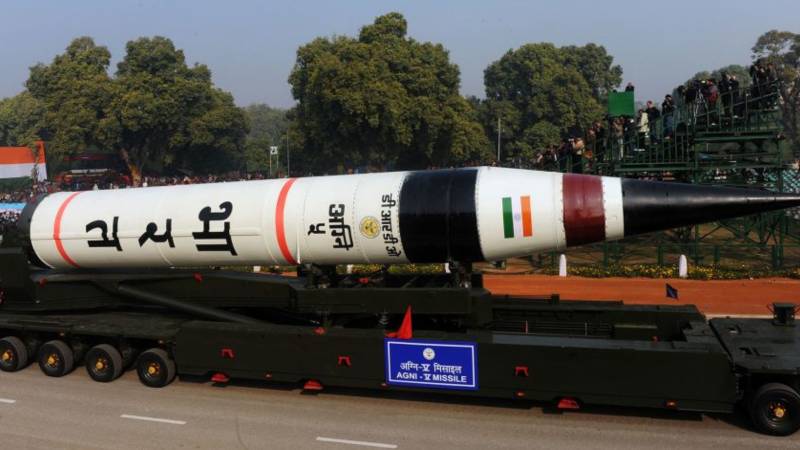
The most recent missile test conducted by India was that of Agni-Prime (Agni-P) on 24 September 2025. It is a new-generation, canisterised, Medium-Range Ballistic Missile (MRBM), which was launched from a rail-based mobile launcher system. Agni-P is the latest iteration of the Agni series missiles.
It is a two-stage, solid-fuel missile that is lighter and more manoeuvrable than earlier Agni variants, and is designed to be launched from both road-mobile and rail-based platforms. It has an operational range of approximately 1,000 to 2,000 km, with a payload of 1,500 kg. Agni-P is capable of carrying Multiple Independently Targetable Re-entry Vehicles (MIRVs). It can deliver both conventional and nuclear warheads to strike multiple targets. The Bulletin of Atomic Scientists’ report on Indian nuclear weapons (September 2024) pointed out that Agni-P could also be equipped with a Manoeuvrable Re-entry Vehicle (MaRV).
According to the UK-based International Institute for Strategic Studies (IISS), India currently has 12 Agni-I and 8 Agni-II launchers in service
According to an Indian Ministry of Defence press release quoted by The Diplomat (30 September 2025), the test involved a “full operational scenario”. India’s Defence Research and Development Organisation (DRDO) carried out the test at an undisclosed site in collaboration with India’s Strategic Forces Command (SFC). India’s Minister of Defence Rajnath Singh posted on X: “This successful flight test has put India in the group of select nations having capabilities that have developed a canisterised launch system from an on-the-move rail network.”
Agni-P’s range, mobility, and warhead options pose a serious threat to regional peace and stability. The missile’s canisterised and rail-mobile configuration makes it a quick-response system capable of striking without relying on longer-range systems like the Agni-IV or Agni-V. The missile is expected to complement or replace India’s Agni-I (700 kilometres), but is unlikely to replace Agni-II (2,000 kilometres). According to the UK-based International Institute for Strategic Studies (IISS), India currently has 12 Agni-I and 8 Agni-II launchers in service.
In an operational context, a rail-based launcher would be able to exploit India’s extensive railway network of about 70,000 kilometres. It would allow the missiles to be rapidly dispersed in a manner that would be difficult to detect and monitor. A rail-mobile missile launcher offers New Delhi a relatively inexpensive means of fielding additional ballistic missiles with short reaction times and reduced visibility, making them less vulnerable to pre-emptive or counterstrikes. This would enhance India’s second-strike capability.
Rail tunnels available throughout India would provide ready-made hardened bunkers for concealing the rail-mobile missile launchers. Not only would this make them harder to destroy, but it would also be a significant challenge for an adversary to track their movements. They could be moved around, disguised as normal railway wagons. At the same time, decoy rail launchers could be produced very easily, further complicating detection and targeting by any adversary.
The hegemonic mindset of India’s incumbent leadership and their global power ambitions pose a serious threat to international peace and security
The MaRV and MIRV-capable Agni-P missile adversely impacts strategic stability in the fragile environment of South Asia. It is likely to become India’s mainstay for nuclear and conventional forces against Pakistan, as it can cover its entire length and breadth. It will therefore heighten the risk of miscalculation between the two nuclear-armed neighbours. In the evolving strategic environment, Pakistan would be compelled to reassess its threat perception and take appropriate measures to restore strategic stability in South Asia.
The Agni-P, while primarily threatening Pakistan due to its mobility and 1,000–2,000 km range, holds strategic relevance for China as well. Its ability to target key military assets in south-western China, including logistical hubs, airbases and command centres, gives New Delhi a counterforce option against Beijing. According to reports published in the Financial Times of India (12 September 2025) and International Railway Journal (2 October 2025), India has approved a USD 3.4 billion, 500 km-long rail network project near its border with China in the north-eastern mountainous region. Indian strategists are also discussing plans to extend the rail network in the north-west, beyond Baramullah into the Ladakh region.
A dangerous pattern is visible in India’s strategic behaviour, shaped by a series of destabilising developments. Firstly, by exaggerating the two-front threat, New Delhi has, over the years, managed to acquire an array of advanced weapon systems, mainly with support from Western states. Capitalising on this, it has aggressively expanded the scope and range of its missile programme, which now enables it to target states well beyond South Asia. India’s short and medium-range ballistic missiles include the Agni and the Prithvi series with ranges of up to 4,000 km. They are capable of covering the entirety of Pakistan’s territory and significant parts of China. As is evident from India’s test of the Agni-V (ICBM) conducted on 20 August 2025, a Mach 24 nuclear-capable hypersonic missile that can travel over 7,000 km, New Delhi’s hegemonic ambitions are not restricted to South Asia. Agni-V places all of Asia and parts of Europe within striking distance.
Two variants of the Agni-V are also under development that are reported to be capable of delivering a 7,500 kg bunker buster at reduced ranges to strike hardened military infrastructure, including nuclear command centres and missile silos in Pakistan and China. Despite these far-reaching capabilities, India continues to pursue even longer-range delivery systems. Its under-development Agni-VI is expected to have a range of up to 12,000 km, which would place the entire globe within its reach. Collectively, this evolving missile posture demonstrates that India’s ambitions extend far beyond South Asia, reflecting a broader agenda of global power projection. It also highlights India’s threat perception, which is not confined to Pakistan and China. It includes the entire Western world, including the Americas.
The hegemonic mindset of India’s incumbent leadership and their global power ambitions pose a serious threat to international peace and security. Each step taken by India to re-establish its credibility as a regional power and “Net Security Provider” for the West further undermines prospects for peace and stability, both within the region and beyond. For these reasons and India’s failure to win the Four-Day War, prominent Indian defence analyst Pravin Sawhney has described Pakistan as a “peer competitor” of India and wisely advised New Delhi to refrain from indulging in kinetic warfare that it cannot win.