

Political thinkers and practitioners regard Gandhi’s Salt March and Mao Zedong’s Long March as defining events of the twentieth century. In 1930, Gandhi led the Salt March from Sabarmati Ashram to Dandi on the Gujarat coast, where he broke the British salt law. Four years later, in 1934, Mao Zedong and the Chinese Communist Red Army began the Long March to escape encirclement by Nationalist forces led by Chiang Kai-shek. The soldiers faced hunger, disease, harsh terrain, and repeated military attacks. Gandhi marched to challenge an empire; Mao’s army retreated to survive. One mobilised mass resistance through non-violence; the other sought to preserve a revolutionary force through military retreat.
Although many non-fiction books recount both marches, Mao’s Long March seems better known than Gandhi’s Salt March in Pakistan. Several factors may explain this difference. Some political workers may have absorbed official Pakistani narratives that shaped their views of India and its leaders. Mao’s appeal may also reflect an interest in communist ideology, armed struggle, and the promise of revolution. His 1935 poem, The Long March, helped turn the military retreat into a political symbol, while American journalist Edgar Snow popularised it internationally through Red Star Over China (1937).
The Long March in Sindh (1991–2023)
Sindh’s progressive political organisations also drew on Maoist ideas and revolutionary traditions. Among those who helped popularise the long march as a form of political mobilisation was Rasool Bux Palijo, whose Awami Tehreek used this method to bring Sindh’s political and economic demands before the public. Between 1991 and 2023, Sindh witnessed several such marches, each shaped by its own political context and demands.
They turned complex political demands into words that ordinary people could remember, repeat, and make their own
On the 10th of December 1991, Comrade Jam Saqi launched the Aman March (Peace March), which travelled from the Sindh–Punjab border towards Karachi. In 2007, Bashir Khan Qureshi, chairman of Jeay Sindh Qaumi Mahaz, led the Paigham-e-Sindh March from Sukkur to Karachi to raise awareness of Sindhi nationalism and the demand for Sindh’s liberation. In 2023, the Sindh United Party organised another long march from Sukkur to Karachi, protesting corruption, inflation, poor governance, lawlessness, and the failure to rehabilitate people affected by the 2022 floods.
Awami Tehreek’s Legacy of Mobilisation
Over the same period, the Awami Tehreek organised six long marches between 1991 and 2017, each addressing a distinct set of political, economic, or environmental concerns. The 1991 march from Sukkur to Karachi opposed the Kalabagh Dam, the postponement of the census, and the repatriation of Biharis. In 1995, the party again marched from Sukkur to Karachi to oppose the Kalabagh Dam and defend Sindh’s water rights. Its 2001 march from Bhitshah to Karachi renewed opposition to the dam and demanded a fair share of Indus water for Sindh. In 2005, marchers travelled from Sukkur to Karachi to oppose both the Kalabagh Dam and the Greater Thal Canal, which they viewed as threats to Sindh’s water share.
The Awami Tehreek’s 2009 march from Kandhkot to Karachi widened its demands to include provincial autonomy, ownership of natural resources, water rights, and implementation of the 1940 Resolution. In 2017, the party marched from Islamkot to Karachi to oppose the Gorano reservoir project and defend Thar communities, their livelihoods, and their environmental rights.
The Save Sindh March (2017)
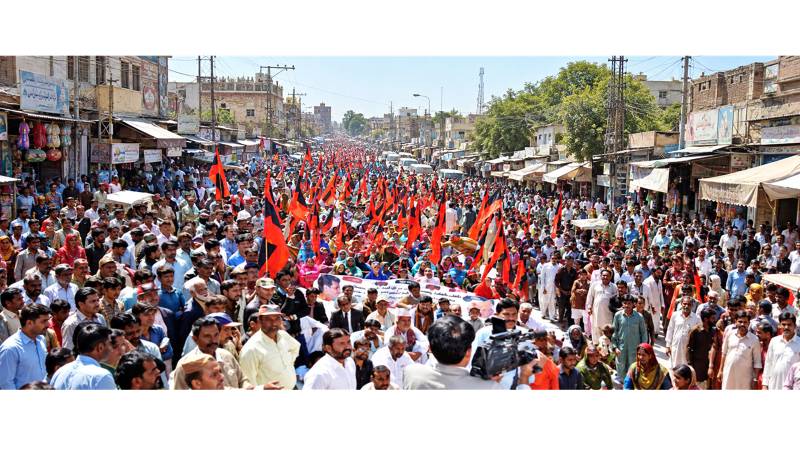
One of the Awami Tehreek’s most significant long marches was the Save Sindh March, which began on the 5th of February 2017. Initially, the march opposed the Gorano reservoir project in Tharparkar, which threatened local communities, their livelihoods, and their environment. As it progressed, the organisers broadened their demands to address wider concerns about Sindh’s land, resources, identity, and future. They called for an end to projects they considered harmful to Sindh, including Zulfikarabad and Bahria Town, opposed the conversion of Sindhis into a minority in their own province, demanded employment opportunities, and sought the abolition of Defence Housing Authority projects in Sindh.
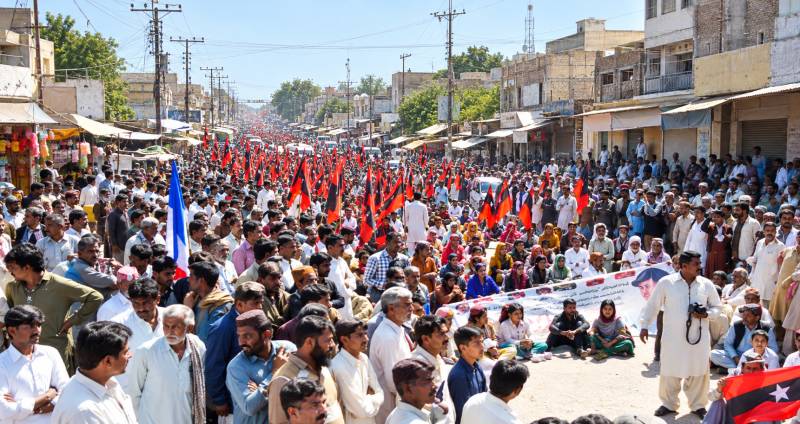
Although Rasool Bux Palijo provided the march’s central political leadership, its strength rested on the commitment of workers from different organisations. The march brought together the Awami Tehreek, Sindhyani Tehreek, Sindhi Mazdoor Tehreek, and Sujaag Baar Tehreek. Among those who walked the route from Islamkot to Karachi were Ghulam Nabi Khoso and Vasant Thari. Zahida Shaikh, Husna Rahujo, and Shamshad Laghari represented the Sindhyani Tehreek. Their participation showed that the march was not the effort of one leader or organisation alone. It was a collective undertaking sustained by workers who carried its message from town to town.
Strategic Communication and Slogans
The Awami Tehreek used the march as a strategic means of mobilising people and bringing Sindh’s concerns into public debate. Its organisers followed three main approaches: briefing the press, holding public gatherings, and distributing leaflets. These methods helped the march gain coverage in local newspapers, with press clubs in many towns reporting its progress. The organisers also chose a route that passed through areas where the Awami Tehreek and its allied organisations had an established presence. Along the way, marchers met shopkeepers, students, tea-stall owners, and other residents, explaining their demands and distributing political literature.
The march carried its message through simple, memorable slogans: Sindhi Jago, Sindh Bachayo (Awake, Sindhis; Save Sindh); Sindhi Theo, Sindhi Likhrayo (Identify as Sindhi; Register Sindhi as your mother tongue in the census); and Sindhi Galhayo, Sindh Bachayo (Speak Sindhi; Save Sindh). These slogans linked language and identity with the protection of land and resources. They turned complex political demands into words that ordinary people could remember, repeat, and make their own.
Over 32 days, the marchers covered roughly 500 kilometres, holding press conferences and public gatherings along the way. They distributed pamphlets, spoke to people in towns and villages, and used everyday meeting places to explain their cause. This sustained contact helped carry the march beyond its immediate organisers. It also gave the Awami Tehreek and Sindhyani Tehreek opportunities to expand their membership and renew their links with communities across the route. In a society where political mobilisation could easily lose momentum, the march brought renewed energy to public debate.
The Conclusion in Karachi
When the march reached Karachi, the organisers were stopped to take the approved route to reach the destination. Instead of ending at the Karachi Press Club, the march concluded at Phohara Chowk, now called the Press Club roundabout. There, political workers and members of the press joined the gathering, which grew into a public meeting. Awami Tehreek leaders restated their demands and described what they saw as the political, economic, and environmental pressures facing Sindh. The closing gathering gave the marchers an opportunity to bring their month-long effort before a wider audience.
The most inspiring achievement, however, lay in the marchers’ endurance and collective resolve. Members of the Sindhyani Tehreek walked alongside their fellow workers from Islamkot to Karachi for 32 days, covering roughly 500 kilometres. Their journey turned political commitment into a visible act of solidarity. The Save Sindh March demonstrated that a long march could do more than carry demands from one place to another: it could build relationships, strengthen organisations, bring local grievances into a shared public debate, and inspire people to take part in collective action. Its lasting lesson lies in the determination of ordinary workers who kept walking, speaking, and organising for the future they wanted for Sindh.
Conclusion
The Awami Tehreek deserves recognition for making the long march a sustained and people-centred method of political mobilisation in Sindh. Under Rasool Bux Palijo’s leadership, the party used these marches to take political demands beyond meeting halls and party offices, carrying them through towns and villages and bringing them directly to the people. Its example showed how a long march could raise awareness, unite communities around shared concerns, and turn local grievances into a broader public cause.
Over time, this approach offered a model that other political parties and organisations could adopt for their own struggles. The Awami Tehreek demonstrated that a long march is more than a protest; it is a means of building solidarity, strengthening political organisation, and engaging people in public life. Its enduring contribution lies in showing that when people walk together for a common cause, the road becomes a space for democratic expression, and collective footsteps become a powerful call for change.
Postscript: The Role of Train Marches
Pakistan’s political history includes several train marches that used the railway network to connect cities and mobilise public support. In the 1960s, Fatima Jinnah’s campaign against Ayub Khan and Zulfikar Ali Bhutto’s rise after the 1966 Tashkent Agreement were associated with train-based political outreach.
In later years, Jamaat-e-Islami organised train campaigns, including a 2013 journey from Karachi towards Rawalpindi over electoral concerns, an anti-corruption march from Peshawar towards Karachi in 2016, and a wider campaign in 2018 for a corruption-free Pakistan. In 2019, the Pakistan Peoples Party’s Caravan-e-Bhutto, led by Bilawal Bhutto Zardari, travelled from Karachi to Larkana for political outreach and commemorations.
Jamaat-e-Islami used another train campaign in 2022 to protest inflation and corruption. In 2024, Pakistan Tehreek Insaf’s Sindh chapter organised a march from Karachi towards Sukkur, demanding Imran Khan’s release and challenging the election results. In 2026, Jamaat-e-Islami launched a train campaign from Karachi towards Islamabad to protest the petroleum levy.