

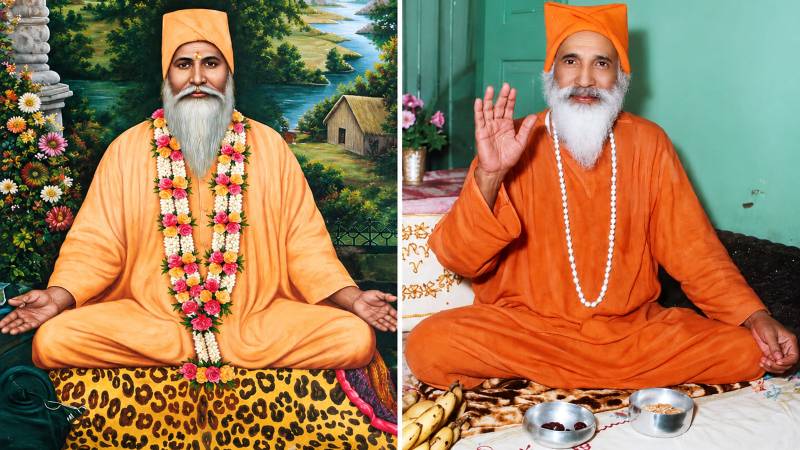
In my fieldwork for this article, I went to Tando Adam and met two groups of residents. The first group consisted of people born in the 1940s and 1950s. The following day, I met another group whose members were born in the 1970s and 1980s.
The first group remembered Tando Adam through its railway station, the old pipal tree on Platform No 4, and the dhodho and chutney served at the Amrapur Asthan of Sant Teoonram. One participant told that dhodho is a chapati made from millet flour. Another old man explained that the chutney was made from fresh green chillies, garlic, coriander leaves, salt, and cumin. The second group remembered Tando Adam through a different set of places and people. Their reference points included sajji, a whole leg of goat roasted over an open fire; Suleman Roshan Medical College; Shah Nawaz Junejo, remembered for his fair decisions; Ustad Manzoor Ali Khan, the celebrated classical singer; and Teoonram’s Asthan.
When I compared the two conversations, a pattern emerged. Their memories fell broadly into two periods: before Partition and after Partition. But Sant Teoonram appeared in both. His name crossed generations and remained part of the town’s living memory. In these conversations, 1947 emerged as a break between two sets of memories.
This article draws primarily on the memories of Tando Adam’s residents. Where those memories leave gaps, I have used secondary sources to fill them. I have then arranged the material chronologically to trace Teoonram’s life, teachings, and the spread of his ideas across the two periods of history—pre-Partition and post-Partition of India.
A Childhood on the Indus
Sant Teoonram was born on the 6th of July 1887 in Khandu, a small village on the banks of the Indus, not far from Hala town in Hyderabad District, now Matiari District. His parents were Chellaram and Krishna Devi. Both were devout people who regularly attended satsang, gatherings for spiritual discussion and devotion. One day, a group of sants from Haridwar and Rishikesh visited Khandu. Both cities were important pilgrimage centres, known for their temples, ashrams, and religious traditions.
Chellaram welcomed the visitors into his home and served them. Their presence deeply impressed Krishna Devi. She prayed for a child who would possess the spiritual qualities of these sants. With her husband's permission, she observed a forty-day fast. In due course, a son was born. On the sixth day, the family held his chhathi, a naming ceremony, and named him Teoonram. From childhood, Krishna Devi sang the dhuni of Shivohum, ‘I am Shiva,’ to him. The song expressed the idea that the divine presence exists within the self.
The Making of a Satsang
Sant Teoonram grew up in a religious household. Ordinary children's games did not interest him much. Instead, he gathered his friends and encouraged them to chant, repeatedly reciting the name of God. He was enrolled in a primary school, but he often left before the school day ended. He would neither return home nor come back for lunch. Sometimes, his father found him absorbed in meditation under a tree. This soon became a regular habit. At other times, Chellaram found him beneath a pipal tree on the bank of the Indus or in a grove of babul trees.
One day, Chellaram asked him to stay at home, no need to go to school. He wanted Teoonram to serve the sants, fetch drinking water for home, and help with household chores. Teoonram listened to conversations of sants, and he gradually became familiar with their spiritual ideas, teachings, and practices.
Finding a Guru
Sufi Aasuram Faqeer (1854–1941) was a sant, poet, primary-school teacher, and hakim, traditional healer. Around 1901, he was posted as a school headmaster in Khandu. One day, Sant Teoonram listened to him speak about the importance of a guru, a spiritual teacher who guides a disciple towards self-realisation. Aasuram taught that a person needs a guru to follow the spiritual path.
The following day, Teoonram received mantra diksha, a formal spiritual initiation in which a guru gives a disciple a sacred mantra for regular practice. Sant Teoonram later expressed the depth of his devotion to his disciples. He said, “Aasuram is a master for you, but for me, he is Allah.” Pahlaj, one of the well-known poets of those days, expressed a similar feeling in a poem dedicated to Aasuram. Its opening line reads, “Aassu is your master; for me, he is Allah.”
Questioning Old Boundaries
Satguru Swami Teoonram Maharaj Ji Jeevan Chetar (2005), a biographical book published in two volumes by Prem Prakash Mandir Trust, Amrapur Asthan, Jaipur, India, records episodes that reflect Sant Teoonram’s belief in compassion, service, and coexistence. Several stories reveal how these values shaped his conduct, his relationships with people from different religious and social backgrounds, and his understanding of the world around him.
One day, while Sant Teoonram was on his way to his agricultural land, he came across a group of Muslims gathered and singing. As he approached, a man named Ramzan stood up, touched his feet, folded his hands, and asked him to sing a song about divine love. Sant Teoonram asked why the group had gathered. Ramzan explained that it was hashar, the ninth day of Muharram, and that they had gathered to observe Ashura.
In 1921, Teoonram and his disciples transformed a sandy, wooded area outside Tando Adam into a thriving spiritual sanctuary through sheer determination and labour
Sant Teoonram took an yaktara from one of the men and sang a bhajan. Its opening line was, “O Momin, don’t strike your shoulders; just drive away your satanic desires.” Sant Teoonram then continued towards his fields, but Ramzan followed him. When Sant Teoonram asked why he was following him, Ramzan said that he wanted to become his chela, or disciple. He advised him to think carefully because mullahs might object to a Muslim becoming the disciple of a Hindu sant. Ramzan remained firm in his decision. The following day, Sant Teoonram accepted him as his disciple. Soon afterwards, Ramzan’s family came and took him away. They confined him in a small room and told him that they would release him only if he gave up his association with Teoonram. Ramzan soon returned to Teoonram and continued to live as his disciple. The episode shows how a Muslim could become the disciple of a Hindu sant while retaining his own religious identity.
In pre-Partition Sindh, the followers of pirs and sants came from different religions, families, and occupations. Sant Teoonram’s followers were no exception. The situation changed when Maharaj Hondaldas, a brahmin, became Teoonram’s chela, a disciple. One day, Bhagat Bansiram of Khandu saw him sweeping the satsang thalho. He taunted Hondaldas, saying that a brahmin should be served by others rather than perform such work himself. The incident drew attention to the growing number of people joining Sant Teoonram’s satsang. The panchayat called a meeting and decided to send a delegation to him. The delegation asked Sant Teoonram to discourage young people from attending his satsang. Sant Teoonram gave a simple answer: “No one would be stopped from attending, and no one would be forced to attend. Visiting the satsang or leaving it was a matter of individual choice.”
The panchayat sent another delegation with the same request, but Sant Teoonram gave the same answer. The panchayat then decided to expel Sant Teoonram’s family and ordered people in Khandu and nearby villages to boycott their social and cultural gatherings. A manghanhar, a traditional drummer and public announcer, was sent through the streets to announce the decision. Anyone who violated the order would be fined Rs 5.
The next day, about twenty-five young people attended Sant Teoonram’s satsang. When they returned home that evening, many found their doors locked. Some slept outside their homes, while others returned to the thalho and spent the night there. The following morning, the panchayat treasurer and his assistants collected the Rs 5 fine from those who had defied the boycott. Some parents refused to pay because their children had remained with Sant Teoonram. The panchayat later read out the names of those who had not paid. Their families argued that they could not force their children to obey them. Villagers who had already paid the fines also objected and considered the punishment unfair.
The panchayat became divided, and those who refused to pay were expelled. Some eventually paid, while others accepted the expulsion. Then cholera reached Khandu. Within a short time, around twenty-five people died. Some villagers began to believe that their treatment of Sant Teoonram had brought misfortune upon the community. The same community that had tried to control his satsang eventually approached him and sought his pardon.
Another episode shows how Sant Teoonram challenged caste practices in everyday life. One day, while he was on his way to the Indus River for his bath, a poor elderly woman stopped him. A dead puppy lay outside her house. She had asked a bhangyani, a woman traditionally responsible for removing such bodies, to take it away. The woman could afford only two annas, but the bhangyani demanded four. Unable to pay the higher amount, she asked Sant Teoonram for help. He tried to persuade the bhangyani to accept two annas, but she refused. Sant Teoonram then removed the dead puppy himself and placed it in a nearby ditch.
The next day, the bhangyani complained to the seths, bavas, and brahmins. She argued that such work belonged to her community and that allowing others to perform it could threaten their livelihood. The matter went first to the mukhi, the head of the panchayat, a village council. Its members disagreed about whether Sant Teoonram had violated caste and religious customs. When they asked Sant Teoonram to explain his action, he remained calm. He simply asked, “Is helping a destitute person a sin or a virtue?” He then left the decision to the panchayat.
The panchayat remained divided for more than a week. Finally, Seth Motiram proposed that Sant Teoonram be fined Rs 51 and 1¼ annas. He also proposed that Sant Teoonram feed two and a half maunds of cottonseed (kakra) to cows and seek forgiveness. Then Bhagat Bansiram reminded the members that “Darya Shah has reached our doors” and that Khandu itself might soon be threatened. The panchayat dropped the case against Teoonram, and the matter was never raised again.
Sant Teoonram’s opposition to goat sacrifice emerged at an annual mela in Thorrha village, in present-day Matiari District, Sindh. Large numbers of he-goats were brought there, slaughtered, cooked, and eaten during the celebrations. Liquor was also served. Over time, the mela had become less a religious gathering and more an occasion for feasting, drinking, and merrymaking. Sant Teoonram’s chelas were concerned about the practice. They asked him to visit the mela and speak against balidan, the sacrifice of goats.
Teoonram agreed and travelled from Khandu to Thorrha with his mandli. Bhagat Persuram was leading the satsang when Teoonram arrived. During his discourse, Bhagat Persuram spoke about the sanctity of life. He said that no one should kill a jeev, a living being, because taking the life of any living creature was a paap, sin. When Sant Teoonram’s turn came to sing with his mandli, he referred to what Bhagat Persuram had said. He asked whether the same principle applied to the goats being slaughtered at the mela. If killing even a small living creature was a sin, he asked, how could the slaughter of so many goats be justified? Bhagat Persuram replied that balidan was an old Hindu religious tradition.
Sant Teoonram asked a simple question: “But for what purpose?” He then explained the teaching attributed to Nīti Śāstra. The responsibility, he said, did not rest only with the person who slaughtered the animal. Everyone who took part in the sacrifice shared responsibility: the person who ordered it, the one who advised it, the one who provided the animal, the one who slaughtered it, the one who cooked it, the one who tasted it, and the one who ate it. Sant Teoonram then asked those at the satsang whether they really wanted to continue slaughtering and eating goats. A moment of silence followed. Then, one by one, hands began to rise. “No, we do not want to slaughter them or eat them.” What had long been accepted as part of the mela was now being questioned by the people themselves.
Sant Teoonram also challenged the idea that religious scriptures belonged exclusively to one community. His satsang attracted Muslims, Hindus, and Sikhs. Once, in Chak, a town in northern Sindh, he quoted verses from the Holy Quran during his talk. A man stood up and objected. He argued that a Hindu should not quote the Quran. Teoonram listened calmly. He replied that religious books belonged to humanity. A Muslim could read the Gita. A Jew could read the Bible. A Hindu could read the Holy Quran. He saw nothing wrong with this. The man accepted his explanation.
Women’s participation in his satsang became another point of dispute. On one occasion, Sant Teoonram held a satsang in Shikarpur, where women also attended. The bavas and brahmins regarded their presence as a challenge to the existing social order. They went to the mukhi and complained that women’s participation broke an old tradition. They asked him to stop women from attending Sant Teoonram’s satsang. The mukhi agreed. Some people then approached Teoonram and asked him to prevent women from attending. He refused. No woman, he said, should be stopped from attending the satsang. At the same time, no one should be forced to attend.
The mukhi then ordered some men to stand outside the mandal, a temporary stage, in the form of a circle or half-circle. They followed the order, but the women continued to attend the satsang by their own choice. Some even shouted at the men who tried to stop them. The bavas then took another step. They hired a man to spread a false report that the Sindh Government had arrested Sant Teoonram and sent him to Central Jail, Sukkur.
Building an Asthan in the Sand
In earlier times, Tando Adam was surrounded by sandy terrain and wooded areas. W Hughes, in A Gazetteer of the Province of Sind (1876), and J W Smyth, in Gazetteer of the Province of Sind: Nawabshah District (1926), both place the town’s foundation at around 1800. The settlement took its name from its founder, Adam Khan Mari. On 20 phagun, samvat 1978 (the 3rd of March 1921), Sant Teoonram and his chelas left Tando Adam for Khandu. Along the way, Teoonram changed direction. When his disciples asked why, he told them that he wanted to go into the forest. They followed him.
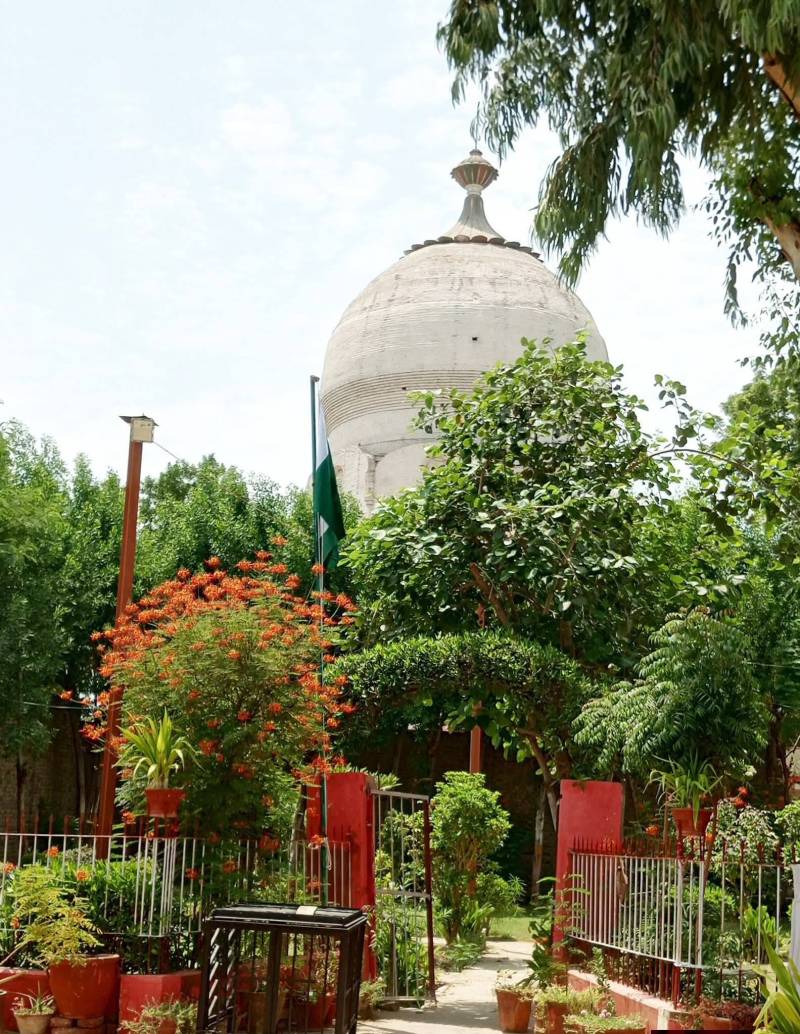
The forest lay near the town. Teoonram found the site suitable for an Asthan, a place where people could gather for spiritual teaching and practice. Loose sand covered the ground. Teoonram and his devotees worked to stabilise it with cow dung. They built a platform for gatherings and fenced the site. Working day and night, they gradually turned the difficult ground into a place for worship and community life.
A Sant and the Colonial State
The mukhis and bavas of Tando Adam tried to dislodge the Asthan, but they failed. They eventually submitted a complaint to E J Bolus, the Collector of Nawabshah District and a British civil servant and writer. Bolus has authored A Sehwan Reverie (1918) and Shrines and Spires (1921), works that described aspects of Sindh and its geography.
The complaint alleged that the sants had occupied government land without permission. It also claimed that they had cut down the forest, which was meant to hold back sand dunes, prevent erosion, and protect the town from sandstorms. The complainants further accused the sants of being thieves who had hidden in the forest under the guise of religion. According to the complaint, their presence had contributed to an increase in theft, and they were allegedly hiding stolen livestock there. The complainants also accused the sants of following Mahatma Gandhi, supporting non-cooperation, and working with the Indian National Congress. They further alleged that the sants were conducting an anti-government campaign. Another allegation concerned livestock. Animals that entered the forest, they claimed, did not return to their owners because the sants kept them, hid them, and later sold them.
Eventually, E J Bolus visited the site. He ordered the Asthan removed, the huts burned, and the satsang thalho dismantled. The sants offered no resistance. The next day, they continued their satsang among the ruins. A few days later, an Englishman and an Englishwoman arrived. They asked who had burned the huts. Sant Teoonram pointed towards them and replied, “You people have done it.” They understood his meaning and assured the sants that the Asthan would soon be restored.
The matter then reached the Commissioner’s Office in Karachi. The application was forwarded to the newly posted Collector of Nawabshah. He reviewed the case, inspected the site, and eventually allocated seven acres and twelve gunthas of land to the Asthan. Some of the documents refer to Sant Teoonram by a different spelling of his name. The variations appear in the records themselves.
Sant Teoonram and his disciples began the Asthan in the 1920s with very little. It was formally inaugurated on 12 chett, samvat 1980 (the 26th of March 1924), when the flag was hoisted. The event was announced throughout Tando Adam, and people were invited to attend the satsang. The programme continued for four days, and visitors could stay for the entire festival. Teoonram lived at the Asthan only for short periods. He travelled across Sindh and held satsangs in different places. He preached ahimsa, or non-violence, and equality.
From Sindh to India
Sant Teoonram spent the sacred month of Purushottam, also known as Adhik Maas, in Hyderabad. This additional month in the lunar calendar helps keep the lunar and solar calendars aligned. Teoonram died there at the age of 55, in Vikram Samvat 1999 (1942 CE). His fellow sants and disciples carried his body to the Amrapur Pradhan Asthan at Tando Adam. They performed his funeral rites there and established his samadhi.
Sant Teoonram had also formed the Prem Prakash Mandal at the Asthan of Tando Adam. Its principles included spreading Vedic culture, encouraging devotion to God, serving people without distinction of caste or creed, promoting religious unity, and maintaining friendly relations with other religious communities.
After his death, the community of sants appointed Swami Sarwanand Maharaj as his successor and gadi-nashin. The Prem Prakash tradition continues in several places in India, including Ulhasnagar in Maharashtra; Haridwar; Jaipur in Rajasthan; Bombay, now Mumbai; Madras, now Chennai; Kanpur; Nagpur; and Baroda, now Vadodara. Taken together, these centres trace the movement of the tradition from its roots in Sindh to its new homes across India.
The Memory That Crossed the Border
The original Amrapur Asthan at Tando Adam remains an important point of memory. The centres established in India have provided new spaces where Teoonram’s ideas and the Prem Prakash tradition could continue to flourish. Alongside these centres and mandlis, another important source of continuity is his granth, Prem Parkash Granth, published by the Prem Prakash Mandir Trust, Amrapur Asthan, Jaipur, India. This voluminous collection brings together numerous bhajans, arranged according to Sindhi and Indian raags.
But the authorship of all the compositions is not entirely certain. Aakash Asswani, compiler of Deewan-e-Aassu Poet: Aassu Mal Daandu Mal Faqeer Sufi, points out that many of Teoonram’s chelas also used the name “Teoon” in their poetry. He suggests that some of their compositions may have been included in the granth because they were attributed to Sant Teoonram.
These different perspectives also show how a spiritual tradition continues to grow through the contributions of its followers. One devotee of Sant Teoonram emphasises the importance of preserving the Sindhi bhakti tradition of pluralism, coexistence, and respect for different faiths. Such reflections keep attention focused on the values that made Teoonram’s teachings meaningful to people from different religious and social backgrounds. His legacy therefore lives not only in the Asthan, centres, mandlis, and granth, but also in the songs people sing, the stories they remember, and the values they continue to discuss. From Khandu and Tando Adam to the many centres across India, the memory of Sant Teoonram continues to travel, connecting generations through devotion, music, service, and a spirit of religious harmony.