

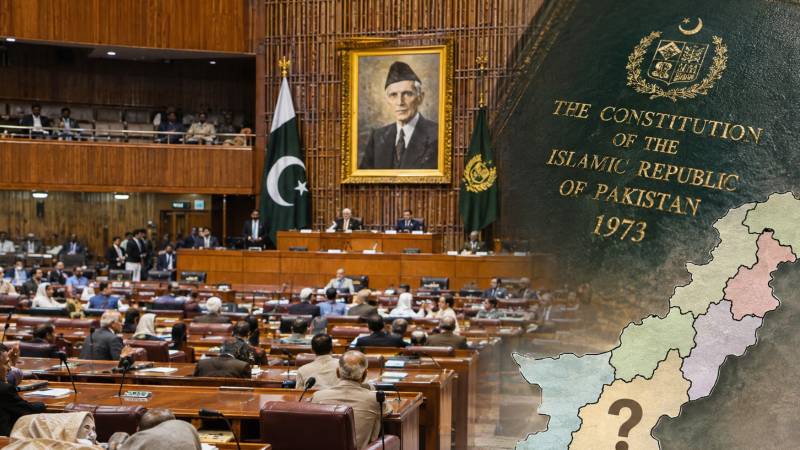
Much is being discussed about the creation of new provinces in Pakistan, with avenues being explored through legal and constitutional experts reminiscent of the late Sharifuddin Pirzada and A.K. Brohi, figures who in the past stood ready to assist military rulers from self-declared Field Marshal Ayub Khan in the 1960s to General Zia-ul-Haq in the 1980s and General Pervez Musharraf in the 2000s. Today, a new crop of legal minds and narrative builders appears poised to serve similar ends.
While the Pakistan People’s Party (PPP) opted out of joining the federal cabinet, it remains one of the biggest beneficiaries of the current hybrid setup, securing key constitutional offices instead. From the Presidency under Asif Ali Zardari to power-sharing across Sindh, Balochistan, and Khyber Pakhtunkhwa (KP), the party’s gains are substantial. Nowhere is this clearer than in KP, where the PPP has emerged as a primary beneficiary of Governor’s Rule, exercising sweeping influence over funneled federal funds following emergency measures across the 12 terror-affected districts of the former Federally Administered Tribal Areas (FATA) along the Afghan border. Yet on the question of new provinces, the party draws a hard line, opposing any division, particularly in Sindh, out of sensitivity to its vast Sindhi-speaking vote bank.
Amid the indecisiveness of the ruling political elite, including the PML-N and PPP—over creating new federating units, establishment allies have been fielded to promote the narrative of holding a national referendum. Historically, however, referendums in Pakistan have served as instruments to bypass broader public sentiment and legitimize authoritarian rule. Ayub Khan held an indirect referendum in February 1960 through 80,000 selected Basic Democracies members to secure a five-year presidential term following the 1958 coup. Similarly, General Zia-ul-Haq held a referendum in December 1984 under the banner of his "Islamization program," tying a question on aligning laws with the Quran and Sunnah to his own five-year presidency. Later, in April 2002, General Pervez Musharraf asked voters to grant him five more years in office. Tellingly, all three exercises officially recorded approval ratings exceeding 95 percent.
As originally adopted, Pakistan’s 1973 Constitution, crafted under the consensus leadership of Prime Minister Zulfikar Ali Bhutto, founder of the PPP—contained no provision for a national referendum. However, following rigging allegations in the March 1977 general elections, the Pakistan National Alliance (PNA), a nine-party opposition coalition covertly backed by General Zia, launched a nationwide agitation movement to topple his government.
To break the deadlock and seek a direct vote of confidence from the public, Bhutto introduced a temporary provision via the Seventh Amendment in May 1977, inserting Article 96-A with a built-in sunset clause. Ultimately, the vote was never held, and the clause lapsed shortly after General Zia imposed martial law in July 1977. When restoring the Constitution in 1985 through the Eighth Amendment, Zia embedded Article 48(6) to retroactively validate his 1984 referendum and empower the President to unilaterally call a referendum on any "matter of national importance," allowing a strong presidency to sidestep Parliament.
Bypassing Parliament and the provincial assemblies to create new federating units would undermine national unity at a time when the federation is already under severe strain from ongoing terrorism and security operations in Khyber Pakhtunkhwa and Balochistan.
Globally, the modern framework of direct democracy was institutionalized in the 19th century when Switzerland formally embedded referendums and citizen-led initiatives into its federal constitution in 1848 and 1874. Throughout the 20th and 21st centuries, the mechanism expanded worldwide, used after both World Wars to redraw borders and decide decolonization and independence (such as the 1947 votes in British India and the 1958 referendums across French Africa), as well as to ratify European Union treaties and settle pivotal national questions like Brexit.
Pakistani politicians have frequently cited the United Kingdom’s 2016 Brexit referendum, in which citizens voted on whether to remain in or leave the European Union to advocate for holding referendums at home. Following the public’s narrow decision to leave, and after a series of prolonged deadlocks and failed votes in the House of Commons over withdrawal terms, the UK formally exited the bloc in 2020. Today, many in the United Kingdom continue to feel the economic repercussions of that choice, grappling with a persistent cost-of-living crisis, inflation, and labor market pressures.
Yet importing that playbook into Pakistan raises profound constitutional hurdles. The central question is whether new provinces—including carving a separate unit out of Sindh, can be created via a referendum and subsequently validated by the Constitutional Court under Justice Amin-ud-Din Khan. Constitutional experts reject this route, pointing out that Article 239(4) of the Constitution explicitly bars altering provincial boundaries unless a constitutional amendment bill is first passed by the concerned Provincial Assembly by at least a two-thirds majority of its total membership. A referendum under Article 48(6) cannot substitute for mandatory provincial assembly and parliamentary votes. Beyond the two-thirds threshold, experts warn that proposing specific borders risks triggering fierce inter-provincial disputes over territory, resource distribution, and administrative control—and would require amending as many as 12 separate constitutional articles.
These constitutional barriers mirror equally delicate political realities on the ground. Alongside longstanding calls for South Punjab, Bahawalpur, and Hazara provinces, sections of Karachi’s Urdu-speaking population have also demanded a separate province. While the Punjab and Khyber Pakhtunkhwa assemblies have previously adopted resolutions supporting the creation of their respective proposed units, the Sindh Assembly has firmly rejected any division of its existing boundaries, making the issue acutely sensitive.
Although the megacity of Karachi has suffered from chronic underdevelopment despite generating immense economic resources, it remains a deeply multilingual metropolis, home to Urdu-speaking, Sindhi, Baloch, Punjabi, Pashtun, Seraiki, Gujarati, and Bohra communities. Given the city's painful history of ethnic violence and political polarization since the rise of the MQM in the mid-1980s, many linguistic groups fear that elevating a single dominant identity at the expense of others could ignite a fresh wave of bloodshed. Carving out a new province in Sindh or anywhere else in the country requires broad consensus among all ethnic and linguistic stakeholders, a task that remains exceptionally challenging.
Bypassing Parliament and the provincial assemblies to create new federating units would undermine national unity at a time when the federation is already under severe strain from ongoing terrorism and security operations in Khyber Pakhtunkhwa and Balochistan. Any move toward redrawing Pakistan’s administrative map must therefore be anchored in constitutional procedure and genuine political and social consensus to prevent further discord and bloodshed.