

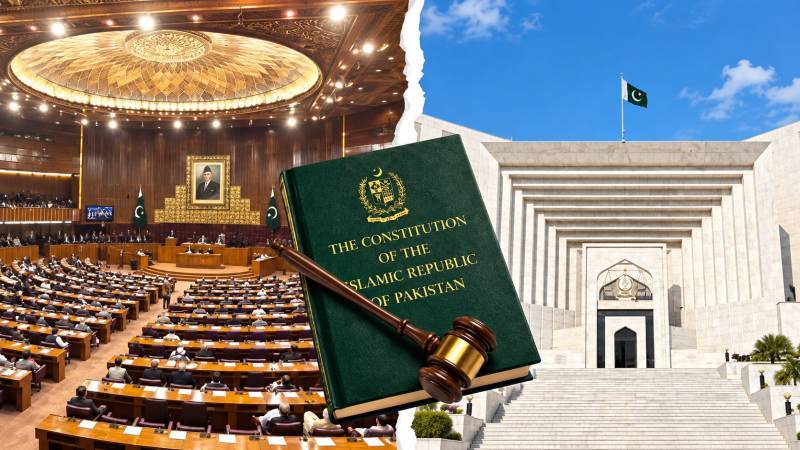
There was a time when the suspension of an elected provincial government would have provoked a national constitutional crisis. In Pakistan, it has become another afternoon’s news. On the 11th of October 2026, the federal government imposed emergency rule in Khyber Pakhtunkhwa (KP), suspending its elected government amid rising militancy. The justification was security; the political context, however, makes the decision impossible to separate from Pakistan’s entrenched struggle over who actually governs the country. The extraordinary has become ordinary, and that is perhaps the most frightening indictment of our republic.
We are no longer merely governed by clowns. We have become an audience that applauds, tolerates, or quietly accommodates the circus. Pakistan’s constitutional crisis is not simply that powerful people violate constitutional principles. It is that the violation itself has lost its capacity to shock us. We have witnessed elected governments weakened, political opponents pursued, dissent treated as disloyalty, and constitutional guarantees reduced to ceremonial language. Article 17 protects freedom of association; Article 19 protects freedom of expression; Article 25 guarantees equality before the law. Yet what value do these guarantees possess when their practical protection appears to depend on political convenience?
The Suspension of Constitutional Restraints
A constitution is not a document that legitimises whoever happens to wield power. It is the instrument that limits that power. When the state treats constitutional restraints as obstacles rather than obligations, the distinction between constitutional government and government by coercion begins to disappear.
Consider KP. Articles 232 and 234 provide constitutional mechanisms for emergencies and the failure of provincial constitutional machinery. Their existence does not make their invocation automatically justified. Extraordinary powers demand extraordinary scrutiny, a demonstrable legal basis, proportionality, and meaningful parliamentary and judicial oversight. Article 234 itself requires the proclamation to be presented to a joint sitting and limits its duration unless approved. The question is not whether the Constitution permits exceptional measures; it is whether those measures are necessary, lawful, and genuinely directed towards restoring constitutional government.
An elected government cannot be removed from meaningful authority merely because the federal establishment finds its politics inconvenient. Nor should any party receive immunity from accountability because it won an election. The principle must be consistent: incompetence must be addressed lawfully, terrorism must be confronted decisively, and constitutional power must never become a partisan instrument.
The Balochistan Comparison
And this brings us to the question nobody should be permitted to evade: if terrorism justifies extraordinary intervention in KP, what explains the apparent absence of an equivalent political response to the catastrophe in Balochistan?
The comparison is not speculative. The Centre for Research and Security Studies reported that, in the third quarter of 2026, Balochistan accounted for nearly 88 per cent of the nationwide increase in violence-related fatalities and overtook KP as the worst-affected province in both fatalities and recorded incidents. These figures do not establish that identical constitutional measures should apply in both provinces. They establish something more fundamental: the state must explain its priorities according to evidence, law, and public safety, rather than political convenience.
The state must explain its priorities according to evidence, law, and public safety, rather than political convenience
Balochistan is not merely a security theatre. It is home to strategic geography, mineral wealth, the deep-water port of Gwadar, and the ambitions of the China-Pakistan Economic Corridor (CPEC). Its potential to contribute to national prosperity is immense. Yet investment cannot flourish where citizens fear violence, disappearances, collective punishment, or exclusion from decisions about their own resources. CPEC cannot become a substitute for political legitimacy. Roads, ports, and mines cannot compensate for a population that feels dispossessed of its dignity.
Nor is the answer to demand that the security forces simply eliminate every terrorist overnight. Pakistan’s security personnel have made enormous sacrifices, and militant networks present a genuine threat. But after years of operations, recurring attacks demand an honest examination of intelligence failures, border management, prosecution, political reconciliation, and the policies that allow militancy to regenerate. The state cannot claim unlimited authority when confronting its political opponents while treating persistent insecurity as an endlessly renewable excuse. The objective must be sustainable security under the rule of law, not merely spectacular displays of force.
Institutional Accountability and Systemic Failure
Interior Minister Mohsin Naqvi has reportedly acknowledged that the system has failed. On that point, Mr Naqvi, the country might agree. But the obvious question is: who is responsible for that failure? A political order in which unelected centres of influence exercise power without equivalent democratic accountability cannot indefinitely blame elected politicians for every institutional breakdown. Naqvi’s own position makes the question of institutional accountability unavoidable. If the system has failed, those exercising substantial authority within it must explain their decisions, their record, and the limits of their mandate. No individual should be presumed to represent any institution without evidence; equally, no officeholder should be insulated from scrutiny because of proximity to power.
A Nation's Complicity
The final indictment, however, belongs to us. We condemn the system in private and accommodate it in public. We denounce authoritarianism until it targets our opponents. We discover constitutional principles when our preferred party suffers and forget them when our own side benefits. Access, patronage, influence, and personal advantage have made too many of us willing participants in the arrangements we claim to despise.
Perhaps we are not a dead nation. Perhaps we are something more dangerous: a nation that still possesses the capacity for outrage but has learned to ration it according to self-interest. Calling ourselves courageous means little when our courage disappears at the first threat to our privileges.
Pakistan does not need another sermon about national unity, another slogan about stability, or another powerful man announcing that the system has failed. It needs institutions that answer to law, elected governments that respect constitutional limits, security policies applied consistently, and citizens who refuse to trade principle for proximity to power.
A republic does not die only when its Constitution is suspended. It dies when its citizens stop caring whether the Constitution survives.
The clowns may occupy the stage. But the tragedy continues because the audience has forgotten that it can walk out.