

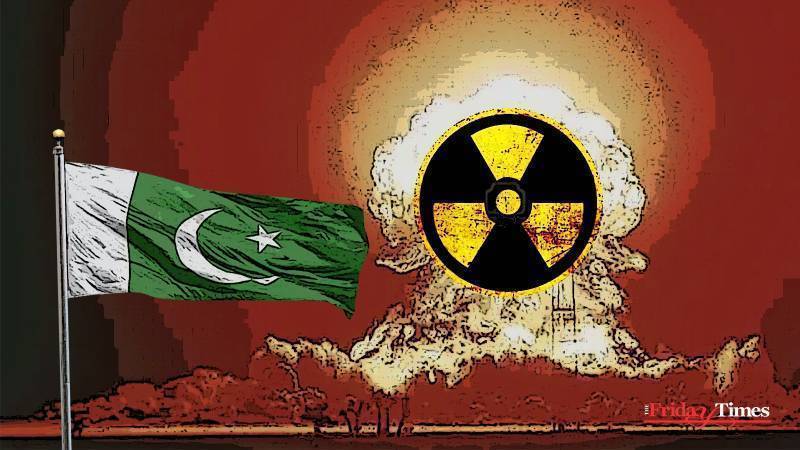
Overview of How to Survive the New Nuclear Age and its Claims on Pakistan
Vipin Narang and Pranay Vaddi’s recent Foreign Affairs article, “How to Survive the New Nuclear Age,” paints a picture of a rapidly deteriorating global nuclear order with rising threats across multiple regions. The authors argue that as arms control frameworks erode and new powers expand their arsenals, U.S. security faces proliferating risks. They highlight challenges from an assertive Russia e.g. nuclear coercion in Ukraine, a massively expanding Chinese arsenal, North Korea’s growing capabilities, and even the prospect of U.S. allies contemplating their own nuclear arms. Within this broader context, Narang and Vaddi single out Pakistan as yet another threat in the emerging nuclear landscape. They assert that despite Islamabad’s official stance of deterring India, U.S. intelligence believes Pakistan’s military is developing an intercontinental ballistic missile (ICBM) that could reach the continental United States.
The article speculates that Pakistan may seek such long-range reach to deter U.S. intervention, either to prevent Washington from attempting a preventive disarming strike or from coming to India’s aid in a future South Asian conflict. The authors ominously conclude that if Pakistan acquires an ICBM able to target U.S. cities, Washington “will have no choice but to treat the country as a nuclear adversary” akin to other hostile powers, since no nation with that capability is considered a friend. In essence, the article urges U.S. policymakers to consider Pakistan in the same problematic category as North Korea if these trends hold.
This rebuttal focuses on the Pakistan-specific claims in Narang and Vaddi’s piece.
Pakistan’s Nuclear Program is India-Centric, Not Aimed at the United States
A central premise of the Foreign Affairs article is that Pakistan might be seeking ICBM-level capability to threaten the U.S. mainland. This claim is problematic and unsupported by the weight of historical and strategic evidence. Pakistan’s nuclear weapons program, from its genesis to its current force posture, has always been driven by the threat perception from India, not the United States. Pakistani officials and doctrinal publications have consistently framed their nuclear arsenal as a counter to India’s conventional and nuclear superiority in South Asia. From the 1980s onward, Islamabad’s pursuit of nuclear capability was a direct response to India’s nuclear program and its larger military forces, aimed at deterring Indian aggression or coercion. Even after overt nuclearisation in 1998, Pakistan’s doctrine of credible minimum deterrence, later evolved to full spectrum deterrence, is explicitly oriented toward the Indian threat adjusting dynamically to India’s capabilities rather than any global power.
Crucially, Pakistan’s missile development has mirrored this India-centric orientation. Its longest-range operational ballistic missile to date is the Shaheen-III, with an estimated range of ~2,750 km. This range is just enough to cover all of India’s territory, including India’s far eastern regions and the Andaman and Nicobar Islands in the Bay of Bengal. In fact, Pakistani strategic planners have openly stated the rationale for the Shaheen-III range: to deny India any safe haven for strategic assets on its periphery. General Khalid Kidwai, inaugural and longtime head of Pakistan’s Strategic Plans Division, noted that a 2,750 km missile was needed to reach the farthest reaches of India, for example, India’s islands in the Bay of Bengal, so that India cannot hide any territory from Pakistan’s reach. By covering India’s extremities, Pakistan believes it closes a gap where India might station forces or second-strike capabilities out of range of earlier Pakistani missiles.
Nowhere in official statements or credible assessments is there indication that Pakistan seeks ranges beyond this for targeting distant countries like the United States. If Pakistan were truly intent on threatening the U.S., it has shown remarkable restraint: it has never tested or deployed a missile even half the range needed to strike the U.S. homeland, despite having had nuclear weapons for decades. This stands in contrast to India, which has tested missiles well into the ICBM range, for example, the Agni‑V has a confirmed range of 7,000-8,000 km and entered service in 2018, and the Agni‑VI, currently under development, is projected to reach 9,000-16,000 km, clearly capable of striking targets far beyond the Indian Ocean and into North America. Pakistan, by comparison, has never pursued missile ranges beyond what is needed to hold all parts of India, and has not shown any intention to develop systems capable of targeting the United States.
The Foreign Affairs article’s claim that “U.S. intelligence” concludes Pakistan is developing an ICBM may be referencing recent U.S. government concerns about Pakistan’s missile research, for example, the development of larger rocket motors possibly for space launch or longer-range systems. Indeed, in late 2024 the U.S. imposed sanctions on several Pakistani entities, alleging work on long-range missile technology that could eventually…strike targets well beyond South Asia, including the United States, in the words of Deputy NSA Jon Finer.
There is no evidence that Pakistan is designing missiles to reach beyond targets associated with India’s present or future capabilities
Pakistan did not confirm any such program, and its response to those sanctions was to emphasise that its missile developments are security-driven and not intended for aggression. In short, while Pakistan appears to be incrementally extending its missile range and payload capacity, the driving factor is its security competition with India, not a sudden intent to target America. If Pakistan were to pursue an ICBM-class system, it would contradict its longstanding strategic calculus and invite severe international backlash, a step Pakistan’s security establishment has little incentive to take unless they perceived an extreme threat from the U.S. directly. No such direct U.S.-Pakistan hostility exists today to rationalise Pakistan diverting resources toward deterring Washington; on the contrary, Pakistan depends on a functional, if fraught, relationship with the U.S. for economic and diplomatic support. The more parsimonious explanation for any prospective range increases is given by Pakistan’s dynamic view of minimum deterrence: it adjusts its capabilities in response to India’s moves. As India’s military reach grows, through power projection and bases abroad, Pakistan is hedging to ensure its deterrent remains credible in an India-centric conflict scenario.
Missile Ranges and India’s Expanding Overseas Military Footprint
If Pakistan’s missile planners are contemplating longer ranges, India’s own expanding military footprint around the world is the most plausible catalyst, not an inexplicable desire to strike American cities. India in recent years has pursued military access and bases beyond its borders, which potentially extend the theater of Indo-Pakistan rivalry. For instance, India has obtained operational access to airfields in Tajikistan, Ayni base near Dushanbe, jointly run with the Tajik Air Force, India’s first foreign airbase, where Indian Su-30MKI fighters have been deployed. India has also secured naval logistics facilities in the Middle East and Africa: it operates a signals intelligence listening post at Ras al-Hadd in Oman and has berthing rights at the port of Muscat for the Indian Navy. In the western Indian Ocean, New Delhi is dramatically bolstering its presence.
Notably, India is funding the construction of a 3000-meter runway and military infrastructure on the North Agaléga Island in Mauritius, including accommodations for Indian troops. This base, inaugurated in 2023–24, will allow India to station maritime patrol aircraft such as P-8I reconnaissance planes and other assets deep in the Indian Ocean, thousands of kilometers from the Indian mainland. Similarly, India has pursued, with mixed success, a naval/coast guard facility in the Seychelles and maintains surveillance radar stations across island states in the region. It also has a monitoring station in northern Madagascar, reflecting its interest in the southwest Indian Ocean approaches.
Why do these far-flung Indian bases matter for Pakistan’s missile program? Because they potentially provide India with strategic depth and power projection nodes that were previously out of Pakistan’s reach. For example, Agaléga island is over 4,500–5,000 km from Pakistan, well beyond the 2,750 km range of the Shaheen-III. In a hypothetical future conflict, if India can operate combat aircraft or even missiles from such distant bases, Pakistan would find itself unable to target or threaten those sites with its current missile inventory. Pakistani strategic analysts have already identified India’s Nicobar and Andaman Island bases, roughly 2,000+ km from Pakistan, as a motivation for developing Shaheen-III. As India establishes footholds even further away e.g., in the southwest Indian Ocean, it is logical that Pakistan’s defence planners will seek ways to extend deterrence coverage to those locations. In effect, Pakistan may want to ensure that India cannot escape retaliation by relocating key assets outside the subcontinent. This logic is fundamentally India-centric: it is about covering Indian targets wherever they may be, not about targeting unrelated countries.
There is no evidence that Pakistan is designing missiles to reach beyond targets associated with India’s present or future capabilities. We should recall that India’s own missile developments have pushed ranges outward, ostensibly to cover targets in China, India’s Agni-V can reach 5,200+ km, bringing Beijing within range. As India’s strategic horizon has widened to a two-front scenario, China and Pakistan, and to securing the Indian Ocean sea lanes, Pakistan’s horizon may have modestly expanded to an India plus scenario to include India and India’s out-of-area assets. Even so, Pakistan’s focus remains squarely on India. It has shown little interest in matching India’s capability to target far-off Chinese or other extra-regional targets. Therefore, the causal chain for Pakistan’s missile range increases runs through New Delhi, not Washington. If observers see signs of Pakistan exploring larger missiles or space-launch vehicles that could be converted to longer-range delivery systems, the context is likely India’s expanding military reach and Pakistan’s attempt to neutralise the impact of India’s modernisation, rather than a sudden desire to menace the United States unprovoked.
Even at the height of proliferation concerns, top U.S. officials recognised that pushing Pakistan into a corner could worsen outcomes
Debunking the ‘Hostage U.S. Cities’ Theory: Pakistan’s Actual Deterrence Posture
Implicit in Narang and Vaddi’s formulation is the suggestion that Pakistan, by pursuing longer-range missile capabilities, may be seeking to deter the United States from launching a preventive disarmament strike or intervening militarily in support of India during a future conflict. This line of reasoning parallels the logic often attributed to North Korea, which openly aims to hold U.S. cities like San Francisco or Washington, D.C., at risk in order to forestall regime-threatening actions. Applying a similar inference to Pakistan, however, constitutes a serious mischaracterisation of its nuclear posture and strategic calculus. Pakistan’s deterrent is fundamentally India-centric, and its force developments have consistently been shaped by regional dynamics rather than extra-regional ambitions. Suggesting that Pakistan is evolving its program to target the U.S. reflects speculative extrapolation rather than evidence-based analysis, and overlooks the structural and doctrinal distinctions between Pakistan and states like North Korea.
First, Pakistan has never articulated a doctrine of targeting the U.S. or other distant adversaries as a shield against intervention. Its public and private messaging has been the opposite: Pakistan portrays its nuclear weapons as a last resort against Indian aggression, not tools of broader power projection or coercion. Unlike North Korea’s highly centralised regime which fears the U.S.-led regime change and thus loudly advertises its ability to nuke American cities, Pakistan’s leadership does not live under the same siege mentality vis-à-vis the United States. Islamabad’s primary security anxieties center on India and to a lesser extent internal threats, not an American invasion. While Pakistan certainly is wary of U.S. pressure or covert operations for instance, fears of a U.S. mission to seize its nukes in extremis have been speculated in Pakistani discourse, its strategy to handle those contingencies has emphasised operational secrecy and redundancy of its nuclear arsenal, not threatening America with attack.
So how would Pakistan seek to prevent a hypothetical U.S. decapitation strike or intervention on India’s side, if that specter truly worried its strategists? The answer lies in ensuring a credible second-strike capability and survivability by indigenous means, not in city-busting threats. Pakistan’s nuclear posture is built on survivability and the ability to retaliate even after absorbing an attack, thereby deterring adversaries from attempting a first strike in the first place. To this end, Pakistan has invested in a range of measures:
- Hardening and concealment: Pakistan is believed to store warheads and missiles in secure, underground facilities and to use mobility and decoys to complicate enemy targeting. The exact details are classified, but the dispersed nature of its arsenal is intended to prevent any enemy, India or otherwise, from wiping it out in one go.
- Mobile missile systems: Most of Pakistan’s delivery systems are road-mobile or can be relocated, which increases their survivability. Pakistan has deployed solid-fueled, road-mobile medium-range missiles that bolster its ability to hide and launch if attacked.
- Redundancy and rapid response: Pakistan maintains a policy of keeping its nuclear forces at a low observable alert in peacetime, warheads separated, but in a crisis it can mate warheads to delivery vehicles and disperse them to ensure a retaliatory capability. This flexible readiness is part of its concept of full-spectrum deterrence.
- Sea-based second strike: Recognising the survivability conferred by a naval leg of the triad, Pakistan has been developing a sea-based nuclear capability. In 2017, it tested the Babur-3, a nuclear-capable cruise missile designed to be launched from a submarine hailed this as achieving a credible second-strike capability. The plan is to deploy nuclear-tipped cruise missiles on its diesel-electric submarines, which would be far harder for an adversary to preempt, thereby deterring even a powerful opponent from considering a decapitation strike.
- Penetration aids (MIRVs): Pakistan has also flight-tested the Ababeel ballistic missile, reported to be capable of carrying Multiple Independently Targetable Reentry Vehicles (MIRVs). MIRV technology would allow a single missile to deliver several warheads against different targets or employ decoys, thus overwhelming missile defences. The impetus for Ababeel is clearly to defeat India’s ballistic missile defence systems and ensure Pakistan’s warheads can get through to their targets . By improving penetration and requiring an adversary to intercept multiple incoming warheads, Pakistan bolsters the credibility of its deterrent. It is worth noting that Pakistan tested Ababeel twice in 2017 and again in 2023, underscoring its focus on regional deterrence requirements, India is deploying missile defences; the U.S. mainland, by contrast, is not the target of Ababeel’s range.
Collectively, these measures demonstrate that Pakistan’s strategy to avoid being disarmed or decapitated is to make such an attack infeasible or too costly by strengthening the survivability of its forces. There is no need to threaten American cities when Pakistan can instead credibly threaten the assets and forces that an adversary like India, or any intervening power, would actually use in a conflict against Pakistan. By ensuring a guaranteed ability to retaliate against Indian cities and military forces, Pakistan already deters India and by extension any ally of India, from contemplating a disarming strike.
This logic is very different from North Korea’s. Pyongyang lacks the conventional strength or geographic strategic depth, so it openly telegraphs an ability to devastate Los Angeles or New York in order to make U.S. generals think twice about attacking it. Pakistan, on the other hand, does not hinge its deterrence on such ‘hostage-taking’ of U.S. populations. Its nuclear weapons are not a bargaining chip for international prestige or extortion, they are a shield against India. Even during the War on Terror era, when U.S.-Pakistan tensions ran high, Pakistan never insinuated it would use nukes on U.S. forces if, say, American troops crossed into Pakistan.
Thus, the claim that Pakistan seeks to hold the U.S. at risk as a deterrent is unsupported by Pakistan’s doctrine and behavior. Pakistan has ample means to secure its arsenal’s survival and to deter intervention without crossing the Rubicon of targeting the U.S. homeland, a move that would be strategically self-defeating by turning a former ally into a permanent mortal enemy.
Treating Pakistan identically to North Korea in U.S. policy would be both inaccurate and counterproductive. Pakistan’s nuclear development has been tied to a regional security dilemma that the U.S. has long sought to manage through balanced engagement, not isolation. Indeed, even at the height of proliferation concerns, top U.S. officials recognised that pushing Pakistan into a corner could worsen outcomes. The Foreign Affairs article’s recommendation that if Pakistan tests an ICBM, Washington must regard it as an adversary akin to North Korea overlooks the probability that such a Pakistani move, while undesirable, might be reactive to strategic shifts, not driven by a North Korea-style hostility or irrationality. Rather than a blanket adversarial stance, the more effective response would be to address the security drivers behind Pakistan’s decision. Lumping a former major non-NATO ally with a hermit dictatorship disregards the leverage and channels the U.S. still has with Pakistan, channels that have helped prevent worst-case outcomes in the past.
The real policy failure lies in not acknowledging how India’s unchecked evolution, its ballistic missile defence, naval expansion into the Indian Ocean, and provocative doctrines feed Pakistan’s security dilemma
Opacity and Speculation: The Pitfalls of Worst-Case Analysis
Why do analyses like Narang and Vaddi’s veer into what Pakistan views as worst-case speculation? A significant factor is the opacity surrounding Pakistan’s nuclear program. Pakistan deliberately maintains secrecy about its nuclear warhead stocks, deployment procedures, and even doctrinal thresholds, much like all NWS. Unlike Western nuclear powers that issue white papers or India which has a publicly stated doctrine, Pakistan keeps its doctrinal details out of the public domain. This opacity is intentional, it creates uncertainty for adversaries and room for flexible response but it also feeds external anxiety. It is difficult for distant observers to make optimistic assessments about Pakistan’s nuclear security or restraint in the absence of little information. The result is that analysts often default to worst-case assumptions about Pakistan’s intentions and capabilities, filling the knowledge gaps with speculation.
Narang and Vaddi cite U.S. intelligence conclusions, but those too are influenced by analytic presumptions about what Pakistan might be up to, precisely because Pakistan does not declare its plans. For example, a secretive missile research project in Pakistan could be assumed to be an ICBM effort when it might be a space launch vehicle or simply a speculative technology test. It is understandable that opacity invites misinterpretation. However, that said, we must be careful not to conflate lack of evidence with evidence of malign intent. The absence of a public Pakistani statement renouncing interest in ICBMs, for example, does not automatically mean they are doggedly pursuing one for anti-U.S. use. It is here that careful consideration of Pakistan’s established threat perceptions and patterns is crucial to temper alarmism.
Another aspect fueling speculative analysis is Pakistan’s relatively silent nuclear command and control structure. Pakistan does not advertise how it secures warheads or what the exact “red lines” for nuclear use are, beyond broad strokes. This leads some to speculate that Pakistan’s arsenal could be prone to unauthorised use, theft, or precipitous use, essentially assuming fragile control. Yet U.S. officials who have engaged Pakistan on nuclear security often came away more reassured. Since the post-9/11 period, Pakistan undertook considerable measures with some U.S. support to improve personnel reliability, physical protection, and command-and-control technical systems. President Obama and others repeatedly affirmed confidence in Pakistan’s nuclear security arrangements. Nevertheless, because these systems are not visible to outsiders, every terror attack in Pakistan or each instance of political turmoil reignites speculation that Pakistani nukes could slip from control. The Foreign Affairs article’s scenario, fearing Pakistan’s military might act rashly to target the U.S., is an extension of this worst-case thinking. It imagines a Pakistan that would cross a major threshold, developing ICBMs and pointing them at the U.S., which, if one looks at Pakistan’s incentive structure, would be anathema to its own interests. Certainly, analysts should consider worst-case possibilities, but policymaking must not be based solely on worst-case assumptions divorced from strategic context.
Pakistan’s opacity is a double-edged sword: it enhances deterrence through ambiguity, but internationally it breeds mistrust, rumors, and exaggeration. The challenge for analysts is to neither be naive nor hyperbolic to assess Pakistan’s moves with a level-headed understanding of its motivations. The Narang/Vaddi article, by treating a hypothetical, Pakistan aiming for the U.S.-range ICBMs, as a fait accompli, leans toward hyperbole. A more nuanced analysis would weigh Pakistan’s every action against its primary security driver, India, and historical restraint in extra-regional nuclear signaling.
Conclusion: A Balanced U.S. Policy Approach - Without Alarmism
Pakistan’s portrayal in “How to Survive the New Nuclear Age” is that of a looming nuclear threat on the path of North Korea, a characterisation this rebuttal finds to be misplaced and lacking in nuance. Yes, Pakistan is modernising its nuclear forces and yes, any reports of longer-range missile work warrant attention. But the context, a regional deterrence-driven arms competition with India, must lead the analysis, not speculative worst-casing, that Pakistan will turn its arsenal toward the United States. An alarmist or adversarial U.S. posture toward Pakistan could become a self-fulfilling prophecy if it is continued to be pedaled unchallenged. Instead, the United States should craft a policy that acknowledges Pakistan’s security concerns while safeguarding U.S. interests. Rather than lumping Pakistan with North Korea, U.S. strategy must reflect the unique circumstances of South Asia.
Key recommendations for U.S. policy:
- Do Not Treat Pakistan as a Monolithic Enemy State: Washington should resist the narrative that Pakistan is inevitably a nuclear adversary on par with North Korea. Publicly declaring or acting as if Pakistan is a hostile entity will harden Pakistan’s threat perceptions. Instead, the U.S. should maintain a nuanced stance recognising Pakistan as a regional partner and not an outright foe. This means keeping diplomatic channels open, continuing cooperation in areas of mutual interest, counterterrorism, regional stability, and avoiding rhetoric that paints Pakistan as an enemy. History shows Pakistan responds better to engagement than isolation; even during periods of sanctions, quiet dialogue continued. Preserving some goodwill makes Pakistan more receptive to U.S. concerns such as missile developments than if it were cast out entirely.
- Address Underlying Security Drivers through Regional Diplomacy: Many of Pakistan’s riskier strategic moves are driven by fear of India’s growing capabilities. The U.S. cannot change Pakistan’s India-centric mindset, but it can mitigate the security dilemma. Washington should continue encouraging India-Pakistan confidence-building measures. For example, it can quietly promote dialogues on missile restraint, perhaps an informal understanding that neither side will field missiles beyond a certain range or that they will commit to non-deployment of conventional weapons and nuclear weapons at overseas facilities. While ambitious, such ideas get a hearing only if the U.S. shows it understands both sides’ fears. Furthermore, as the U.S. deepens strategic ties with India, a U.S. policy goal, it should simultaneously reassure Pakistan that this is not meant to threaten Pakistan’s existence. Simple steps like supporting India-Pakistan crisis communication hotlines, or even trilateral talks on nuclear-risk reduction in South Asia, could go a long way. The goal is to prevent worst-case planning on either side; if Pakistan feels less encircled, it has less incentive to seek extreme capabilities.
- Maintain Crisis Management Readiness, But Privately: In the event of an India-Pakistan crisis, U.S. diplomacy has proven crucial in preventing escalation e.g. Kargil 1999, the 2001-02 standoff, the Pulwama/Balakot crisis in 2019 and most recently May 2025 post-Pahalgam crisis. The U.S. should be prepared to play this role and even enhance it perhaps by establishing a dedicated South Asia crisis cell. However, these preparations should be kept discreet. Publicly siding too overtly with India or issuing threats toward Pakistan during peacetime will diminish U.S. leverage when a crisis hits. By staying engaged with both sides and building trust, the U.S. will be better positioned to defuse future showdowns which is the real key to surviving the new nuclear age in South Asia. The last thing the U.S. wants is a mistaken signal that causes Pakistan to panic in a crisis about U.S. intentions. Steady, even-handed crisis diplomacy is a better investment than prematurely treating Pakistan as a hostile that must be deterred by an American nuclear force.
Let’s Have an Honest Conversation
This rebuttal was necessary because Pakistan’s nuclear program cannot be understood through reductive comparisons or speculative threat inflation. The Foreign Affairs article, while rightly concerned with the evolving risks of the nuclear age, collapses nuance when it lumps Pakistan with North Korea and implies destabilising ambitions detached from regional context. Such framings ignore the central driver of Pakistan’s strategic behavior: India. Every development in Pakistan’s missile or doctrinal posture is calibrated against New Delhi’s expanding conventional capabilities, missile defence initiatives, and its growing network of overseas military bases. These developments force Pakistan to adapt, not escalate, for credible deterrence.
To view Pakistan’s deterrent through a U.S.-centric lens, or to attribute imaginary designs of strategic reach against the United States, is not only analytically unsound but strategically dangerous. It betrays a failure to grasp Pakistan’s security logic, which remains squarely India-focused.
The real policy failure lies in not acknowledging how India’s unchecked evolution, its ballistic missile defence, naval expansion into the Indian Ocean, and provocative doctrines feed Pakistan’s security dilemma. In the absence of that honest conversation, any call to discipline Pakistan appears tone-deaf and disconnected from the structural asymmetries at play. Preaching restraint without acknowledging the drivers of insecurity is not strategic wisdom.
If the United States seeks stability in South Asia, it must move beyond worst-case narratives and instead pursue policies rooted in regional understanding, dialogue, and balanced engagement. Anything less risks pushing Pakistan to validate the very insecurities these alarmist assessments claim to fear. Stability begins not with pressure alone, but with perspective.